
General contractor cost in California typically runs 10%–20% of the total project cost, with roughly 15% as a common average for mid-size residential work. That fee covers the contractor’s overhead and profit on top of the actual cost of labor, materials, subcontractors, and permits. On a $150,000 remodel, a 15% fee is $22,500, bringing the total to $172,500.
Small jobs often land at the top of that range or above it, because a $40,000 bathroom still needs the same estimating, scheduling, permit handling, and supervision as a larger job. Large commercial and multifamily projects can fall to 5%–10% because the fixed overhead is spread across a much bigger contract.
The final number depends on how the contract is structured (fixed price, cost-plus, or percentage fee), the size and complexity of the project, your city or county, and how much of the work is self-performed versus subcontracted. This guide breaks down how California general contractors price their work, what the fee should and shouldn’t include, how it compares to national norms, and how to read two bids side by side.
All figures are 2026 planning ranges, not quotes. Published California numbers vary widely by source, and where sources disagree this guide says so.
How Much Does a General Contractor Cost in California in 2026?
For most residential projects, plan on a general contractor fee of 10%–20% of direct project costs. For commercial work, the fee is usually lower as a percentage, but the dollar amount is much larger.
| Project Scale | Typical Fee Range (% of direct cost) | Why |
| Small remodel (under $50,000) | 15%–25% | Fixed management time spread over a small budget |
| Mid-size remodel or addition (50,000–250,000) | 12%–20% | Standard residential range |
| Large custom home or major renovation (250,000–1M) | 10%–18% | Larger base, more subcontractor coordination |
| Commercial or multifamily ($1M+) | 5%–15% | Overhead spread across a large contract; competitive bidding |
These ranges assume a licensed California general contractor (CSLB-licensed) with insurance, managing subcontractors, handling permits and inspections, and supervising the job to completion.
Three ways to read the number
When someone asks “how much does a general contractor charge in California,” they may be asking about three different things:
- The fee itself. The overhead-and-profit portion, usually 10%–20%.
- The all-in project price. The fee plus all direct costs, which is what you pay.
- An hourly rate. Some online sources quote 50–150 per hour for contractor time. That is uncommon for full-project management, and it should not be confused with a tradesperson’s wage.
Calculation examples
| Direct Cost | Fee % | Fee Amount | Total Price |
| $40,000 | 20% | $8,000 | $48,000 |
| $150,000 | 15% | $22,500 | $172,500 |
| $600,000 | 12% | $72,000 | $672,000 |
| $2,500,000 | 8% | $200,000 | $2,700,000 |
The math is simple: direct cost × fee percentage = fee, then add it back to direct cost.
What Does the General Contractor Fee Actually Cover?
The fee is not pure profit. It pays for the cost of running a contracting business and managing your job. Typical items inside it:
- Project management and supervision: the superintendent or project manager’s time on your job
- Office overhead: estimating, accounting, software, rent, admin staff
- Insurance and bonding: general liability, workers’ compensation, and sometimes bonds
- Scheduling and coordination: lining up subcontractors, material deliveries, and inspections
- Warranty and call-back risk: fixing defects after completion
- Profit: what the contractor keeps after everything else is paid
Industry surveys put net profit for general contractors in the low-to-mid single digits for the average firm, and around 10%–12% for top performers. A rule of thumb you’ll hear is the “10-10” approach: 10% overhead plus 10% profit, giving a 20% markup. That is a convention, not a law, and it varies by firm.
Markup vs. margin: they are not the same
This is where many homeowners and even new contractors get confused.
-
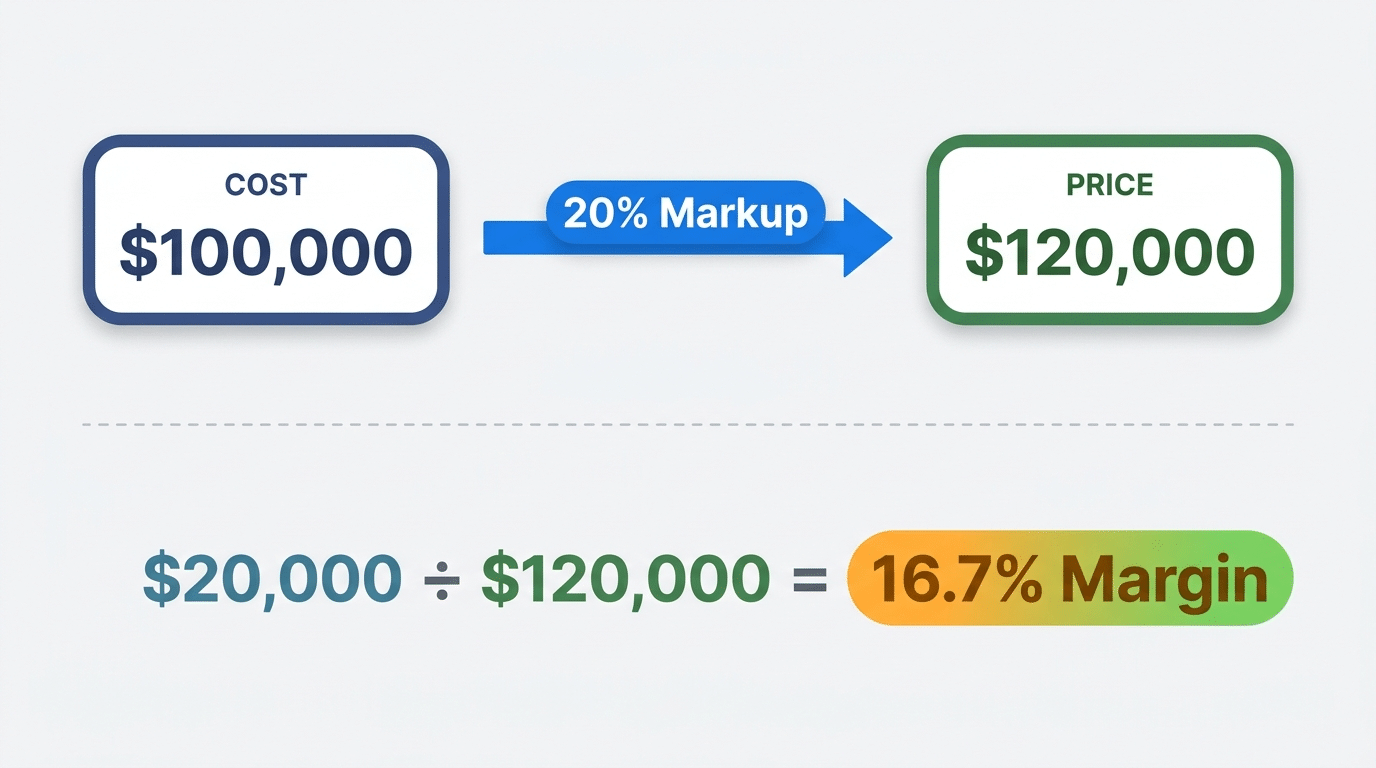
- Markup is added on top of cost. A 20% markup on $100,000 of cost is $20,000, for a $120,000 price.
- Margin is the share of the final price that is profit or fee. That same $20,000 is 16.7% of $120,000.
Convert between them:
- Margin = Markup ÷ (1 + Markup)
- Markup = Margin ÷ (1 − Margin)
Example: a 15% markup equals a 13.0% margin (0.15 ÷ 1.15). If one bid says “15% fee” and another says “15% margin,” they are not the same price.
What Are the Common General Contractor Pricing Models in California?
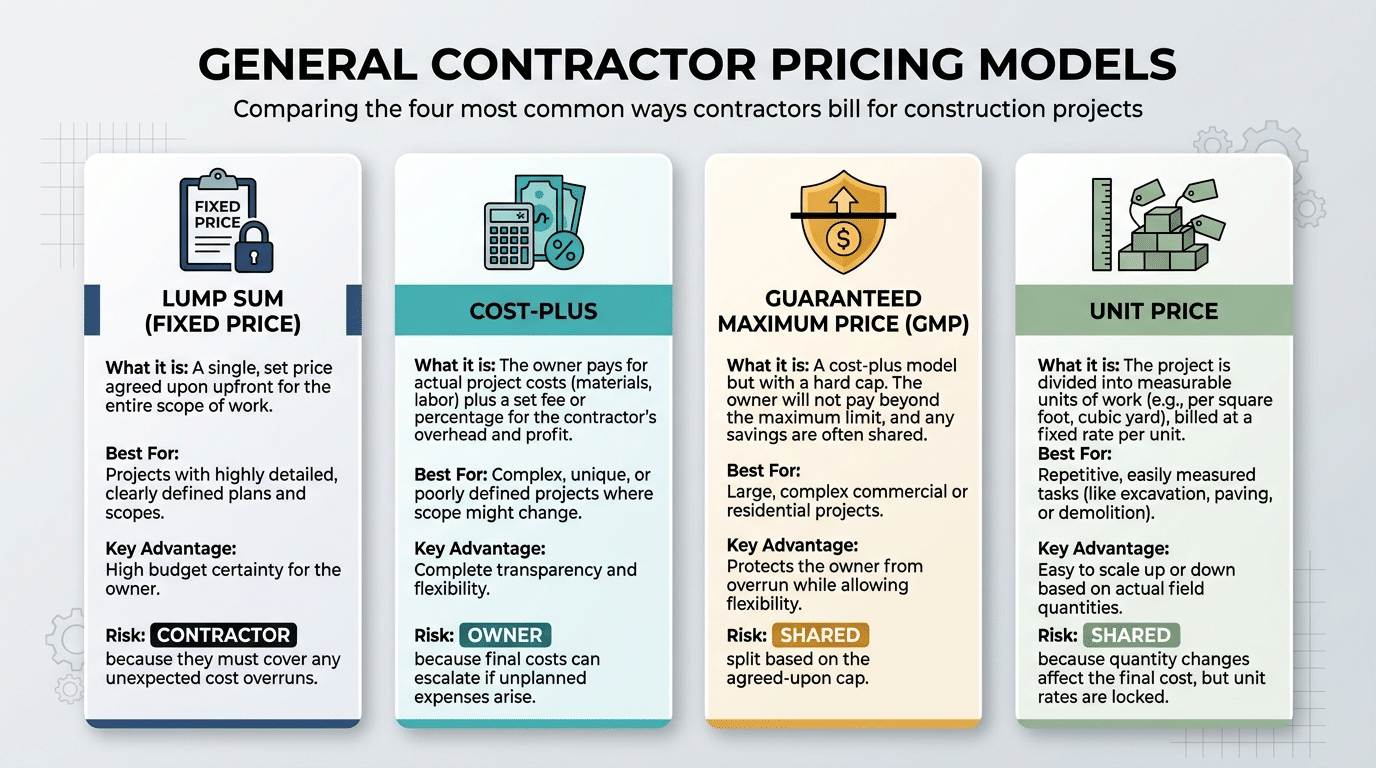
Contractors typically use one of four structures. The right one depends on how well-defined the scope is.
| Pricing Model | How It Works | Best For | Main Risk |
| Fixed price (lump sum) | One price for a defined scope | Well-designed projects with complete plans | Change orders if scope shifts; contractor may pad for risk |
| Cost-plus (percentage fee) | You pay actual costs plus a disclosed percentage | Uncertain scope, older homes, phased work | Costs can grow; needs transparent receipts |
| Cost-plus with GMP | Actual costs plus fee, with a guaranteed maximum price | Larger projects needing budget certainty | GMP must be set against complete drawings |
| Flat management fee | Fixed dollar fee for managing, regardless of cost | Owner-controlled projects with a defined schedule | Less incentive for the contractor to control costs |
Cost-plus contractors in California
In a cost-plus contract, the contractor bills the actual cost of materials and subcontractors plus an agreed fee. You should see invoices and receipts. For example:
- Actual costs: $120,000
- Agreed fee: 15% = $18,000
- Total: $138,000
Cost-plus gives transparency, but it only works well if the fee is clearly defined, markup on subcontractors is disclosed, and there is a not-to-exceed cap or regular budget reporting.
Fixed price (flat fee) contractors
A fixed-price contract hides the contractor’s markup inside the total. It’s easier to budget, but you need complete plans and a detailed scope. If the plans are vague, expect either a high bid (to cover unknowns) or change orders later.
California contract rules worth knowing
California regulates home improvement contracts through the Contractors State License Board (CSLB). Under the Business and Professions Code, the down payment on a home improvement contract generally cannot exceed the lesser of $1,000 or 10% of the contract price. On a $50,000 contract the maximum down payment is $1,000; on a $6,000 contract it is $600. Contracts must be in writing and include specific required language. Rules change, so confirm current requirements with CSLB before signing.
What Are Typical California Project Costs With a General Contractor?
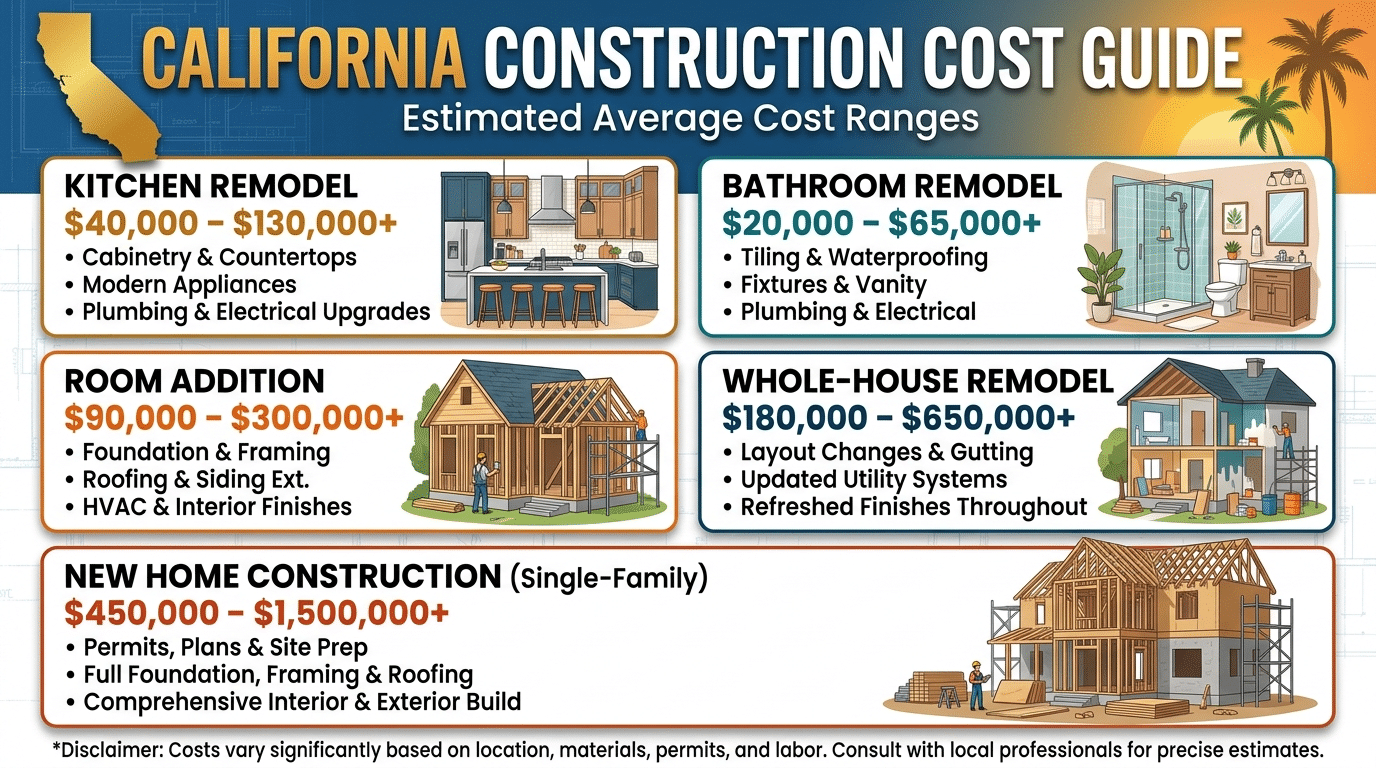
The following ranges are all-in installed prices, meaning they already include the general contractor’s fee. Published numbers for California vary a lot by source, city, and scope. Use these as planning ranges only.
| Project | Typical California Range | Notes |
| Kitchen remodel | About 16,000–80,000 typical; 100–530+/sq ft in published sources | LA metro cosmetic refresh near 16,000–33,000; full gut with layout change much higher |
| Bathroom remodel | About 8,000–45,000; 120–500/sq ft | Wide spread from partial refresh to full gut |
| Whole-house remodel | About 195–520/sq ft; 520–900+ for structural or high-end work | Always confirm whether “gut” and systems are included |
| Room addition | Typically above whole-house remodel per sq ft | Foundation, tie-in, and structural work add cost |
| New home construction | Roughly 250–600/sq ft common; 185–300 in lower-cost metros; 600–1,000+ for custom or hillside builds | Land, soft costs, and landscaping usually excluded |
Worked examples
Kitchen: A 200 sq ft kitchen at a mid-range $250/sq ft = 200 × $250 = $50,000. At $350/sq ft = $70,000.
Bathroom: A 60 sq ft bathroom at 250–400/sq ft = 60 × $250 = $15,000 to 60 × $400 = $24,000. Small spaces cost more per square foot because plumbing, waterproofing, and fixtures don’t shrink with the room.
New home: A 2,200 sq ft home at 350–500/sq ft = 2,200 × $350 = $770,000 to 2,200 × $500 = $1,100,000, before land, design, utility connections, and site work not included in the quote.
Per-square-foot figures are a screening tool, not a bid. A 180 sq ft kitchen with stock cabinets and no layout change can cost less than a 120 sq ft kitchen where plumbing moves and the electrical panel gets upgraded.
What Is the Cost Breakdown of a California Construction Project?
Here is a typical breakdown for a mid-size residential remodel or addition. Shares vary by project type.
| Cost Component | Typical Share of Total Price |
| Labor (trades and subcontractors) | 35%–50% |
| Materials and fixtures | 25%–40% |
| General contractor overhead and profit | 10%–18% |
| Permits, design, engineering, inspections | 3%–10% |
| Equipment, disposal, temporary facilities | 2%–6% |
| Contingency | 5%–10% (owner’s reserve) |
These shares shift with the job. A kitchen with premium appliances and stone is material-heavy. A structural renovation with seismic retrofit is labor- and engineering-heavy.
Labor costs in California
Labor is the biggest swing factor. U.S. Bureau of Labor Statistics OEWS data shows California construction wages well above the national average. Published figures put California carpenters at a mean of roughly $38 per hour and construction laborers around 29–31 per hour, compared with lower national means. One analysis of BLS data puts California construction wages roughly 15% above the U.S. average.
Do not confuse these wages with what you pay. There are three layers:
| Layer | What It Is | Example (carpenter) |
| Worker wage | What the employee earns per hour | About $38/hr |
| Payroll burden | Payroll taxes, workers’ comp, insurance, benefits | Often adds roughly 25%–40% |
| Contractor billing rate | Wage plus burden plus overhead and profit | Roughly 55–75/hr and up |
An illustration: $37.89 × 1.30 burden = $49.26. Add 20% overhead and profit and the billing rate is about $59 per hour. Specialty trades, small-job minimums, and union or prevailing-wage work push this higher.
Material costs
Materials vary more with specification than with location, but California adds some costs: delivery in congested metros, energy-code-compliant products, and fire-rated assemblies in wildfire zones.
| Item | Typical Range | Unit | What Changes Price |
| Cabinets (stock to semi-custom) | 100–400+ | per linear foot | Stock vs. custom, hardware, finish |
| Quartz countertops (installed) | 60–130 | per sq ft | Brand, edge profile, slab availability |
| Granite (installed) | 50–120 | per sq ft | Grade and origin |
| Asphalt shingle roofing | 5–10 | per sq ft | Tear-off, pitch, underlayment |
| Tile, metal, or premium roofing | 20–40 | per sq ft | Structural support, labor intensity |
| Framing (labor and materials) | 40–70 | per sq ft of floor area (published Bay Area figure) | Lumber market, complexity |
Lumber, copper, and steel prices move with the market. Ask your contractor how long a quote is held and what happens if material prices change.
Equipment, site preparation, and permits
Equipment: Dumpsters, scaffolding, lifts, temporary power, and excavation equipment are usually in the direct cost, not the fee. Tight hillside access can require smaller equipment and hand labor, which raises the price.
Site preparation: Demolition, grading, soil conditions, drainage, tree removal, and hauling can swing a project by tens of thousands. Two lots with identical home plans can have very different costs. A flat, accessible lot with good soil is a different job than a sloped lot needing retaining walls and special foundations.
Permits: California permit and plan-check fees depend on the city or county and the project’s valuation. Costs can range from a few hundred dollars for minor work to tens of thousands for a new home once school fees, utility fees, and impact fees are included. Check your jurisdiction’s current fee schedule rather than relying on a statewide average.
How Much Does a General Contractor Cost in Different California Regions?
California is not one market. Labor, land access, permit complexity, and demand vary sharply.
| Region | Typical New Construction Range (published, per sq ft) | Why It Differs |
| Sacramento / Central Valley | About 185–350 | Lower labor costs, more production builders, easier sites |
| San Diego / Inland Empire | About 250–450 | Mixed; coastal premiums and hillside lots |
| Los Angeles metro | Wide: $300 to $1,000+ | Hillside lots, tight access, strict plan check, high demand |
| San Francisco Bay Area | About 250–450 for standard; 450–1,000+ for custom | Highest labor, permit timelines, tight lots, seismic requirements |

Sources disagree, and some high-end figures reflect custom or hillside work rather than typical builds. Compared with neighboring states, modeled estimates show California kitchen and bathroom remodels running only modestly above Arizona, Nevada, and Oregon per square foot. The larger gaps come from permitting, energy and seismic code compliance, and project-specific site conditions.
Rural California can run 10%–25% lower in labor cost but may carry higher mobilization and delivery costs, and fewer qualified subcontractors may be available.
What Makes a General Contractor More or Less Expensive?
Factors that raise the fee or total price:
- Small project size with fixed management overhead
- Incomplete plans or unclear scope
- Structural changes, additions, or foundation work
- Older homes with unknown conditions (knob-and-tube wiring, asbestos, lead paint)
- Hillside, tight-access, or fire-zone sites
- Tight schedules or high-demand seasons
- Heavy subcontractor coordination
- High-end finishes and custom millwork
Factors that lower it:
- Complete drawings and finish selections before bidding
- Larger projects with economies of scale
- Simple layouts with no plumbing or structural moves
- Owner-supplied materials (with caution; this can shift warranty risk)
- Flexible scheduling
- Competitive bidding with equal scope
What Are the Hidden Costs When Hiring a General Contractor in California?
These are the items buyers commonly miss when comparing numbers:
- Permit and plan-check fees: Often excluded from handyman-style quotes. Ask who pulls them and who pays.
- Design, architecture, and engineering: Structural calculations, Title 24 energy compliance, and soils reports can be thousands of dollars.
- Hazardous material testing and abatement: Common in older homes. Asbestos or lead discovery can add cost and delay.
- Unforeseen conditions: Rotted framing, outdated electrical, or non-compliant plumbing found after demolition.
- Utility upgrades: Service panel upgrades, gas line changes, and sewer laterals.
- Change orders: Mid-project changes are usually priced with markup. Get them in writing before the work happens.
- Disposal and cleanup: Dump fees and hauling costs vary by area.
- Temporary housing: For whole-house work, you may need to live elsewhere.
- Soft costs for new builds: School fees, utility connections, landscaping, and driveway work.
- Escalation clauses: Some contracts allow price increases if materials rise.
A sensible contingency is 10%–15% on remodels of older homes and 5%–10% on new construction with complete plans.
What Should a Professional General Contractor Estimate Include?
A lump-sum number tells you very little. A professional estimate should break the job into line items. Look for:
- Scope of work with specific inclusions and exclusions
- Quantities and units for major items (sq ft of flooring, linear feet of cabinets)
- Unit prices or allowances for materials
- Labor by trade
- Subcontractor costs listed separately
- Equipment, disposal, and temporary protection
- Permits and inspection fees (and who pays them)
- Waste allowance (commonly 5%–10% depending on material)
- Overhead and profit shown clearly
- Allowances for items not yet selected (tile, fixtures, appliances)
- Schedule and payment milestones
- Exclusions and assumptions
- Warranty terms and contractor license number
Itemized estimates let you see where money is going, compare apples to apples, price out changes, and catch missing scope before it becomes a change order.
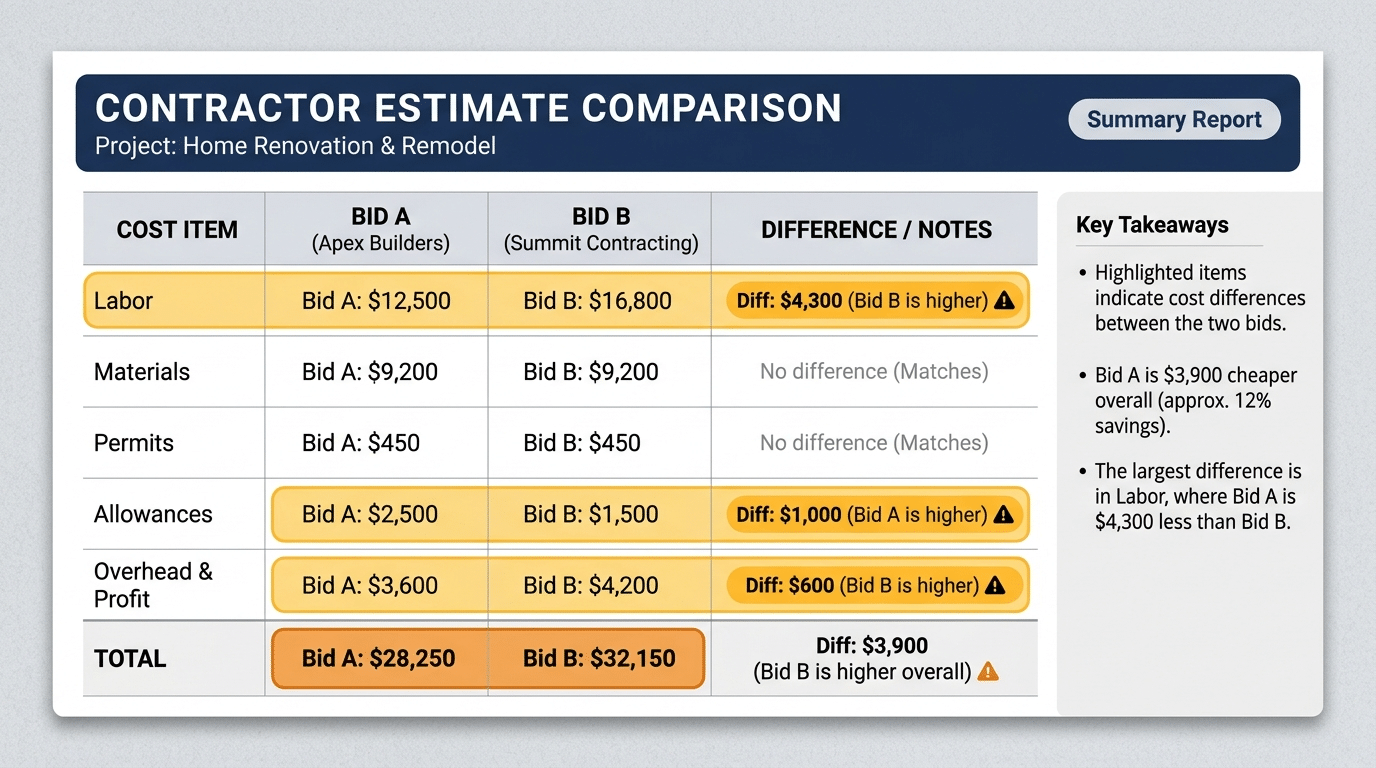
How Do You Compare Two General Contractor Bids?
Two contractors can quote the same project and be $30,000 apart. The gap usually comes from differences in what is being priced, not from one contractor being dishonest or the other being a bargain.
| What to Compare | What to Verify |
| Scope | Are demolition, permits, design, and cleanup in both bids? |
| Material quality | Brand, grade, and thickness for cabinets, flooring, fixtures |
| Quantities | Do both use the same measurements? |
| Allowances | Are allowances realistic, or set low to win the job? |
| Labor assumptions | Hours, crew size, and who does the work |
| Site prep | Demolition, grading, drainage, access |
| Exclusions | What is left out of each bid? |
| Overhead and profit | Shown separately or buried? |
| Warranty | Length, coverage, and who services it |
| Schedule | Start date, duration, and penalties for delays |
| Payment terms | Compliance with California down payment limits |
A low bid is not automatically good or bad. Ask why it is low. It may reflect an efficient contractor, a smaller scope, or low allowances that will become change orders. A high bid may include more contingency, better materials, or a contractor who is simply busy. Verify the CSLB license status, insurance, references, and past work before deciding.
Example: Bid A is $142,000 with $8,000 in tile allowances. Bid B is $151,000 with $16,000 in tile allowances. If you actually plan to spend $16,000 on tile, Bid A is likely $142,000 + $8,000 = $150,000, almost the same as Bid B. The difference was the allowance, not the contractor.
When Is a Professional Construction Estimate Worth Getting?
A professional estimate helps when you need to know the budget before committing to a contractor, or when you need to check whether a bid is reasonable.
An independent estimate can help contractors, builders, developers, subcontractors, and owners understand:
- Material quantities and takeoffs
- Labor requirements by trade
- Equipment and site needs
- Project scope and exclusions
- Cost breakdowns by category
- Bid preparation numbers
- Potential cost gaps between bids
- The budget required to finish the project
Estimating before you hire gives you a benchmark. If your estimate is $480,000 and the bids come in at $520,000, $535,000, and $390,000, you know which questions to ask the low bidder.
Need a detailed estimate for your upcoming project? 1st Estimator provides professional construction estimating and quantity takeoff services for residential, commercial, and industrial projects.
How Can You Reduce General Contractor Costs in California?
- Finalize the design first. Changes after contracting are the most expensive way to spend money.
- Get at least three itemized bids on identical scope.
- Choose the right contract type. Fixed price for defined scope; cost-plus with a cap for uncertain scope.
- Make selections early. Allowances that stay open often grow.
- Avoid moving plumbing and structure if budget is tight.
- Ask about phasing if cash flow is a concern.
- Check the fee on subcontractor work. Some contractors mark up each layer.
- Keep a contingency instead of cutting scope blindly.
Frequently Asked Questions
How much does a general contractor cost in California in 2026?
Typically 10%–20% of direct project costs, with about 15% common for mid-size residential work. Small remodels can run higher, and large commercial projects often run lower.
What percentage does a general contractor charge in California?
Most residential contractors charge 10%–20% on top of direct costs. Some state it as a markup and others as a margin, so ask which one the number refers to.
How much does a general contractor charge per hour in California?
Online sources commonly cite 50–150 per hour, but full-project management is rarely billed hourly. Tradesperson wages are lower; for example, BLS-based data shows California carpenters averaging roughly $38 per hour before burden and markup.
Is it cheaper to be your own general contractor?
You may save the 10%–20% fee, but you take on licensing questions, permits, scheduling, insurance, and liability. In California, hiring unlicensed trades for larger work can create legal and insurance problems. Many owners underestimate the time involved.
What is the difference between cost-plus and fixed price?
Fixed price sets one total for a defined scope. Cost-plus charges actual costs plus a percentage or fee. Cost-plus fits uncertain scope; fixed price fits complete plans.
How much can a California contractor ask for as a down payment?
For covered home improvement contracts, generally the lesser of $1,000 or 10% of the contract price. Confirm current rules with CSLB.
What hidden costs should I expect on a California remodel?
Permits, engineering, hazardous material abatement, unforeseen conditions, utility upgrades, and change orders. Hold 10%–15% in contingency for older homes.
How can I estimate my total construction cost before hiring a general contractor?
Start with per-square-foot ranges for your area and project type, then build a rough takeoff of quantities and unit costs. A professional estimate gives a more reliable budget than square-foot averages.
Should I get a construction estimate before hiring a general contractor?
Yes, especially for projects over $100,000. An independent estimate gives you a benchmark to evaluate bids and spot missing scope.
How do I know if a general contractor’s estimate is accurate?
Check that quantities match your plans, allowances are realistic, permits and exclusions are clear, and unit prices are consistent with local market rates. Compare against at least two other itemized bids.
What should I compare when reviewing general contractor estimates?
Scope, material grades, allowances, exclusions, overhead and profit, schedule, warranty, and payment terms, not just the bottom-line number.
How can I avoid paying too much for a construction project in California?
Finalize plans before bidding, get itemized bids on identical scope, verify license and insurance with CSLB, and avoid large upfront payments beyond the legal limit.