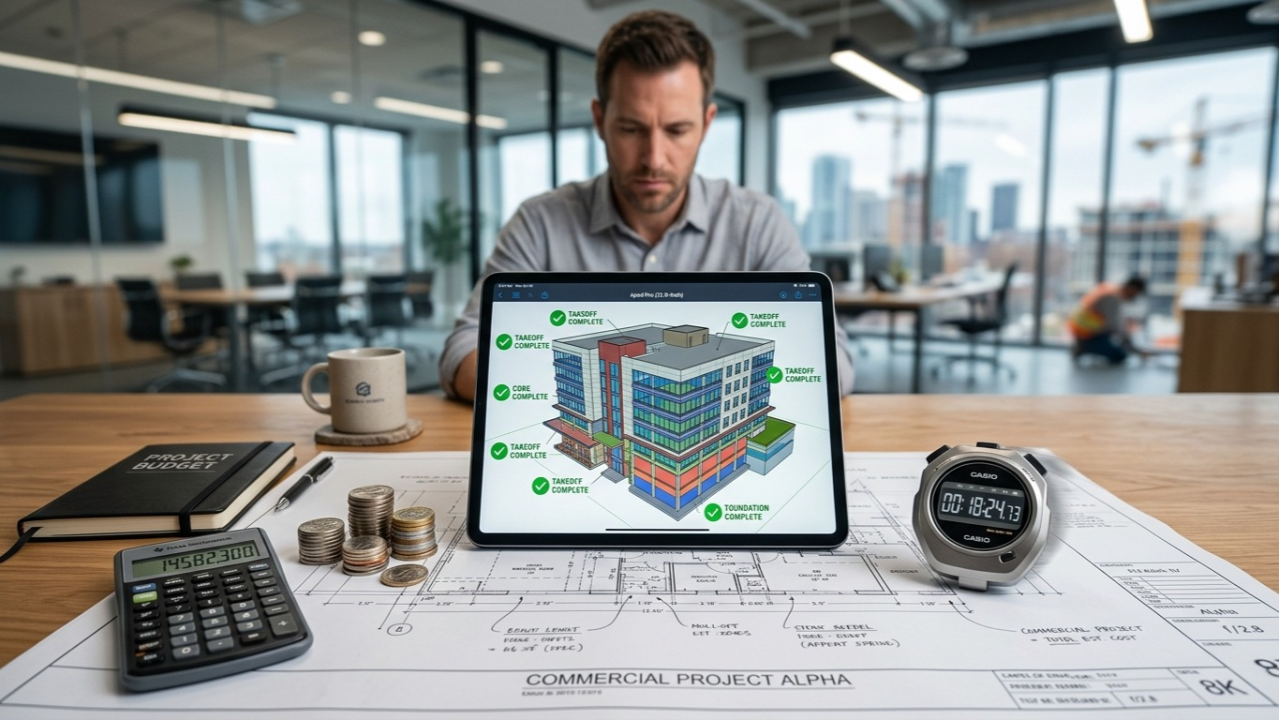
Let’s be real when a bid deadline is staring you down, the last thing you want to hear is ‘it’ll be ready in five business days.’ Time is money in construction, and a slow takeoff can cost you a contract before you even get to compete. That’s exactly why contractors across the country are turning to 1st Estimator. But speed is one thing what about accuracy? And does getting a faster turnaround mean you’ll pay more? The answer is no, you won’t. These are fair questions, and we’re going to answer every single one of them right here.
What Is a Construction Takeoff and Why Does Turnaround Time Matter?

If you’ve been in construction for any length of time, you already know what a takeoff is. But just to set the stage a construction takeoff (also called a quantity takeoff) is the process of measuring and listing every material needed to complete a project. Concrete, lumber, drywall, roofing, piping all of it, measured and calculated from your project plans. Now here’s where turnaround time becomes critical. Most general contractors and subcontractors are working against tight bid submission windows. If your estimating team is backed up, or if you don’t have one in-house, every hour you wait on a takeoff is an hour you’re not preparing your proposal. Miss the deadline, miss the job. It’s that simple. That’s where fast turnaround construction estimating makes the difference between winning work and watching someone else take it.
How Fast Does 1st Estimator Actually Deliver?

Here’s the part most contractors want to know first. At 1st Estimator, standard project takeoffs are typically delivered within 24 to 48 hours, depending on the project’s scope and complexity. For smaller residential jobs or straightforward commercial scopes, turnaround can often be even quicker. For larger, more complex projects think multi-story commercial builds or phased construction the timeline might extend to 2 to 3 business days. But even then, we’re talking about detailed, accurate, ready-to-submit quantity takeoffs that your estimating team can use immediately. Compare that to the industry average. Many in-house estimating teams or solo estimators can take anywhere from 3 to 7 days on a mid-sized project, and that’s if nothing else is on their plate. When you factor in the cost of that labor, the math starts to lean heavily in favor of outsourcing.
Does a Faster Turnaround Cost More?
This is the question everyone asks, and the honest answer is: not necessarily. The construction takeoff services cost at 1st Estimator is based on the scope and complexity of the project not on how quickly we deliver it. A lot of people assume that speed comes with a premium price tag, like paying extra for overnight shipping. But that’s not how it works here. 1st Estimator has built its workflow and team structure specifically to deliver fast without inflating the price. You’re not paying a rush fee just because we’re efficient. What does affect the cost is the type and scale of the project. Here’s a general breakdown of what you can expect:
- Small residential projects (single-family homes, additions): Lower-end construction takeoff services cost
- Mid-size commercial projects (retail, medical offices, light industrial): Mid-range estimating and takeoff service rates
- Large commercial or multi-trade projects: Higher cost reflecting the complexity, volume, and number of trades involved
The material takeoff cost per square foot also varies based on building type and region, but 1st Estimator keeps rates competitive and transparent no hidden fees, no surprise invoices.
What Factors Influence the Cost of a Construction Takeoff?

If you’re wondering why one takeoff quote looks different from another, here are the main factors that drive the cost:
1. Project Size and Complexity A 1,200 sq ft bungalow is a completely different animal from a 50,000 sq ft warehouse. The more area, the more trades involved, and the more complex the design the more time it takes, and the more detailed the takeoff needs to be.
2. Number of Trades A full construction estimate might cover carpentry, concrete, MEP (mechanical, electrical, plumbing), roofing, and more. Each trade adds a layer of detail. If you need a multi-trade takeoff, expect the cost to reflect that scope.
3. Plan Quality Clear, well-organized drawings make the process smoother and faster. Poorly scanned or incomplete plans slow things down and may require additional clarification, which can affect pricing.
4. Quantity Takeoff Hourly Rates vs. Per-Project Pricing Some estimating services charge by the hour. 1st Estimator typically works on a per-project basis, which gives contractors a clear upfront number rather than an open-ended bill. This model is almost always more cost-effective for clients.
5. Software and Tools Used There’s a real debate in the industry around accurate construction takeoff software vs services. Software tools like PlanSwift or Bluebeam can help, but they require trained operators and still need time to run properly. 1st Estimator uses industry-standard tools operated by certified construction estimators so you get the benefit of the technology without having to invest in it yourself.
Residential vs. Commercial Takeoff Fees Is There a Difference?
Yes, and it’s worth understanding why. Residential vs commercial takeoff fees differ for a few key reasons. Residential projects tend to follow more predictable layouts and use standard materials. Commercial projects, on the other hand, often involve more complex structural systems, specialty materials, compliance requirements, and multiple subcontractors working across different trades. More complexity means more detail in the takeoff and that naturally affects pricing. That said, 1st Estimator works across both sectors. Whether you’re a home builder, a remodeling contractor, or a commercial GC, the team is experienced enough to turn around accurate takeoffs at competitive rates.
How to Save Money on Construction Takeoff Services
Here are a few practical ways affordable takeoff services for small contractors can work in your favor:
- Submit complete, clean plans. Unclear drawings create back-and-forth that costs time and money.
- Bundle projects when possible. If you have multiple bids coming up, submitting them together can reduce your per-project cost.
- Don’t wait until the last minute. While 1st Estimator can work fast, submitting with a few days’ runway avoids any pressure and keeps costs predictable.
- Be specific about what you need. A full multi-trade estimate costs more than a single-trade material list. Know your scope and communicate it clearly.
The average cost of construction estimating services varies widely by provider and market, but with 1st Estimator, you’re getting professional quantity surveyors for hire at rates designed to be accessible not just for large GCs, but for smaller contractors too.
Are Outsourced Takeoff Services Worth the Price?
Let’s talk about the big picture for a second. If you’ve been doing takeoffs in-house, you might be wondering whether outsourcing is actually worth it. Here’s a simple way to think about it. What does it cost you to have an estimator on staff full-time? Salary, benefits, software licenses, training it adds up fast. And what happens during slow seasons when the workload drops? You’re still paying. With outsourced construction takeoff services, you pay for what you need, when you need it. No overhead, no downtime costs. For small to mid-size contractors especially, this is often the smarter financial move. Beyond the cost, there’s the accuracy factor. Professional quantity surveyors for hire like the team at 1st Estimator bring years of specialized experience. They catch things that an overworked in-house estimator might miss. That accuracy protects your margins. So yes outsourced takeoff services are worth the price. And when you factor in the time savings, the overhead reduction, and the accuracy you’re getting, the value becomes even clearer.
Fast, Accurate, and Affordable. You Don’t Have to Choose.

Here’s the bottom line. Speed should not come at the cost of accuracy, and accuracy should not come at the cost of your budget. At 1st Estimator, all three work together. Whether you’re a small contractor trying to keep up with bid schedules or a mid-size GC managing multiple projects at once, 1st Estimator delivers construction takeoff services that are fast enough to keep you competitive, accurate enough to protect your profits, and priced fairly enough to make outsourcing a no-brainer. If you’ve been relying on slow, expensive, or inconsistent estimating support or if you’re drowning trying to do it yourself it might be time to make a change. Reach out to 1st Estimator today and find out how quickly we can get your next takeoff done. You might be surprised how fast fast actually is.
FAQs
How fast does 1st Estimator deliver a construction takeoff?
1st Estimator typically delivers standard construction takeoffs within 24 to 48 hours. For larger or more complex commercial projects, the turnaround time is usually 2 to 3 business days, ensuring you get accurate, ready-to-submit numbers well before your bid deadline.
Do I have to pay a rush fee for a faster construction takeoff?
No, a faster turnaround does not cost extra with 1st Estimator. The pricing is based entirely on the scope, size, and complexity of your project, not on the delivery speed. There are no hidden fees or inflated rush charges.
What factors determine the cost of a construction takeoff service?
The overall cost of a takeoff is driven by five main factors: the total square footage, the number of trades required (like concrete, MEP, or roofing), the clarity of your project plans, the type of pricing model (hourly vs. per-project), and whether the build is residential or commercial.
Why do commercial construction takeoffs cost more than residential ones?
Commercial takeoffs are generally more expensive because they are far more complex. While residential homes follow standard layouts, commercial builds involve complex structural systems, specialty materials, strict compliance codes, and multiple trades that require deeper, time-intensive calculations.
Is it cheaper to outsource estimating or hire an in-house estimator?
For small to mid-sized contractors, outsourcing estimating is almost always cheaper. Using a service like 1st Estimator eliminates the overhead costs of full-time salaries, benefits, expensive software licenses, and paying for idle time during slow building seasons.