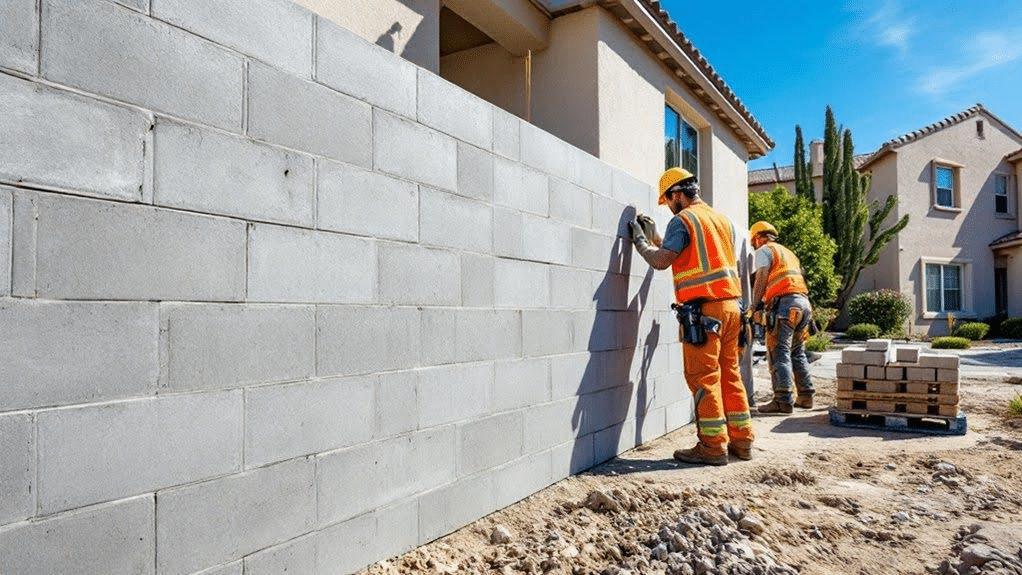
Cinder block wall cost in 2026 typically runs $15 to $30 per square foot installed, with a national average of about $20 per square foot for a mortared, reinforced wall that includes a footing. For a standard 6-foot wall, that works out to roughly $90 to $180 per linear foot, or about $120 at the average. A plain, unreinforced garden wall on an easy site can land near $13 to $15 per square foot. A tall, fully grouted, finished wall on a tight site can pass $35.
The final price depends on wall height and length, block size, reinforcement, footing design, finish, site access, local labor rates, and permit requirements. This guide shows how those pieces add up, how to calculate the cost to build a cinder block wall yourself, what hidden costs show up on real bids, and how to compare one contractor’s number against another.
One note on terms: nearly all “cinder block” sold today is actually a concrete masonry unit (CMU) made with cement and aggregate, not coal cinders. Contractors and suppliers use the words interchangeably, and so does this article.
How Much Does a Cinder Block Wall Cost in 2026?
The national planning range is $15 to $30 per square foot installed, which includes block, mortar, a basic footing, reinforcing steel, and mason labor. Published consumer cost guides vary. Angi’s cinder block wall cost guide puts materials at $3 to $6 per square foot and professional labor at $10 to $17 per square foot, which is $13 to $23 before reinforcement, finishing, and permits. Other guides list ranges from the low teens up to $35. The spread is mostly a difference in what each guide includes.
This range assumes a mortared 8-inch hollow block wall, standard residential access, a poured footing, vertical rebar with grouted cells at ends and pilasters, and no stucco or specialty finish. It is a budget range, not a quote.
| Wall type | Typical specification | Installed cost |
| Garden or low wall (3–4 ft) | 8″ hollow block, light reinforcing, shallow footing | 14–24 per sq ft |
| Privacy wall or fence (6 ft) | 8″ block, vertical rebar, grouted pilasters, footing | 15–30 per sq ft (90–180 per linear ft) |
| Foundation or basement wall | Load-bearing, reinforced, grouted; excavation usually separate | 10–20 per sq ft |
| Garage or shed wall | Varies widely with height, openings, and finish | 8–40 per sq ft |
| Retaining wall | Engineered, drainage, heavy reinforcement, excavation | 60–200 per linear ft |
The foundation, garage, and retaining wall rows come from the Angi guide and reflect how different those jobs are. A retaining wall priced per linear foot carries drainage, backfill, and engineering that a freestanding fence never needs. Treat those rows as starting points, then price your own wall with the method below.
What Does a Cinder Block Wall Cost Per Square Foot?
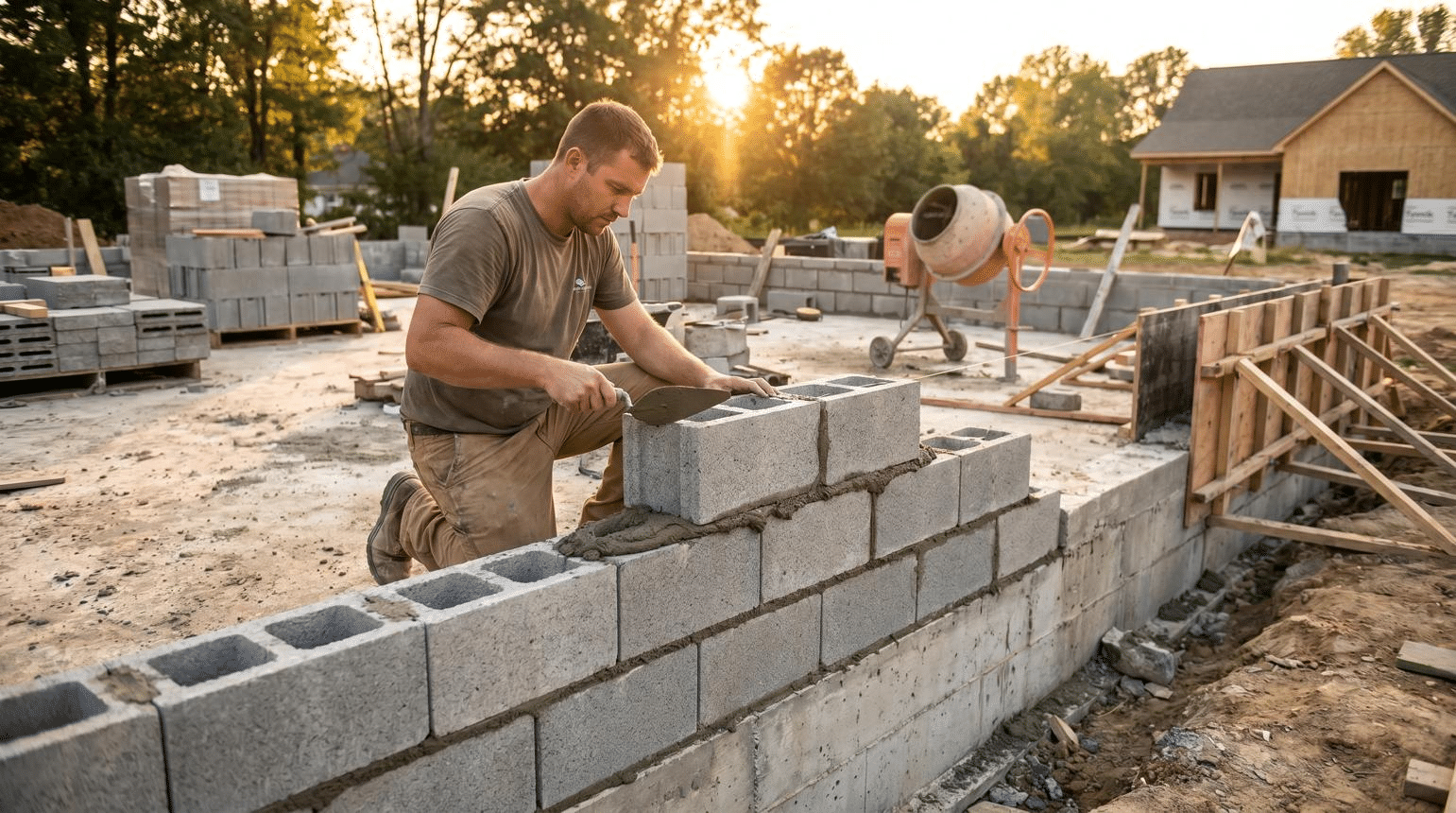
Most contractors price block walls by the square foot of finished wall face. A concrete block wall cost per square foot of $17 to $24 is typical for a residential wall that includes the footing and reinforcement.
| Level | Cost per sq ft | What it usually means |
| Low end | 13–16 | Unreinforced or lightly reinforced, easy access, larger job, no finish |
| Typical | 17–24 | Footing, vertical rebar, partial grouting, cap blocks, flat site |
| High end | 30–40+ | Full grout, bond beams, engineered design, finish, tight access |
Included: block, mortar, a standard footing, rebar, mason and helper labor, basic delivery, and contractor markup. Usually excluded: stucco or paint, waterproofing, permits, engineering, utility locates, rock excavation, demolition of an old wall, and drainage.
Two contractors can quote $16 and $26 for the same sketch because one priced a footing and grouted cells and the other did not. That is why the unit price means little until you know what is behind it.
What Is the Cinder Block Wall Cost Per Linear Foot?
Per linear foot, multiply the square-foot price by the wall height. At $15 to $30 per square foot:
| Wall height | Cost per linear foot | 50 linear ft |
| 3 ft | 45–90 | 2,250–4,500 |
| 4 ft | 60–120 | 3,000–6,000 |
| 6 ft | 90–180 | 4,500–9,000 |
| 8 ft | 120–240 | 6,000–12,000 |
Taller walls often cost more per square foot, not less. Above about 6 feet you add scaffolding, heavier reinforcement, and usually an engineer’s stamp. Some online guides show lower per-foot figures for 6-foot walls. Those usually assume lighter reinforcing or leave the footing out, so check what is included before comparing.
How Do You Calculate Cinder Block Wall Cost?
Start with the wall area, then convert to blocks. A standard 8x8x16 block covers about 0.89 square feet of wall face (the nominal 16 by 8 inches), so you need about 1.125 blocks per square foot.
\text{Area} = L \times H \qquad \text{Blocks} = \text{Area} \times 1.125 \times (1 + \text{waste})
Use 5 to 10 percent waste for cuts, breakage, and openings. Here is the quick count for a 60-foot wall that is 6 feet tall (9 courses):
- Area: 60 × 6 = 360 sq ft
- Blocks: 360 × 1.125 = 405, plus 7% waste = about 434 blocks
- Pallets: about 80 blocks per pallet, so 6 pallets
At $115 to $225 per pallet (the range Angi reports), block alone is roughly $690 to $1,350 for that wall. Block is the smallest part of the bill. Mortar, grout, steel, the footing, and labor make up the rest, which is why a block-only price badly understates the total. The full line-by-line build-up appears later in this guide.
If you want a quick cinder block wall cost calculator at home, a spreadsheet with area, block count, and unit prices for each material and labor line does the same job. A professional takeoff adds waste factors, openings, pilasters, and bond beams that a simple calculator misses.
What Is the Cinder Block Wall Cost Breakdown?
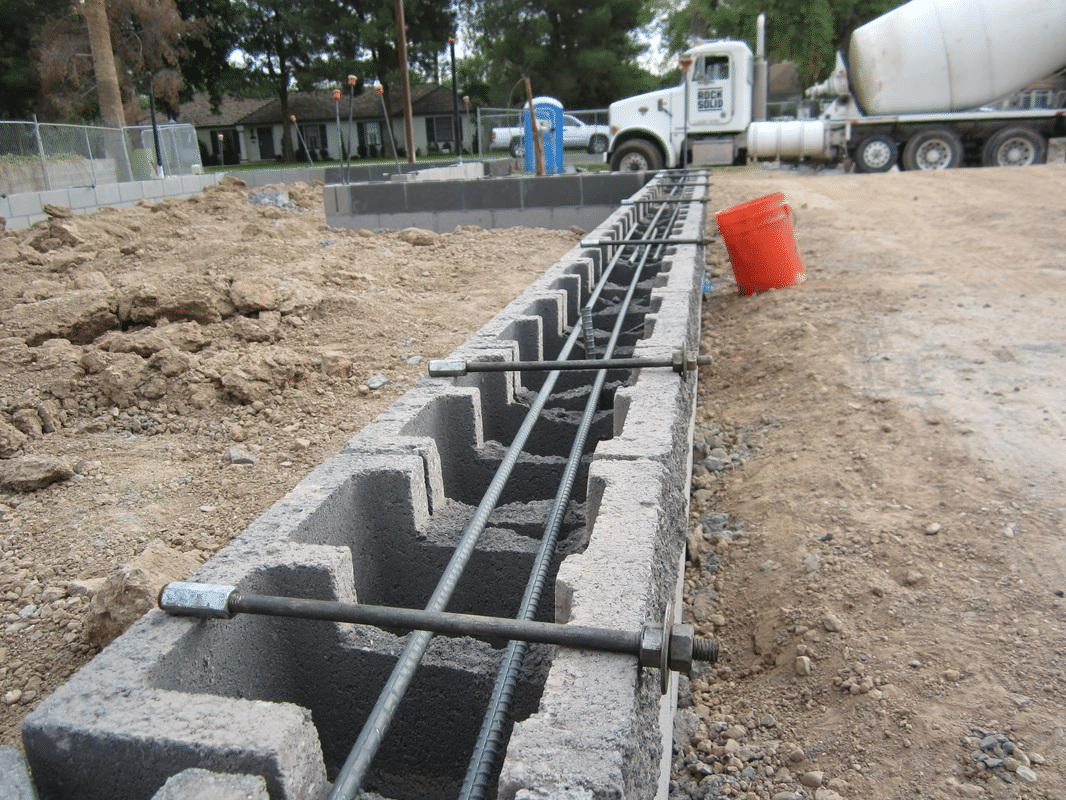
On a typical reinforced residential wall, labor is the largest single piece, followed by materials. These shares are estimating rules of thumb, not published statistics, and they describe the final contractor price.
| Cost component | Typical share of price |
| Labor (footing and block laying) | 35–45% |
| Materials (block, mortar, grout, steel, concrete) | 25–30% |
| Overhead and profit | 15–20% |
| Footing excavation and site preparation | 5–12% |
| Equipment | 3–5% |
| Delivery | 2–4% |
| Permits and engineering | 1–4% |
The ranges do not add to 100 individually, and the mix shifts by job. A retaining wall pushes site work and engineering up. A simple garden wall pushes labor and overhead up because the fixed costs spread over fewer square feet.
What Do Cinder Block Wall Materials Cost?
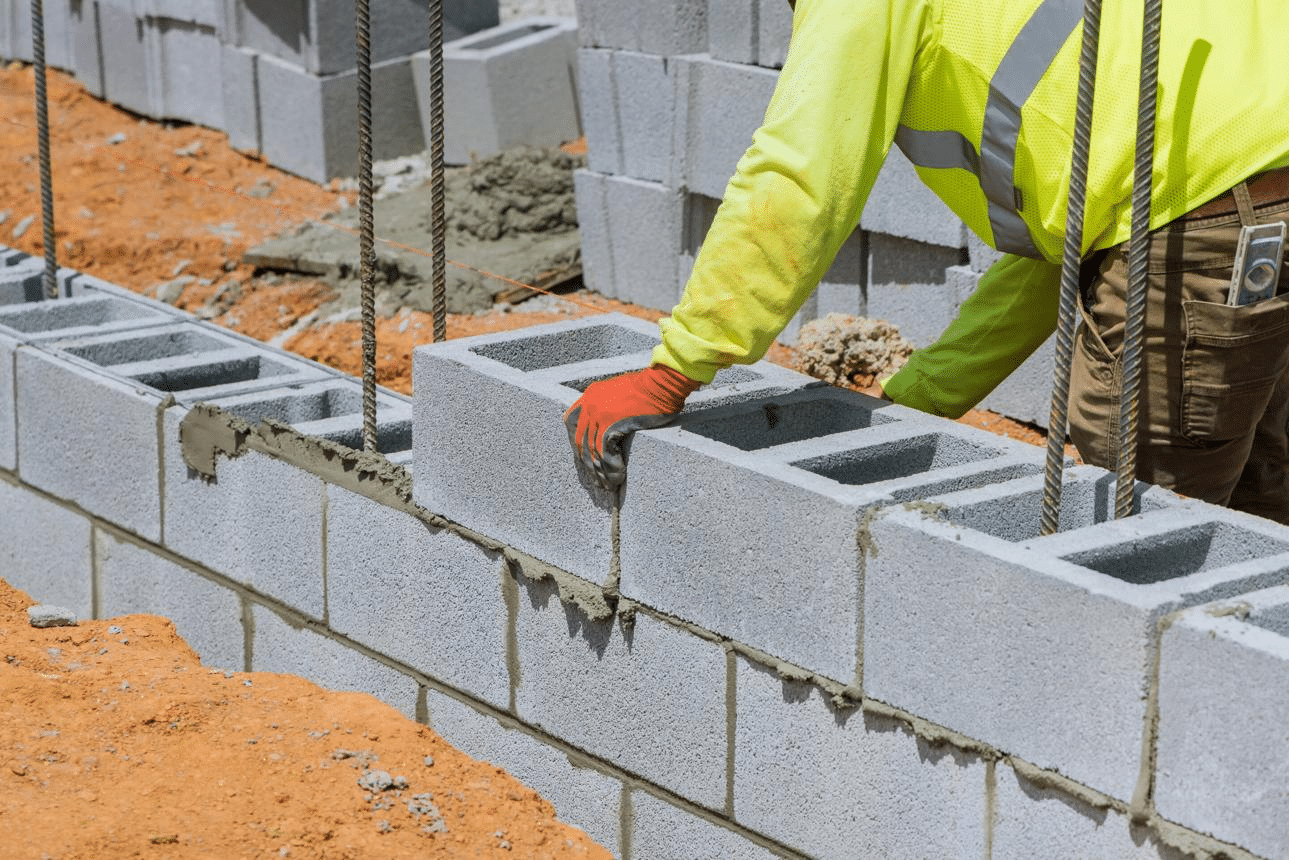
Cinder block material cost is only part of the materials line. A wall also needs mortar, grout, rebar, footing concrete, and cap units.
| Material | Typical 2026 price | Notes |
| Standard 8x8x16 block | 1.25–2.50 each | Larger 12-inch units run 2–4 each |
| Decorative or split-face block | 2–5 each | Raises material cost about 1–3 per sq ft |
| Block pallet (about 80 units) | 115–225 | Plus delivery and a refundable deposit near $20 |
| Delivery | 50–200 | More for long hauls or hard access |
| Mortar (80-lb bag) | 8–14 | About one bag per 25 blocks, confirm with supplier |
| Concrete for footing | 155–215 per cu yd | Short-load fees apply on small orders |
| Cap blocks | 2.50–4.50 each | Sets the finished top edge |
| Rebar and grout fill | 1–5.25 per sq ft | Depends on spacing and how many cells are filled |
Block and pallet prices come from Angi’s cost guide. Mortar, concrete, and cap prices are typical supplier ranges from 2026 consumer guides and vary by market, so confirm them locally.
Three things move the material number. Block type is the first: a standard gray hollow unit costs far less than split-face or architectural block. Reinforcement is the second: a lightly reinforced fence might add $1 per square foot, while full grouting with rebar can add several dollars. Quantity is the third: contractors with yard accounts buy below retail pallet prices, and small buyers pay full retail plus delivery.
Waste also matters. Plan on 5 to 10 percent extra block. Walls with many corners, piers, or openings sit at the high end.
How Much Is Cinder Block Wall Labor Cost?
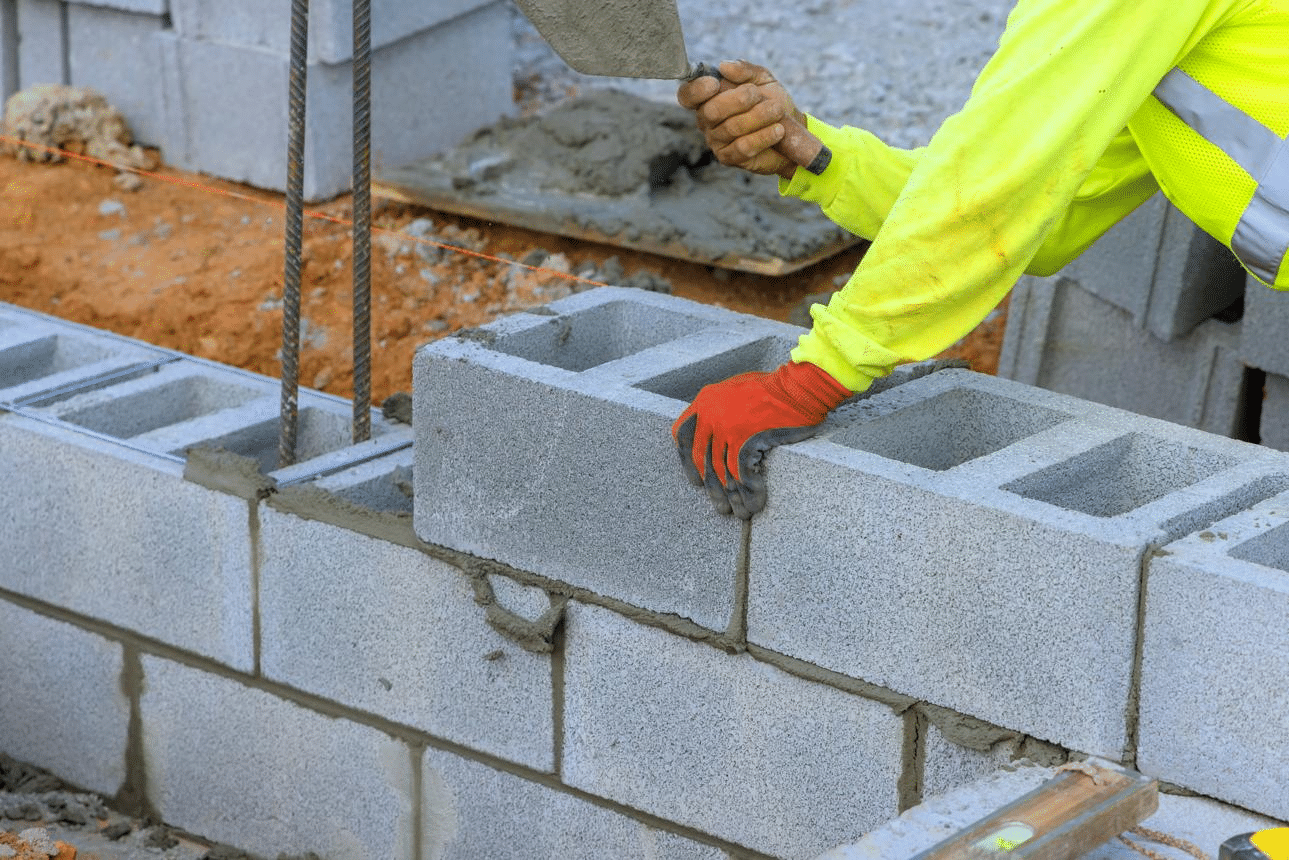
Cinder block wall labor cost usually runs $10 to $17 per square foot, or $34 to $100 per hour depending on the market and the contractor, according to the Angi guide. That is the price a customer pays, which is not the same as what a mason earns.
Three different numbers get mixed up in labor discussions:
- Worker wage. The U.S. Bureau of Labor Statistics reported a May 2023 national mean wage of $30.50 per hour for brickmasons and blockmasons, a median of $28.67, and a 10th-to-90th percentile spread of $18.44 to $45.30. That is the most recent official page this guide opened. 2026 wages are likely higher.
- Payroll burden. Payroll taxes, workers’ compensation, liability insurance, and benefits commonly add roughly 25–40% on top of the wage.
- Contractor billing rate. Overhead (trucks, tools, insurance, office, estimating time) and profit are added on top of burden.
Here is how that stacks for a mid-range mason: $30.50 × 1.30 burden = $39.65, and × 1.25 for overhead and profit = about $49.56 per hour. Small jobs, union markets, and busy seasons push billed rates to the $65 to $90 per hour range, which is why the Angi range is so wide.
Production and crew. A typical small crew is one mason and one helper. Angi reports a mason laying roughly 90 to 120 blocks a day. On residential walls with layout, grouting, and cleanup counted, I plan on 100 to 150 blocks per mason-day, which is about 0.12 to 0.18 labor hours per square foot of laying. At $65 to $95 per billed hour, that gives $8 to $17 per square foot for block laying, in line with published ranges. Footing excavation, forming, and pouring add labor on top.
Labor goes up with height (scaffolding and slower lifts), many corners or pilasters, grouting every cell, cold weather, long carries from the delivery point, and prevailing-wage or union requirements. A mason doing a simple straight wall on open ground is far faster than the same mason on a sloped, cramped backyard.
Skilled and general labor are priced differently. The mason lays and strikes joints. The helper mixes, carries, and fills cells. Many contractors bill the two at a blended rate, so ask whether a quote assumes one or two workers.
What Equipment Does a Block Wall Need?
Equipment is a small share on most walls, usually $150 to $500 for a small job, treated here as a planning allowance rather than published pricing. It covers a mortar mixer or tubs, a masonry saw, scaffolding for walls above about 5 feet, a mini excavator or trencher for the footing, and a grout pump or hopper when cells are filled. Walls over 8 feet, long runs, and engineered retaining walls need more equipment and push this line higher.
How Does Site Preparation Affect Cost?
Two walls with identical dimensions can differ by thousands of dollars because of what sits underneath and around them.
| Site condition | What it adds |
| Excavation for footing | Digging, hauling spoil, and sometimes hand-digging near utilities or trees |
| Poor or soft soil | Deeper or wider footing, gravel base, or an engineer’s design |
| Slopes and stepped footings | More forming, extra block courses, and slower production |
| Rock or roots | Breaking, hauling, and equipment time |
| Drainage | Perforated pipe, gravel backfill, weep holes, and grading, essential on retaining walls |
| Demolition of an old wall | Angi lists $5 to $25 per linear foot for removal |
| Poor access | Hand-carrying block, wheelbarrows, short-load deliveries, or a boom truck |
Footings must also reach below the frost line in cold climates, so a wall in Minnesota can need a much deeper footing than one in Florida. Always confirm local frost depth and footing requirements with your building department.
What Does a Cinder Block Wall Cost by Size?
Size drives total cost, but not in a straight line. Small walls carry a minimum charge (Angi notes some masons bill a $200 to $400 minimum), a full delivery, and the same footing setup as a bigger job. Large walls spread those fixed costs over more area, though very tall or engineered walls climb again.
| Size | Typical use | Area | Cost per sq ft | Estimated cost |
| Small | 20 ft × 4 ft garden wall | 80 sq ft | 22–40 | 1,760–3,200 |
| Medium | 50 ft × 6 ft privacy wall | 300 sq ft | 15–28 | 4,500–8,400 |
| Large | 100 ft × 6 ft property wall | 600 sq ft | 14–26 | 8,400–15,600 |
| Extra large | 200 ft × 8 ft reinforced wall with pilasters | 1,600 sq ft | 16–30 | 25,600–48,000 |
The small wall uses a higher unit price because of minimum charges and mobilization. The extra-large wall costs more per square foot than the large one because of height, pilasters, and heavier reinforcement.
How Do Specifications Affect Cinder Block Wall Cost?
| Specification | Effect on installed cost |
| Unreinforced mortared wall | Baseline, only suitable for low, non-structural walls |
| Vertical rebar with partial grout | Adds roughly 1–3 per sq ft |
| Full grout with rebar | Adds 2–8 per sq ft, with 1–5.25 as the commonly quoted steel-and-grout range |
| Thicker block (12″ vs 8″) | Higher block price, heavier lifts, slower laying |
| Split-face or decorative block | Higher block price and more careful laying |
| Paint, stucco, or sealer | 1.50–10 per sq ft |
| Waterproofing | 2–10 per sq ft |
Reinforcement is the specification that matters most. Block walls are strong in compression but weak against sideways loads such as wind or soil pressure. Building codes and engineers decide how much steel and grout a given wall needs, so a taller wall or a retaining wall is not a place to trim. A fully reinforced wall costs more upfront and is far cheaper than rebuilding a failed one.
What Are the Different Types of Cinder Block Walls and Their Costs?
| Type | Typical use | Cost range | Main cost driver |
| Fence or privacy wall | Property line, yard | 10–30 per sq ft | Height, finish, footing |
| Retaining wall | Holding back soil | 60–200 per linear ft | Excavation, drainage, steel |
| Foundation or basement wall | Load-bearing house wall | 10–20 per sq ft | Reinforcement, waterproofing, code requirements |
| Garage or shed wall | Outbuildings | 8–40 per sq ft | Openings, insulation, utilities |
Ranges are from the Angi guide and overlap with the $15 to $30 planning range used above. A cinder block fence cost lands in the middle of that overlap, while retaining walls sit well above it because of the site work.
How Much Does a Cinder Block Wall Cost in Different U.S. Regions?
I am not going to invent regional cost-per-square-foot figures. What can be sourced is mason wages, which are the main reason regional prices differ. The BLS May 2023 data shows how wide the spread is:
| State | Mean hourly wage, brickmasons and blockmasons (May 2023) |
| Massachusetts | $42.38 |
| Washington | $42.25 |
| New York | $40.34 |
| Illinois | $39.52 |
| Pennsylvania | $33.69 |
| Texas | $24.35 |
| Florida | $22.73 |
A mason in Boston or Seattle earns roughly 75 to 85 percent more per hour than one in Florida or Texas. Labor is close to half of a block wall’s cost, so a wall in the Northeast, Pacific Northwest, or Chicago area will generally price noticeably higher than the same wall in the South or Southwest.
Other regional drivers matter too: delivery distance from the block plant, frost-depth footings in northern states, seismic reinforcement requirements in the West, permit fees, winter work limits, and local demand. Urban jobs add parking, hauling, and access costs.
What Are the Hidden Costs of a Cinder Block Wall?
Most budget overruns come from items that were never on the first number.
| Hidden cost | Typical range | Why it gets missed |
| Delivery and short-load fees | 50–200 | Quoted separately from block price |
| Pallet deposit | About $20 per pallet | Refundable, but it ties up cash |
| Permits | 50–500 | Required for many walls, especially structural ones |
| Engineering | Quote-based | Needed for tall, retaining, or load-bearing walls |
| Old wall removal | 5–25 per linear ft | Disposal and hauling add up |
| Finishing and sealing | 1.50–10 per sq ft | Block is porous and usually needs protection |
| Waterproofing | 2–10 per sq ft | Critical for basement and retaining walls |
| Minimum charges | 200–400 | Applies to very small jobs |
| Weather and rework | Varies | Rain, cold, and failed inspections delay work |
Also watch for utility locates, rock or root removal, overtime on tight schedules, and change orders after the wall layout shifts. Permit, delivery, removal, and finishing ranges are from the Angi guide.
What Does a Professional Cinder Block Wall Estimate Include?
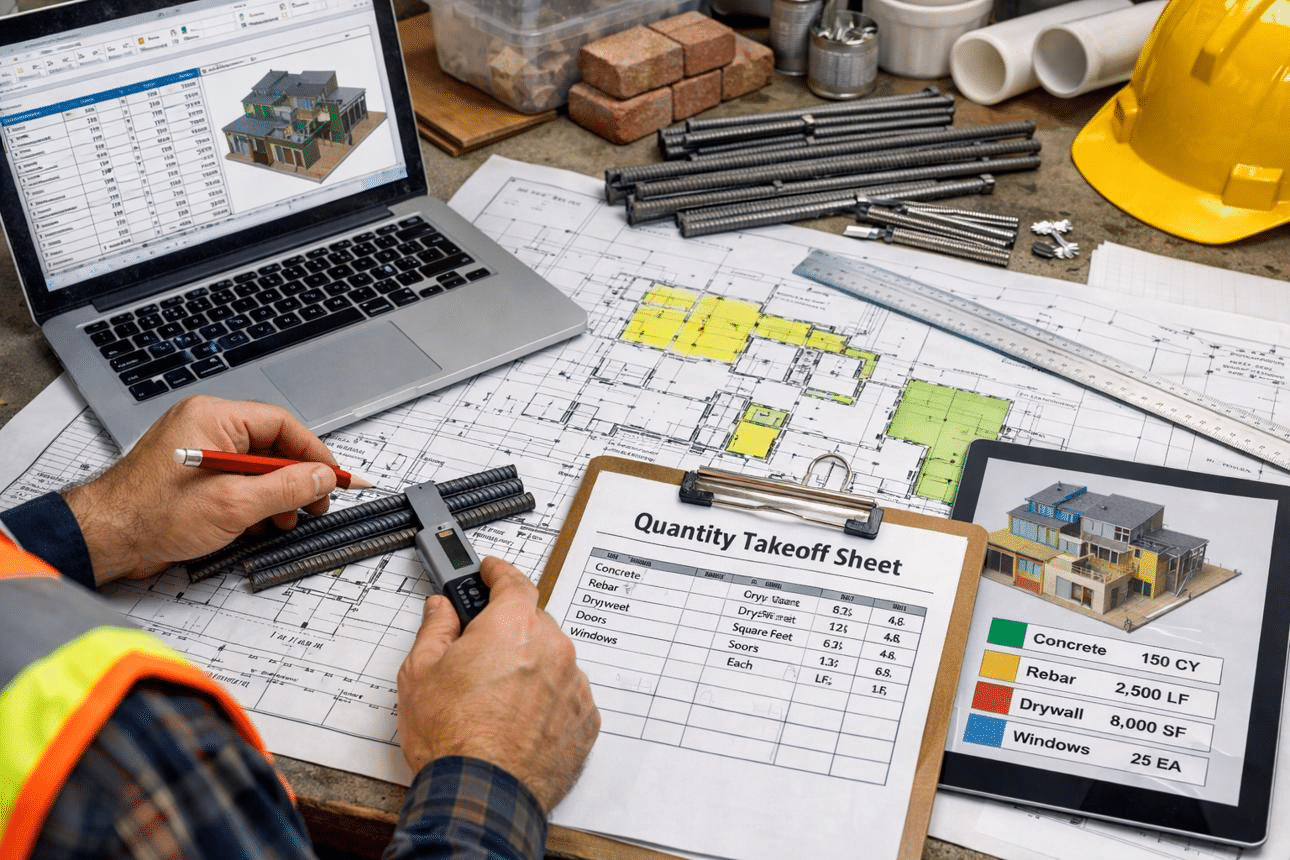
A useful estimate is itemized. Look for these lines:
- Quantity and unit for each item (block count, linear feet of footing, cubic yards of concrete)
- Unit cost, with material and labor shown separately
- Waste factor for block and mortar
- Rebar and grout quantities with spacing noted
- Footing excavation, forming, and concrete
- Delivery, equipment, and scaffolding
- Subcontractor items such as engineering, stucco, or sealing
- Permits, inspections, and testing
- Overhead and profit, shown as a markup
- Clear exclusions and allowances
A lump-sum price hides all of this. An itemized estimate lets you see where the money goes, catch missing scope, and price changes when the design shifts.
Worked Example: Pricing a 40-Foot, 6-Foot-Tall Reinforced Wall
Here is a full build-up for a 40 ft × 6 ft wall (240 sq ft) with a footing, vertical rebar, partial grouting, and cap blocks. Unit prices are mid-range 2026 planning values.
| Line item | Calculation | Cost |
| Block | 240 × 1.125 = 270, plus 7% waste ≈ 290 × $2.25 | $653 |
| Mortar | 12 bags × $10 | $120 |
| Rebar and grout | 240 sq ft × $1.50 | $360 |
| Cap blocks | 30 × $3.50 | $105 |
| Footing concrete | 2 cu yd × $185 | $370 |
| Footing rebar and forming | Allowance | $200 |
| Materials subtotal | $1,808 | |
| Delivery | Allowance | $150 |
| Equipment | Allowance | $200 |
| Footing labor | 10 hr × $65 | $650 |
| Block-laying labor | 28.8 hr × $75 (0.12 hr/sq ft) | $2,160 |
| Direct cost | $4,968 | |
| Permit | Allowance | $100 |
| Overhead and profit | 18% of direct cost | $894 |
| Total | $5,962 |
That is about $24.84 per square foot, or $149 per linear foot. It sits in the upper half of the national range because it includes a footing, reinforcement, and a permit. Drop the grout, rebar, and caps and the number falls to roughly $22 per square foot. A second quick check: 300 sq ft at $15 to $25 per square foot gives $4,500 to $7,500, and a 75-foot wall at the $120-per-foot average would run about $9,000.
How Do You Compare Two Cinder Block Wall Bids?
Two bids for the “same” wall rarely cover the same work. Do not assume the low number is a bargain or the high number is padded. Check these items.
| What to verify | Why it changes the price |
| Scope and wall dimensions | One bid may leave out caps, pilasters, or a section of wall |
| Block type and thickness | Standard vs. split-face or 12-inch units |
| Reinforcement | Rebar spacing and how many cells are grouted |
| Footing | Depth, width, steel, and whether it is included at all |
| Site prep and haul-off | Excavation, spoil removal, and drainage |
| Equipment and access | Scaffolding, mixer, hand-carry assumptions |
| Exclusions | Permits, finishing, sealing, engineering |
| Overhead and profit | Markup varies by contractor and job size |
| Warranty and schedule | Workmanship coverage and start dates |
A low bid may be efficient, or it may leave out the footing. A high bid may include engineering and finish work you have not priced elsewhere. Ask each contractor for a line-item breakdown and put the numbers side by side.
When Is a Professional Cinder Block Wall Estimate Worth It?
Price guides give you a range. A real estimate gives you quantities for your specific wall, and that matters most when the job is large, structural, or competitive. A professional masonry cost estimate helps contractors, builders, developers, subcontractors, and owners see:
- Material quantities, including block, grout, rebar, and concrete
- Labor hours and crew requirements
- Equipment and access needs
- Project scope and what is excluded
- A clear cost breakdown for bid preparation
- Potential cost gaps before the work begins
- The budget needed to finish
Need a detailed estimate for your upcoming project? 1st Estimator provides professional construction estimating and quantity takeoff services for residential, commercial, and industrial projects.
Cinder Block Wall Cost FAQs
How much does it cost to build a cinder block wall in 2026?
Plan on $15 to $30 per square foot installed, with about $20 as the national average. A 6-foot wall costs roughly $90 to $180 per linear foot. A typical 50-foot, 6-foot-tall privacy wall runs about $4,500 to $9,000.
How much does a cinder block wall cost per square foot?
Most residential walls fall between $17 and $24 per square foot with a footing and reinforcement. Simple walls on open ground can be $13 to $16, and finished or heavily reinforced walls can pass $30.
How do you calculate the cost of a cinder block wall?
Multiply length by height for area, multiply by 1.125 blocks per square foot, add 5 to 10 percent waste, then price block, mortar, grout, steel, footing, labor, delivery, permits, and markup separately.
How many cinder blocks do I need for a wall?
For an 8x8x16 block, use area × 1.125 plus waste. A 40-foot by 6-foot wall needs about 270 blocks, or around 290 with 7 percent waste.
What is the labor cost to build a cinder block wall?
Labor typically runs $10 to $17 per square foot, or $34 to $100 per hour. Mason wages averaged $30.50 per hour nationally in BLS May 2023 data, but billed rates are higher once burden, overhead, and profit are added.
What is the cheapest way to build a cinder block wall?
Use standard gray blocks, keep the wall low, keep the design simple, buy blocks in bulk, and make sure the site is easy to access. DIY labor saves the most, but only on non-structural walls. Do not trim the footing or steel on tall or load-bearing walls.
What makes a cinder block wall more expensive?
Height, reinforcement and grouting, split-face or decorative block, difficult access, sloped or poor soil, finishes, high-wage markets, and engineering or permit requirements.
How much does a reinforced cinder block wall cost?
Reinforcement typically adds $1 to $5.25 per square foot, and full grouting with rebar can add up to about $8. A reinforced 6-foot privacy wall usually lands in the upper half of the $15 to $30 range.
What hidden costs should I expect?
Delivery, permits, engineering, footing excavation, haul-off, old wall removal, sealing or waterproofing, and minimum charges. Together they can add 10 to 25 percent to a basic quote.
How accurate are online cinder block wall cost calculators?
They are good for a rough budget and poor for a bid. Most do not account for footing design, reinforcement spacing, access, or local labor. A quantity takeoff of your plans is far more reliable.
Can a construction estimator prepare a cinder block wall cost estimate?
Yes. An estimator measures the wall from plans, calculates blocks, grout, steel, and concrete, applies labor and equipment productivity, and delivers an itemized estimate. 1st Estimator offers construction estimating services of this kind.