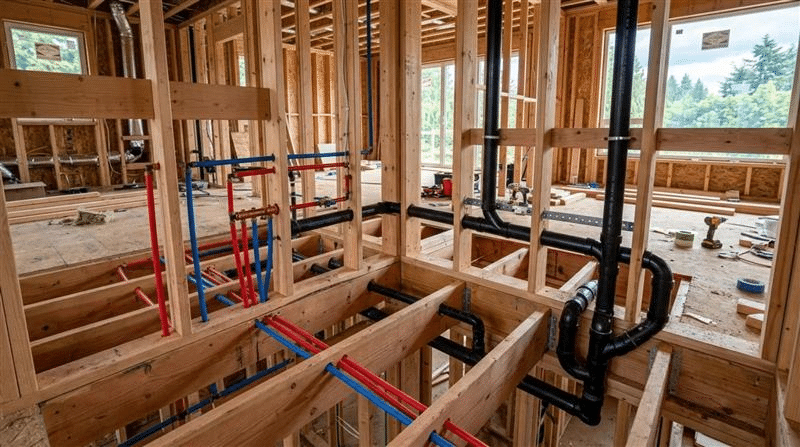
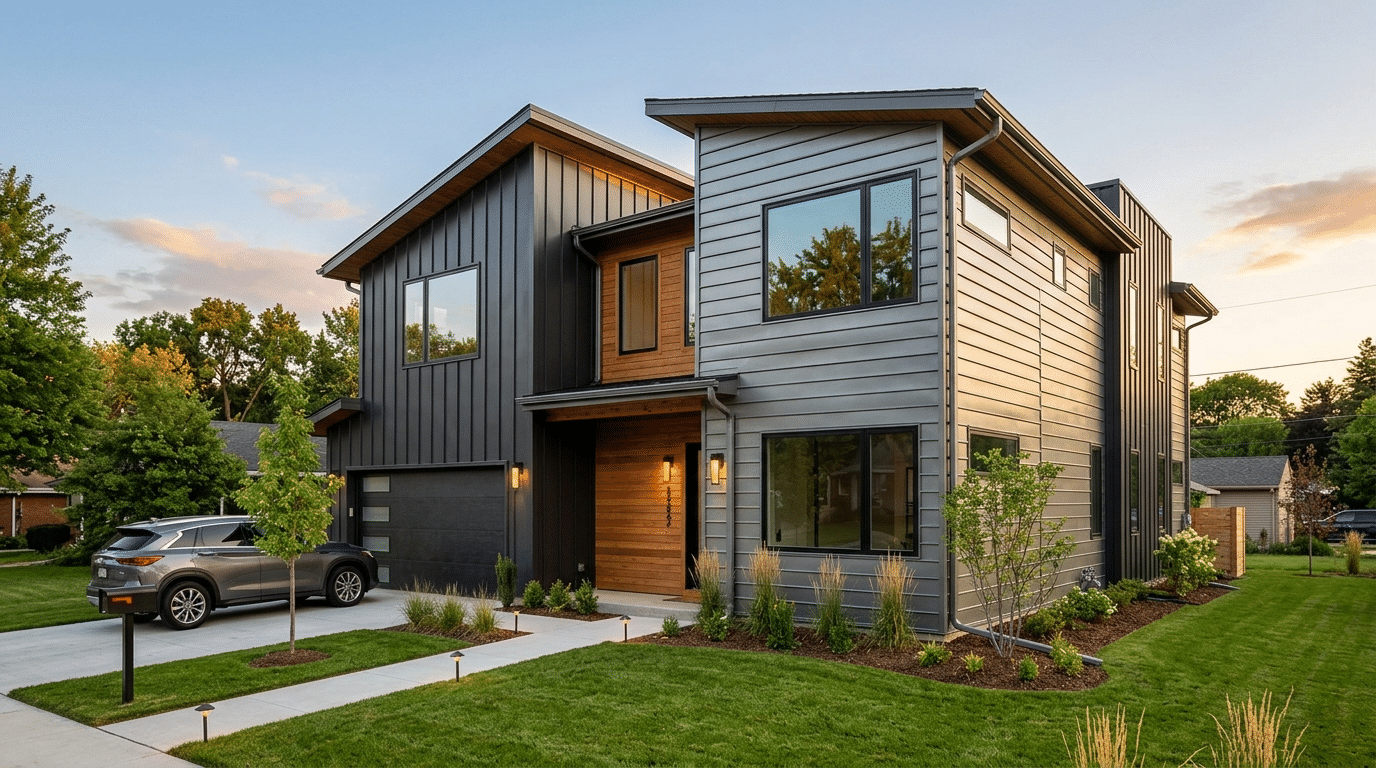
Metal siding cost in 2026 runs about $6 to $16 per square foot installed for most U.S. projects, with a typical price near $10 per square foot. On a whole house, that works out to roughly $9,000 to $28,000, with an average around $17,000. Basic corrugated aluminum on a simple wall can come in around $4 to $7 per square foot, while concealed-fastener steel and standing seam sit at the top of the range. Copper and zinc are a separate, much more expensive category.
Those numbers are national, installed (material plus labor) figures. Your price will move with wall area, metal type, panel profile, gauge, finish, how much old siding has to come off, local labor rates, and how many corners, windows, and gables the crew has to detail. This guide breaks down each of those pieces, shows the math, and explains how to read a contractor’s bid so you can tell a fair price from a gap in scope.
A note on the numbers: Published pricing for metal siding varies a lot between sources. Some guides put corrugated steel at $5 to $8 per square foot installed, others at $7 to $12. We’ve used the overlap between recognized cost publishers and manufacturer pricing, and we flag where sources disagree. Everything here is a planning range, not a quote.
How Much Does Metal Siding Cost in 2026?
For planning purposes, use these national figures:
- Typical installed range: 6–16 per square foot of wall area
- Common mid-range price: about $10 per square foot
- Typical whole-house project: 9,000–28,000
- Average whole-house project: about $17,000 (roughly 1,700 square feet of wall at $10)
These ranges assume 24- or 26-gauge painted steel or aluminum panels, standard trim and flashing, a house-wrap or weather barrier, and installation by a professional crew. They do not assume insulated panels, major structural repair, or removal of hazardous materials.
The table below puts the common project types side by side.
| Project Type | Typical Specification | Installed Cost Range |
| Basic corrugated aluminum | Exposed fasteners, simple walls | 4–7 per sq ft |
| Smooth aluminum boards | Painted, horizontal or vertical | 6–10 per sq ft |
| Corrugated or ribbed steel (R-panel, PBR) | Exposed fasteners, 26–24 ga | 7–12 per sq ft |
| Board-and-batten or wood-grain steel | Concealed fasteners, embossed or battens | 9–14 per sq ft |
| Standing seam or concealed-fastener steel | 24 ga, PVDF finish | 10–16 per sq ft |
| Zinc | Premium, long-life | 15–40 per sq ft |
| Copper | Premium, living finish | 20–45 per sq ft |
Zinc and copper ranges are wide because published sources disagree. One major cost publisher lists zinc at $15 to $25 and copper up to $35, while another lists zinc at $25 to $40 and copper at $30 to $45. Treat both as custom, quote-only materials.
What Does Metal Siding Cost Per Square Foot?
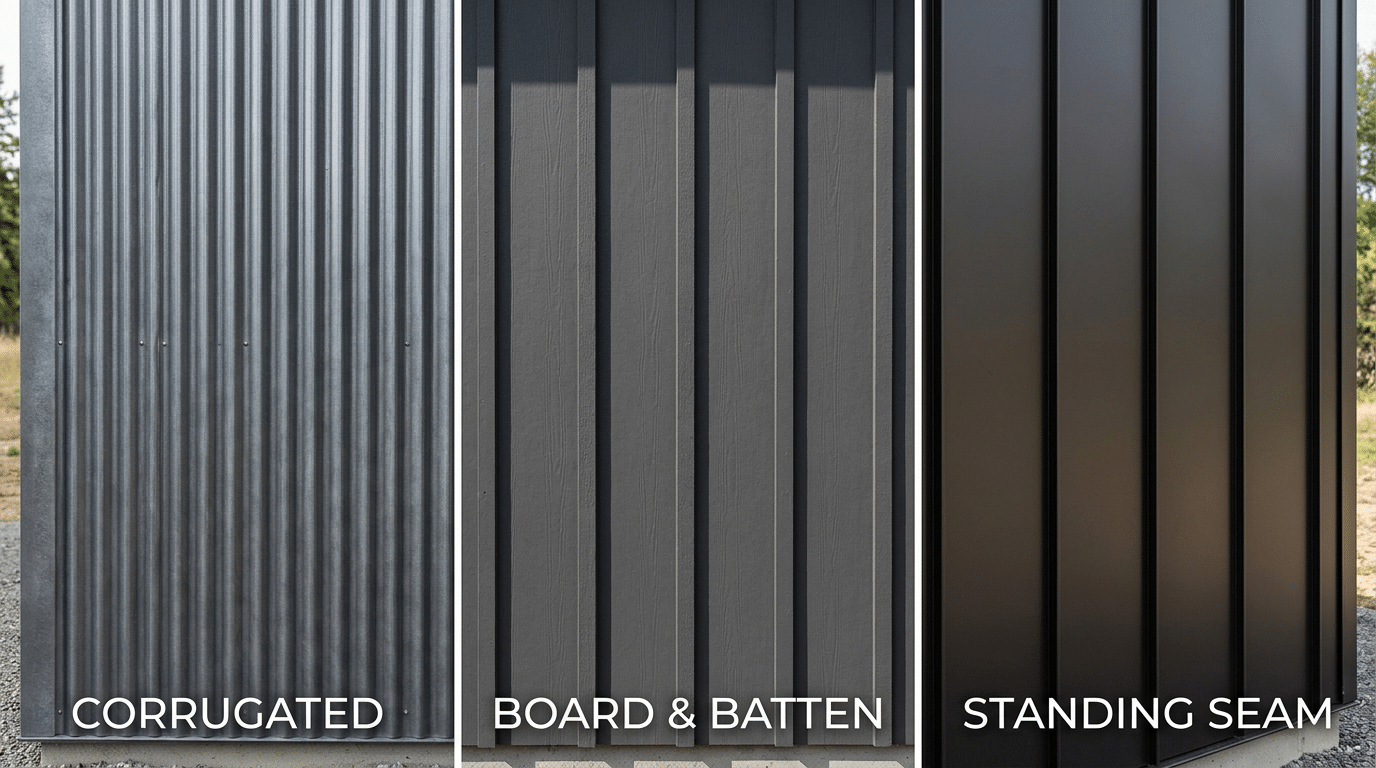
Metal siding is priced per square foot of wall area, not per square foot of floor area. This is where many budgets go wrong. A 2,000-square-foot house does not have 2,000 square feet of siding. It might have 1,400 or 2,400, depending on stories, roof shape, and openings.
Here is how the per-square-foot price breaks into three tiers:
| Tier | Price per Sq Ft Installed | What You Typically Get |
| Low-end | 4–7 | Corrugated aluminum or light-gauge steel, exposed fasteners, simple one-story walls, no removal |
| Typical | 8–12 | 26- or 24-gauge steel, standard painted finish, ribbed or board-and-batten profiles, normal trim |
| High-end | 12–16+ | Concealed fasteners, standing seam, 22–24 gauge, PVDF finish, many corners, difficult access |
What is usually included: panels, fasteners, standard trim and corner pieces, J-channel, flashing at openings, labor, delivery, and cleanup.
What is usually excluded: removal and disposal of old siding, sheathing repair, insulation or rigid foam, window and door replacement, soffit and fascia, gutters, painting, and permit fees if the contractor bills them separately.
Why two contractors quote different per-square-foot prices: one may count gross wall area and another net area after subtracting openings. One may include trim and flashing in the unit price and another may list them separately. When comparing, convert both bids to the same basis.
What Is the Cost Breakdown?
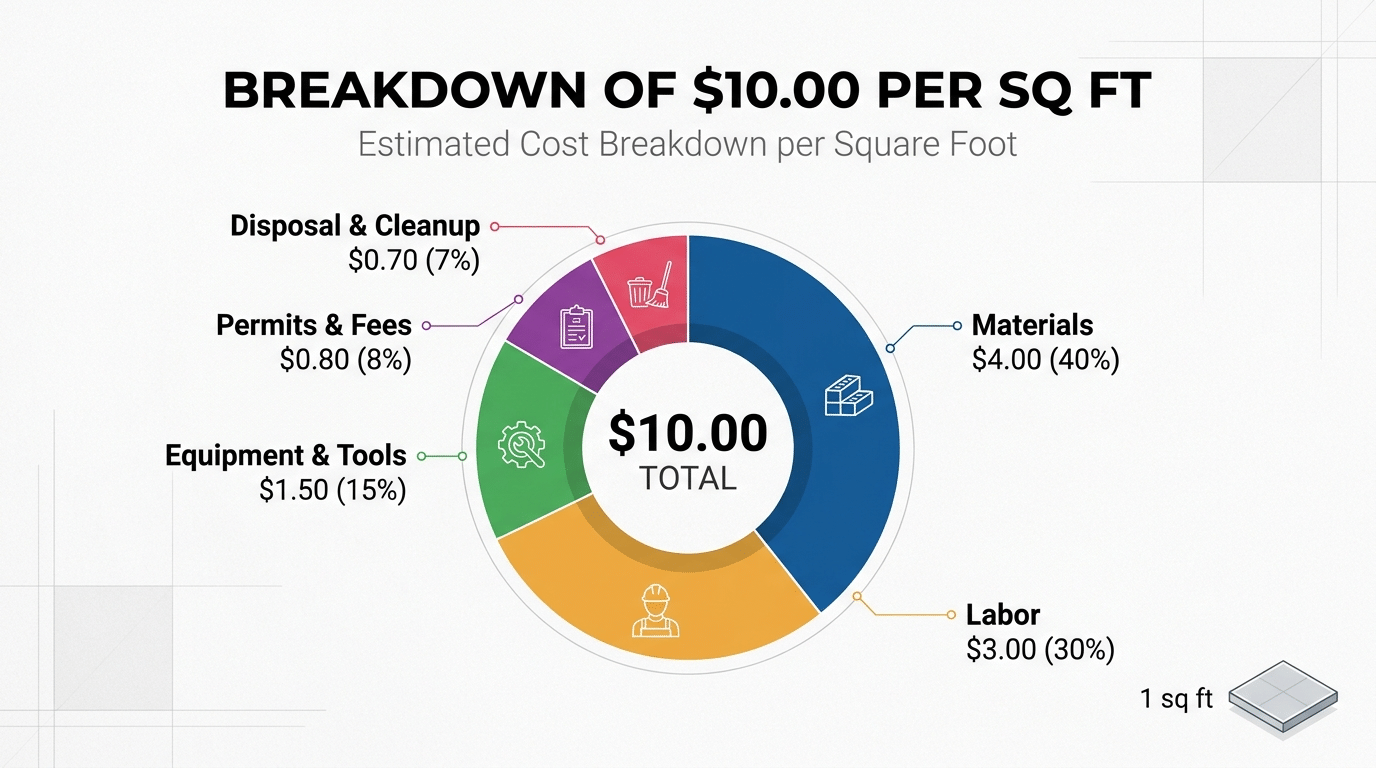
On a typical residential job, materials and labor together make up most of the price. The rest is delivery, equipment, permits, cleanup, and the contractor’s overhead and profit.
| Cost Component | Typical Share of Installed Price |
| Metal panels | 25–35% |
| Trim, flashing, fasteners, weather barrier | 10–15% |
| Labor (billed rate) | 30–40% |
| Equipment, delivery, mobilization | 3–6% |
| Permits, disposal, cleanup | 2–5% |
| Overhead and profit not already in labor | 8–15% |
These shares overlap at the extremes, so they won’t sum to exactly 100% at either end. Some industry sources put labor at 35 to 45 percent of the total, which fits the upper half of the range above.
Here is what a $10 per square foot installed price can look like when broken out:
| Line Item | $ per Sq Ft | Share |
| Panels (24-ga painted steel, ribbed) | $3.00 | 30% |
| Trim, flashing, fasteners, weather barrier | $1.40 | 14% |
| Installation labor | $3.60 | 36% |
| Equipment, delivery, mobilization | $0.45 | 4.5% |
| Permits, cleanup | $0.35 | 3.5% |
| Contractor markup and profit | $1.20 | 12% |
| Total | $10.00 | 100% |
That is one realistic allocation, not a fixed formula. A concealed-fastener job shifts weight toward both materials and labor. A big, simple commercial wall shifts weight toward equipment and away from trim.
Material Costs
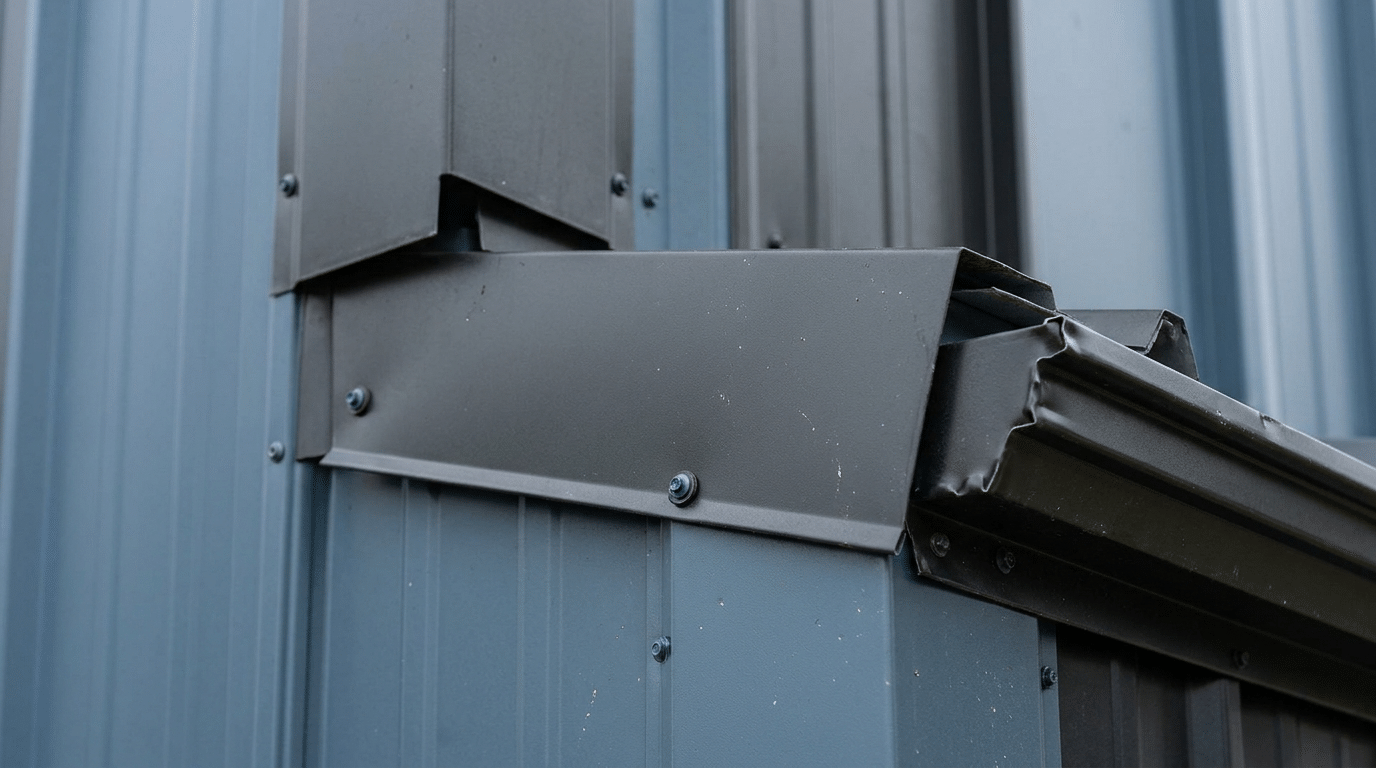
Panel prices depend on the base metal, gauge, profile, and paint system. The figures below are panel-only prices from a metal supplier’s published pricing, not installed costs.
| Panel Material | Approx. Price per Sq Ft (Material Only) |
| 26-ga Galvalume, exposed fastener | 1.50–2.00 |
| 24-ga Galvalume, exposed fastener | 2.50–3.00 |
| 26-ga painted (SMP finish) | 2.00–2.50 |
| 24-ga painted (PVDF, standard colors) | 2.50–3.00 |
| 24-ga painted (PVDF, specialty colors) | 3.75–4.25 |
| 24-ga concealed fastener (PVDF) | 3.00–5.00 |
| Aluminum with PVDF finish | 3.50–6.50 |
A few things move these numbers.
Gauge. Lower numbers are thicker metal. Stepping from 24 to 22 gauge typically adds about 10 to 25 percent to the panel price. Most residential siding is 26 or 24 gauge, and going thinner than 26 is generally not recommended because of denting and oil-canning.
Finish. Bare galvanized or Galvalume is cheapest and looks industrial. Polyester-type (SMP) paint is the budget painted option. PVDF coatings cost more but hold color longer. Specialty colors cost more than standard colors.
Aluminum vs. steel. One supplier puts aluminum panels about 35 percent higher than comparable steel on a material basis, though installed aluminum corrugated can still come out cheaper because of lighter weight and faster handling. Both facts can be true on different projects.
Accessories. Fasteners are a small line, around $0.10 to $0.15 each at roughly one per square foot. That is about $150 to $225 for 1,500 square feet of wall. Trim, corners, J-channel, drip edge, and flashing add more. Budget about $1 to $2 per square foot for flashing and trim on a typical house, more on a cut-up elevation.
Quantity example. Take a two-story house with 2,340 square feet of gross wall and 15 percent openings:
- Net wall area: 2,340 − (2,340 × 0.15) = 2,340 − 351 = 1,989 sq ft
- Add 8% waste: 1,989 × 1.08 = about 2,148 sq ft to order
- At 36-inch coverage and 12-foot panels (36 sq ft each): 2,148 ÷ 36 = about 60 panels
- Panel cost at $3.00 per sq ft: 2,148 × $3.00 = about $6,444
- Fasteners at about 1 per sq ft: ~2,150 pieces × 0.10–0.15 = 215–325
Labor Costs
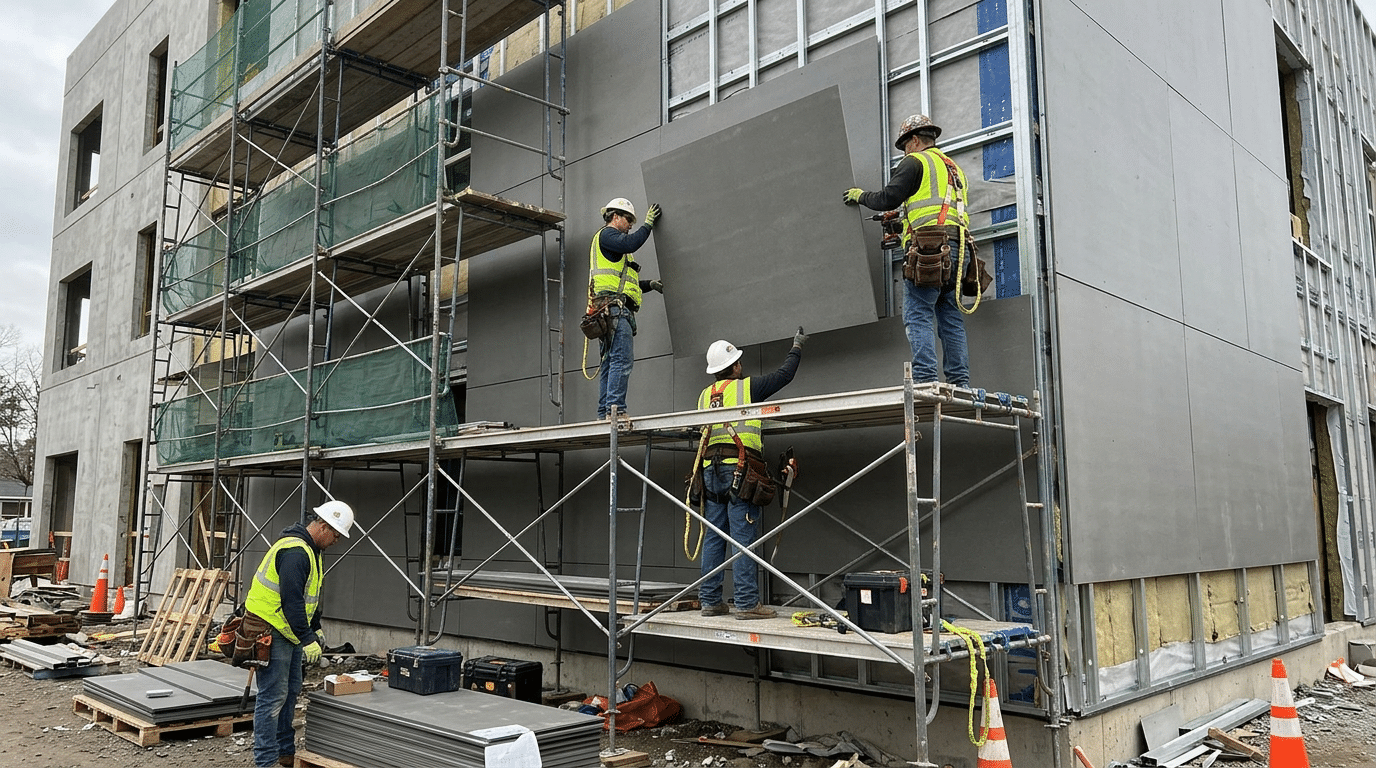
Labor is where most of the variation between bids comes from. Three numbers get confused all the time, so keep them separate:
- Worker wage. What the installer takes home before taxes.
- Burdened cost. Wage plus payroll taxes, workers’ compensation, insurance, and benefits. Burden commonly adds roughly 25 to 40 percent, and workers’ comp on ladder and fall-exposed trades can be a big piece of that.
- Billing rate. What the contractor charges you, which also covers vehicles, tools, supervision, estimating, warranty, and profit.
For a sense of the wage layer, the U.S. Bureau of Labor Statistics reports a median annual wage of $50,970 for roofers as of May 2024, which is about $24.50 an hour. Siding crews are not a separate BLS category, so roofers and similar exterior trades are a reasonable reference point. Wages in metro and West Coast markets run higher.
A burdened and marked-up billing rate of roughly $40 to $55 per installer-hour is typical for a competent residential crew, and published guides cite anywhere from $40 to $90 per hour depending on region and crew experience.
Per-square-foot labor is more useful for budgeting:
- Exposed-fastener panels on simple walls: roughly 2.50–4.50 per sq ft
- Mid-range ribbed or board-and-batten: roughly 3.50–6.00 per sq ft
- Concealed-fastener, standing seam, or complex elevations: roughly 5.00–8.00+ per sq ft
Published guides report labor-only ranges anywhere from $2 to $10 per square foot, with the high end driven by concealed-fastener systems and difficult access. Rural labor can run near $2 to $3 per square foot, while a major metro can run $4.50 to $7.
Labor-hour example. At an estimating assumption of 0.08 labor hours per square foot for exposed-fastener steel:
- 1,700 sq ft × 0.08 = 136 labor hours
- 136 hours × $45 per hour = $6,120
- $6,120 ÷ 1,700 = $3.60 per sq ft
A two-person crew working 8-hour days finishes 136 hours in about 8 to 9 working days, ignoring weather. Concealed-fastener panels often need 0.10 to 0.14 hours per square foot because of tighter alignment and clip installation.
What drives labor up:
- Second and third stories (scaffolding or lifts)
- Many windows, doors, corners, and gables
- Steep or tall walls
- Tight lot lines or landscaping blocking access
- Concealed-fastener or standing seam systems
- Cold weather that slows work and limits panel handling
- Remediation of rot or crooked framing behind old siding
Site Preparation and Existing-Siding Costs
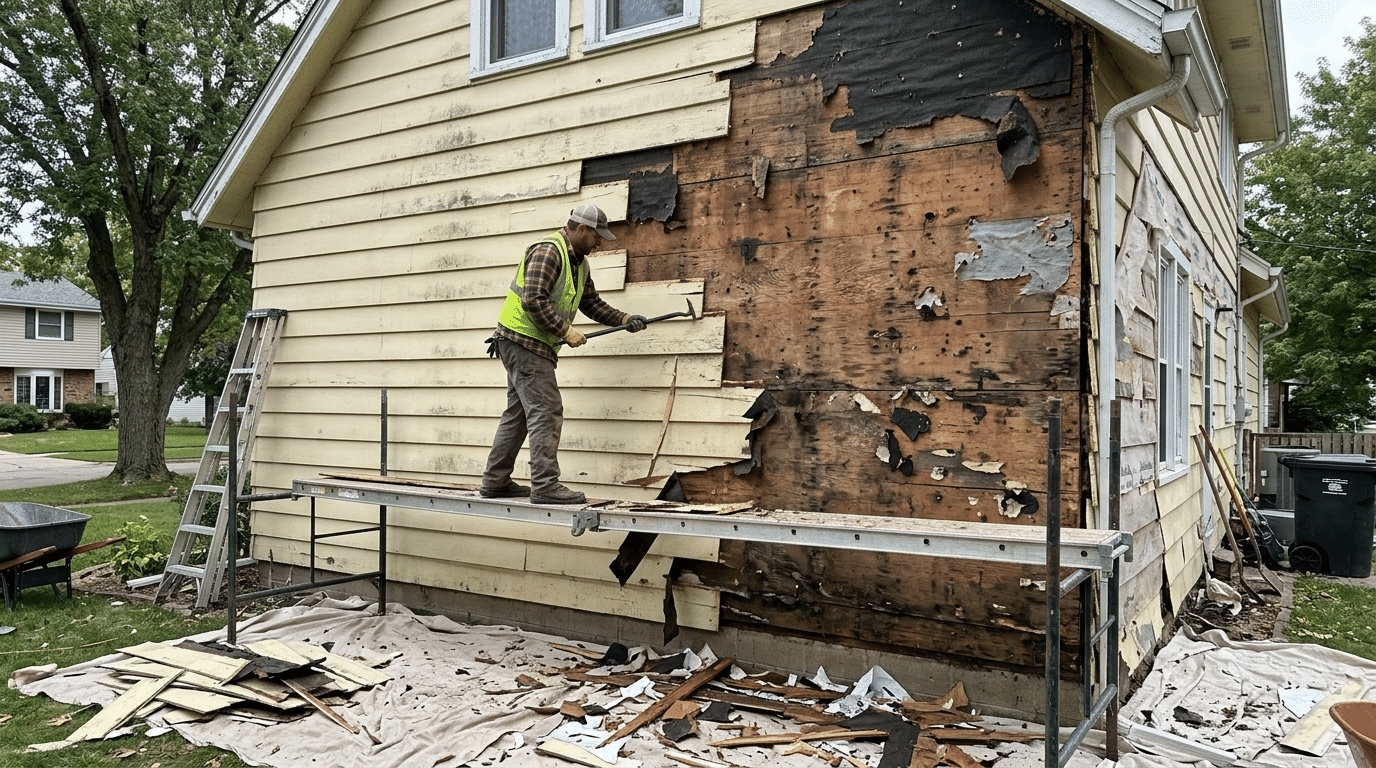
Site prep for siding looks different than for a slab or foundation. The big cost items are what you find behind the old wall and how hard it is to reach.
Removal and disposal. Tearing off old vinyl, wood, or stucco commonly adds about $1 to $3 per square foot. On 1,700 square feet, that is $1,700 to $5,100.
Sheathing and framing repair. Moisture damage behind old siding is common. Replacing rotted sheathing is usually billed separately, per sheet or per hour, and can turn a clean job into a larger one.
Furring and layers. Metal panels often go over vertical furring strips or a rainscreen gap, especially with corrugated profiles. Some codes and manufacturers require a continuous weather-resistive barrier. Ask whether furring and house wrap are in the bid.
Hazardous materials. Older homes may have asbestos-containing siding or lead paint. Federal lead-safe work practices can apply to pre-1978 housing. If either is present, testing and licensed abatement can add real cost and time. Don’t let a contractor wave this away on an older house.
Access. Narrow side yards, steep grades, and landscaping all affect lift or scaffold costs and labor hours. Two houses with identical wall areas can differ by thousands of dollars based on access alone.
What Does Metal Siding Cost by Size?
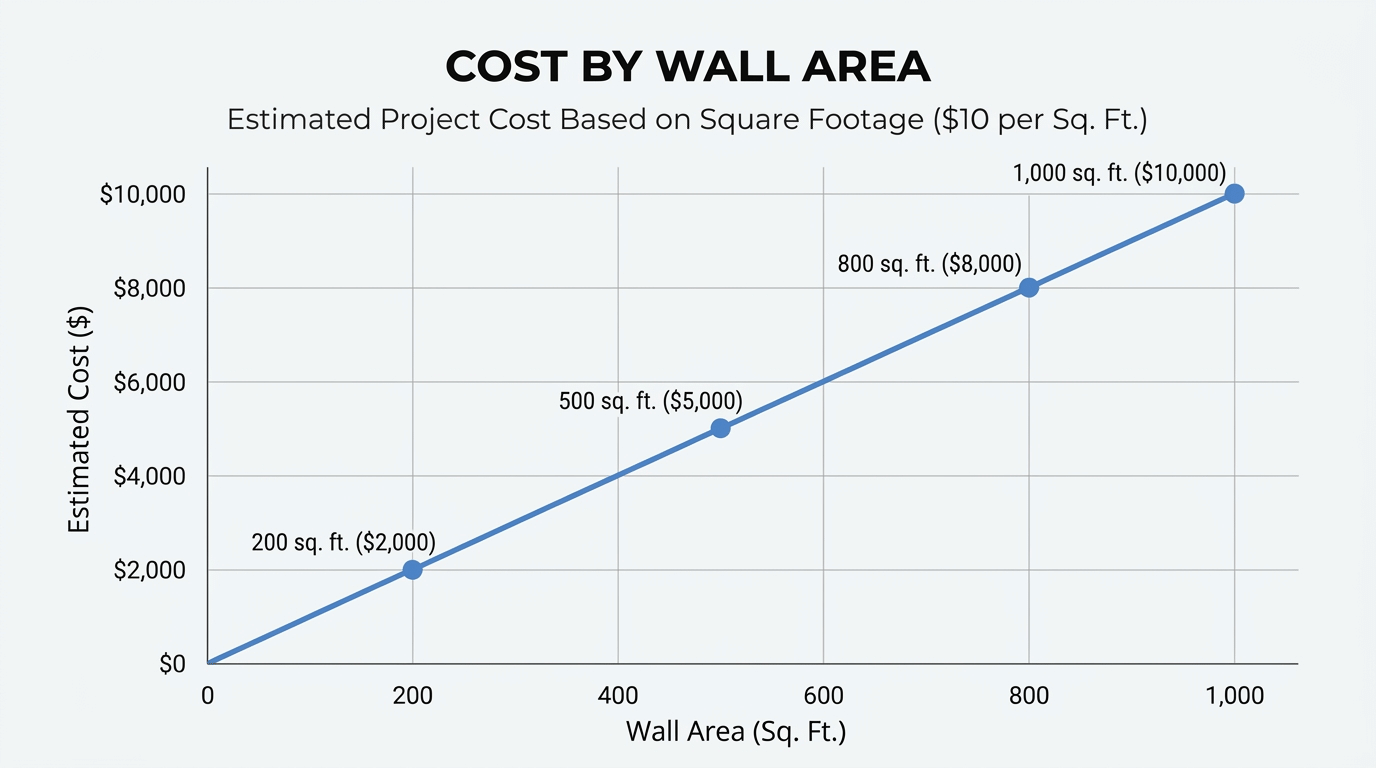
Per-square-foot pricing drops on larger jobs because mobilization, delivery, and the contractor’s fixed costs spread across more area. Very small jobs can cost far more per square foot. One major cost publisher notes that under about 500 square feet of siding, the per-square-foot price can double or triple because of minimum labor and delivery charges.
The table below uses steel siding at mid-range specs. Wall area is net siding area, not floor area.
| Wall Area | Typical Use | $/Sq Ft | Estimated Installed Cost |
| 500 sq ft | Shed, garage, small addition, gable ends | 12–20 | 6,000–10,000 |
| 1,000 sq ft | Small ranch, cabin, accent walls | 9–14 | 9,000–14,000 |
| 1,700 sq ft | Average single-family home | 8–12 | 13,600–20,400 |
| 2,500 sq ft | Large two-story home | 7.50–12 | 18,750–30,000 |
| 4,000 sq ft | Custom home or small commercial building | 7–12 | 28,000–48,000 |
| 10,000 sq ft | Light commercial or agricultural wall | 6–10 | 60,000–100,000 |
How to calculate your own number:
- Measure the perimeter of each wall section and multiply by height. Add gable triangles (½ × base × height).
- Subtract windows and doors.
- Add 5% to 10% for waste, higher with diagonal cuts or many corners.
- Multiply by the per-square-foot rate for your panel type.
- Add removal, repairs, insulation, and permits as separate lines.
Whole-house example (2,000 sq ft, two-story). Gross wall: 130 ft perimeter × 18 ft = 2,340 sq ft. Less 15% for openings = about 1,989, call it 2,000 sq ft.
- Low: 2,000 × $9 = $18,000
- High: 2,000 × $14 = $28,000
One cost publisher shows steel at $14,000 to $32,000 for 2,000 square feet of siding at its wider $7 to $16 range, which is consistent with this.
Standing seam example. 2,500 sq ft × $10 = $25,000. 2,500 sq ft × $16 = $40,000. Range: 25,000–40,000.
Aluminum corrugated example. 1,500 sq ft × $4 = $6,000. 1,500 sq ft × $7 = $10,500. Range: 6,000–10,500.
How Does Gauge, Finish, and Panel Type Affect Cost?
Panel profile usually matters more than any other single choice.
| Panel Type | Fasteners | Installed Cost | Main Cost Driver |
| Corrugated / R-panel / PBR | Exposed | 7–12 per sq ft (steel) | Fastest install, lower material cost |
| Board-and-batten | Mostly concealed | 9–14 per sq ft | Battens add pieces and labor |
| Wood-grain embossed | Concealed | 9–14 per sq ft | Embossed, longer-warranty finishes |
| Standing seam / T-groove | Concealed | 10–16 per sq ft | Precision labor, clips, trim detailing |
| Aluminum corrugated | Exposed | 4–7 per sq ft | Lightweight, simple profile |
| Aluminum smooth boards | Varies | 6–10 per sq ft | Higher material cost than steel panels |
Other specification choices that change the estimate:
- Insulated panels or rigid foam. Adds roughly $1 per square foot or more depending on thickness and R-value.
- Thicker gauge (22 vs. 24). Adds about 10–25% to panel cost, and slightly to labor because the panels are heavier.
- PVDF vs. SMP paint. Often a few tenths to a couple of dollars per square foot on the panel.
- Custom colors. Higher panel cost and sometimes longer lead times.
- Trim package. Corners, window and door trim, soffit transitions, and base flashing can add 1–2 per square foot or more on a detailed elevation.
How Much Does Metal Siding Cost in Different U.S. Regions?
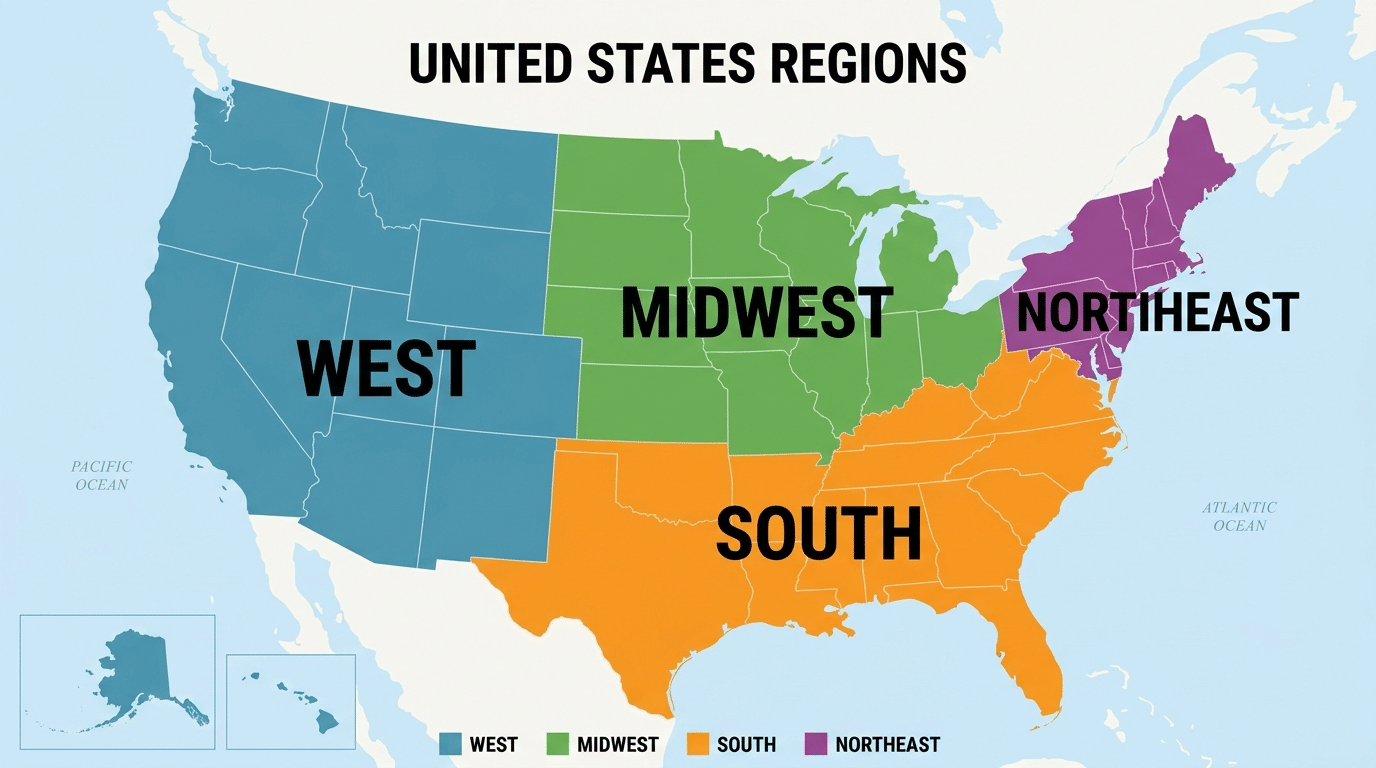
There is no dependable published dollar-per-region table for metal siding specifically, so we won’t invent one. What we can say reliably is where prices tend to run higher or lower and why.
| Region | Typical Price Position | Main Reasons |
| Northeast | Above average | Higher labor and insurance, older homes with removal and lead or asbestos concerns |
| Southeast | Near to slightly below average | Lower labor rates; coastal areas add wind-load requirements |
| Midwest | Near to below average | Lower labor in many markets; cold-season scheduling limits |
| Texas | Wide spread by metro vs. rural | Big labor-rate gap between metros and rural areas; hail drives product choices |
| Florida | Varies; coastal counties higher | Wind and product-approval requirements in coastal and high-velocity zones |
| Southwest | Near average | Heat and UV favor premium finishes; labor tight in growing metros |
| Mountain West | Near to above average | Freight distances, snow loads, short building season |
| Pacific Northwest | Above average | Higher wages, rain-screen and weather-barrier detailing |
| California | Highest | Highest wage pressure, energy and wildfire-zone code requirements, permit costs |
| New York | High in metro areas | Dense-site access issues, high labor and insurance |
The BLS and other construction labor analyses consistently show higher construction wages along the West Coast and in major Northeast metros, which is one reason installed cost per square foot tracks higher there. Rural markets can run materially lower on labor, though freight on panels may offset some of the savings.
What Are the Hidden Costs of Metal Siding?
These are the line items that surprise people.
| Hidden Cost | Typical Range | Notes |
| Old siding removal and disposal | 1–3 per sq ft | More if multiple layers or hazardous material |
| Sheathing repair | Varies by damage | Often billed per sheet or hourly |
| Flashing and trim upgrades | 1–2 per sq ft | Heavier on complex elevations |
| Short-load or minimum charges | Can double or triple $/sq ft under ~500 sq ft | Mobilization and delivery minimums |
| Insulation or rigid foam | About $1+ per sq ft | Depends on R-value |
| Soffit, fascia, gutters | Priced separately | Often excluded from siding bids |
| Permits | Typically modest | Varies by jurisdiction |
| Painting or touch-up | Varies | Aluminum can fade and need repainting |
| Weather delays and overtime | Varies | Cold or wet windows limit install days |
| Change orders | 5–10% contingency is a common planning buffer | Rot, framing issues, scope changes |
| Window and door trim-out | Varies | Frequently overlooked |
Dents and scratches are another factor. Aluminum in particular dents more easily than steel, and published guides put repair costs close to the cost of new installation per square foot. That’s a long-term cost, not a day-one cost, but it belongs in the decision.
What Should a Professional Metal Siding Estimate Include?
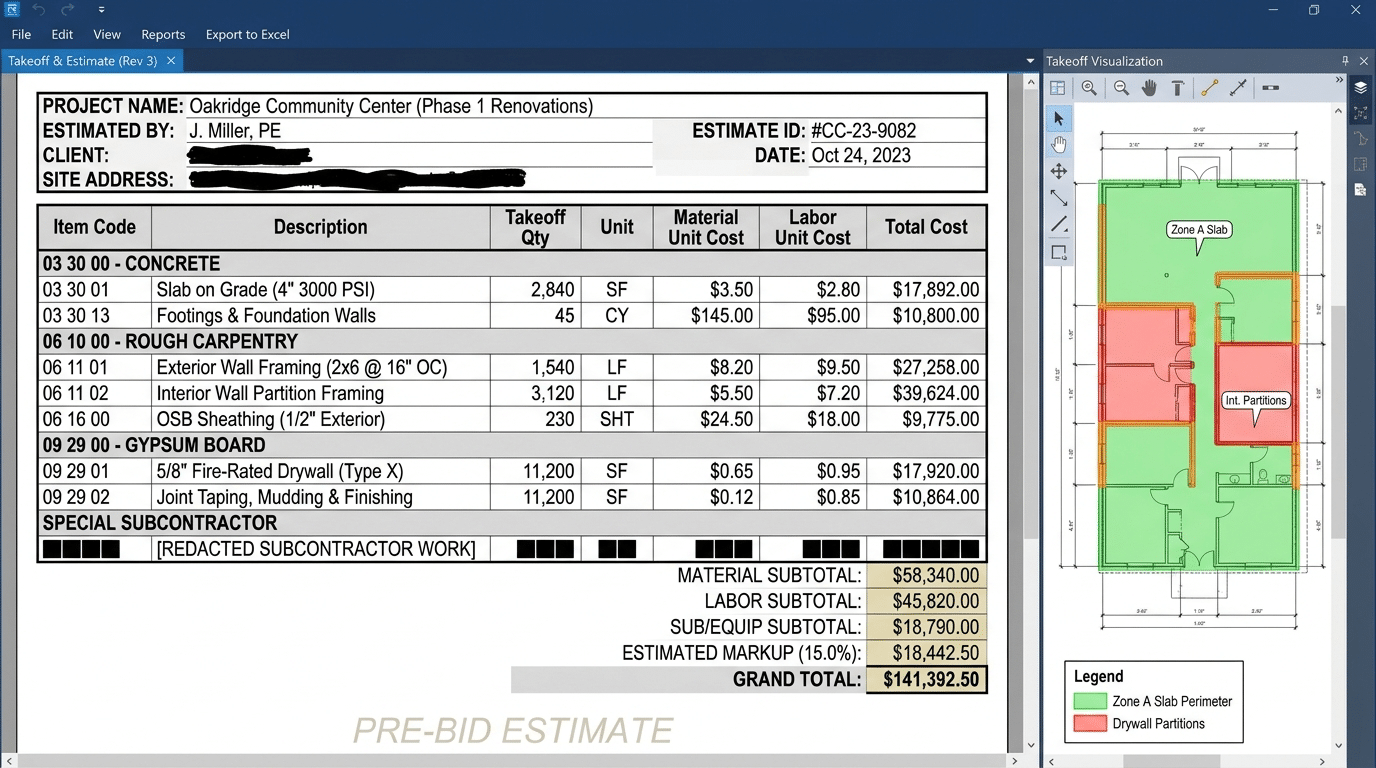
A usable estimate lists quantities and unit costs, not just a lump sum. Look for:
- Scope description: which walls, which elevations, what is included and excluded
- Net wall area (sq ft) with openings subtracted, and the waste factor used
- Panel type, gauge, finish, color, and manufacturer
- Panel quantity and unit cost
- Trim and accessories: corners, J-channel, base flashing, window and door trim, drip edge (linear feet and unit cost)
- Weather barrier, furring, or underlayment
- Insulation, if any
- Fasteners and sealants
- Labor: hours or unit rate, crew size, estimated duration
- Equipment: lifts, scaffolding, rental days
- Delivery and mobilization
- Demolition and disposal of old siding
- Permits and inspections
- Allowances for repairs and the unit price for extra work
- Overhead and profit
- Exclusions and assumptions in writing
- Warranty terms on materials and workmanship
- Payment schedule and start date
Why itemized beats lump sum: an itemized estimate lets you see exactly what changes when you change the panel or add insulation. It shows what’s missing when two bids differ. And if the framing needs repair halfway through, you already have a unit price instead of an argument.
How Do You Compare Two Metal Siding Bids?
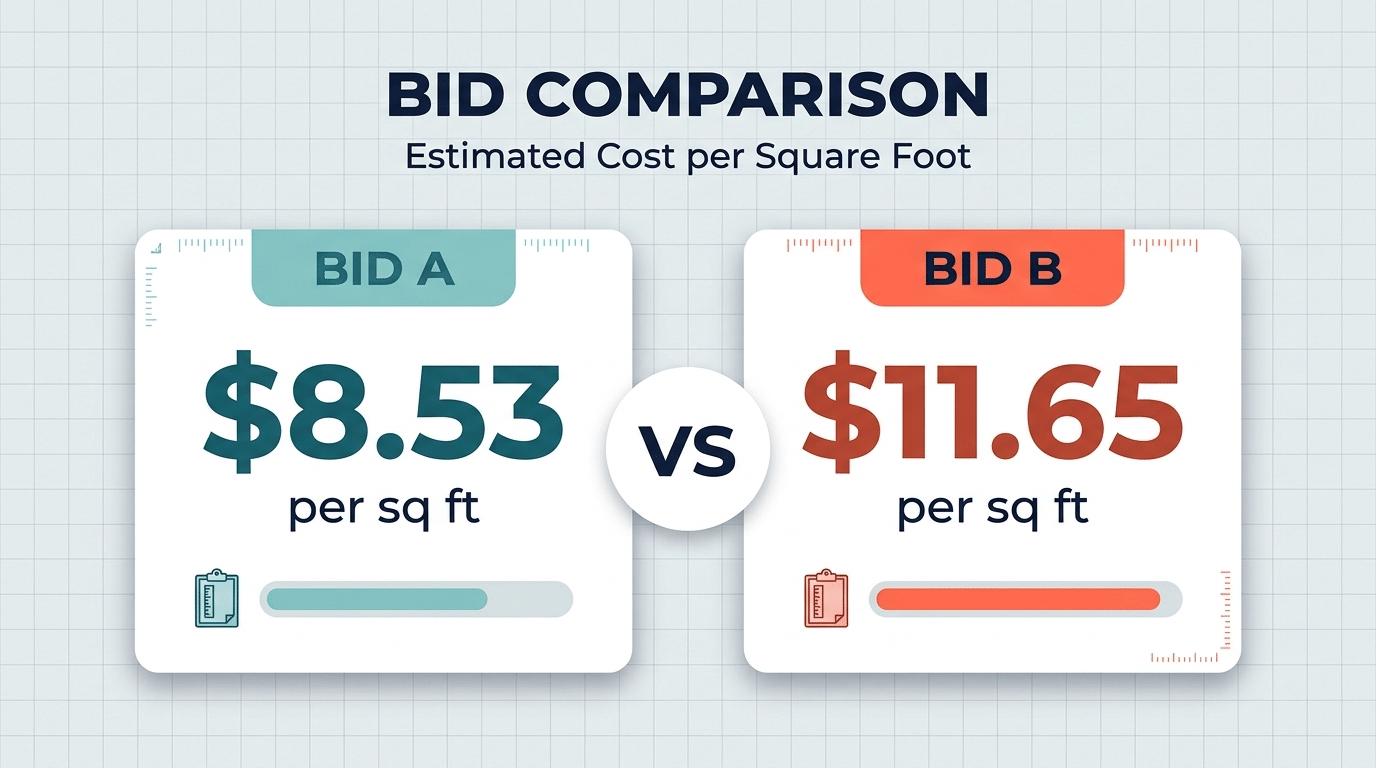
Take two bids for the same 1,700-square-foot house:
- Bid A: $14,500 → $14,500 ÷ 1,700 = $8.53 per sq ft
- Bid B: $19,800 → $19,800 ÷ 1,700 = $11.65 per sq ft
- Difference: $19,800 − $14,500 = $5,300
That gap may be real or it may be scope. Check these before deciding.
| What to Check | Why It Matters |
| Scope | Does one include removal, trim-out, flashing, or soffit and the other not? |
| Wall area | Are both using the same net square footage and waste factor? |
| Panel spec | Same gauge, finish (SMP vs. PVDF), profile, and brand? |
| Labor assumptions | Hours, crew size, duration, and who is actually on site? |
| Site prep | Repairs, furring, house wrap, and hazard testing included? |
| Equipment | Scaffold or lift cost built in? |
| Exclusions | What happens if rot is found? Is there a unit price for repairs? |
| Overhead and profit | Visible or buried? |
| Warranty | Panel and finish warranty vs. contractor workmanship warranty |
| Schedule | Start date, duration, and weather policy |
A low bid isn’t automatically a bargain, and a high bid isn’t automatically padded. A low number with thin scope, missing flashing, or no allowance for repairs often comes back as change orders. A high number may include a better finish, insulation, or a crew that carries proper insurance. Ask both contractors to price the same itemized scope and the gap usually explains itself.
When Is a Professional Siding Estimate Worth It?
If you’re a contractor pricing a bid, a builder setting a budget, a developer comparing options, or a project owner trying to check a quote, the hardest part is getting accurate quantities. Wall area, openings, trim footage, waste, and labor hours drive the final number, and small takeoff errors compound quickly on large buildings.
A professional construction estimate can help you:
- Confirm material quantities and waste factors
- Understand labor requirements and crew duration
- Identify equipment needs
- Define scope clearly and spot exclusions
- Build a transparent cost breakdown
- Prepare competitive bids without leaving money on the table
- Find cost gaps before work begins
- Set a budget you can actually defend to a lender or client
Need a detailed estimate for your upcoming project?
1st Estimator provides professional construction estimating and quantity takeoff services for residential, commercial, and industrial projects, including exterior cladding scopes like metal siding.
Frequently Asked Questions
How much does metal siding cost per square foot installed?
Most installed metal siding costs between $6 and $16 per square foot in 2026, with a typical price around $10. Basic aluminum corrugated can start near $4 to $7, exposed-fastener steel runs about $7 to $12, and concealed-fastener or standing seam steel runs about $10 to $16.
How much does it cost to put metal siding on a 2,000-square-foot house?
It depends on wall area, not floor area. A typical two-story house with 2,000 square feet of floor area has about 2,000 square feet of net wall. At $9 to $14 per square foot, that is $18,000 to $28,000. A one-story house of the same floor area often has less wall and costs less.
What is the labor cost to install metal siding?
Labor commonly runs about $3 to $8 per square foot, depending on panel type and access, with exposed-fastener panels at the low end and concealed-fastener systems at the high end. Hourly billing rates of $40 to $55 per installer are typical, with wide variation by region.
What is the cheapest type of metal siding for a house?
Corrugated aluminum and light-gauge corrugated steel with exposed fasteners are the lowest-cost options, roughly $4 to $12 per square foot installed depending on metal and region. Bare Galvalume is cheapest on materials but has an industrial look.
How do I calculate the amount and cost of metal siding I need?
Measure each wall’s perimeter and height, add gable areas, subtract windows and doors, then add 5% to 10% for waste. Multiply the net area by your material price for panel cost, then add trim, labor, equipment, delivery, and permits. Or multiply the area by an installed $/sq ft rate for a quick budget.
How can I get an accurate metal siding cost estimate for my construction project?
Get a measured takeoff, not a rule-of-thumb guess. Ask for an itemized estimate with quantities, unit costs, labor hours, and exclusions. A professional estimating service can produce the takeoff and cost breakdown from your plans.
Is metal siding more expensive than vinyl?
Usually yes. Vinyl typically runs about $3 to $12 per square foot installed versus roughly $6 to $16 for metal. Metal generally lasts longer, which is where its higher upfront cost is meant to pay back.
How much should I budget for removing old siding?
Plan on about $1 to $3 per square foot. Multiple layers, hazardous materials, or damaged sheathing can push it higher.
What makes metal siding more expensive?
Concealed fasteners, thicker gauge, premium PVDF finishes, specialty colors, insulation, many corners and windows, multi-story access, and high-wage markets all increase cost. Very small projects also cost more per square foot because of minimum charges.
How accurate are online metal siding cost calculators?
They’re good for a ballpark. Most use a single $/sq ft rate and don’t account for trim, access, removal, or local labor. Treat the output as a starting range, then verify with a measured takeoff and at least two itemized bids.
What hidden costs should I expect?
Old-siding removal, sheathing repair, trim and flashing upgrades, insulation, soffit and gutters, permits, weather delays, and change orders. Setting aside a 5% to 10% contingency is a common planning approach.