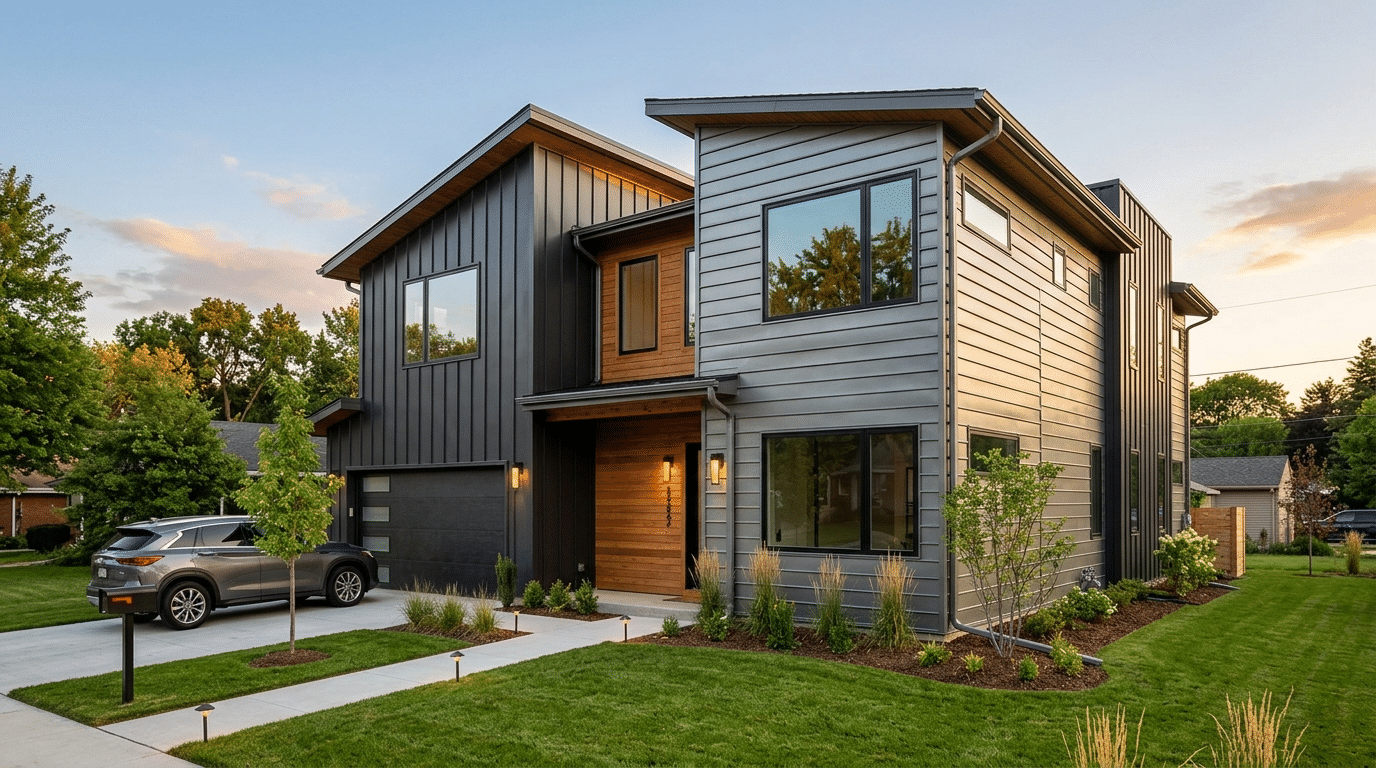
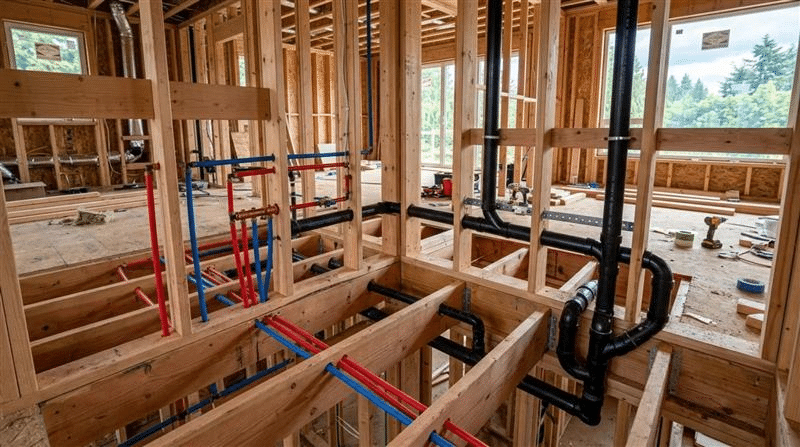
The cost to plumb a 2,000 sq ft house in 2026 is typically 9,000–20,000, with a common price around $13,300, or roughly $6.65 per square foot. That figure covers a new-construction plumbing package for a standard 2.5-bath home: underground and under-slab piping, drain-waste-vent (DWV) and water supply rough-in, builder-grade fixtures, a tank water heater, and basic permits.
Your number will move based on bathroom count, pipe material, fixture grade, foundation type, how far the house sits from the water and sewer connections, and your local labor market. This guide shows where the money goes, how to check a plumbing estimate line by line, and how to compare two bids that look alike but aren’t.
All figures are national planning numbers, not contractor quotes. Published sources vary, and I note where they disagree.
How Much Does It Cost to Plumb a 2,000 Sq Ft House in 2026?
Most published new-construction plumbing guides land on 4–8 per square foot as a planning range. Applied to 2,000 sq ft, that is 8,000–16,000. Some sources run higher once fixtures, a water heater, and site connections are included.
Here is the range I use for a complete package with builder-grade fixtures:
| Scenario | Typical Specification | Estimated Cost |
| Low end | 2 baths, PEX supply, PVC drains, basic fixtures, simple single-story layout, low-cost market | 9,000–11,000 |
| Typical | 2.5 baths, PEX supply, PVC drains, builder-grade fixtures, 50-gal tank water heater | 11,000–16,000 |
| Upper range | 3+ baths, long runs, two stories, mid-grade fixtures, high-cost market | 16,000–20,000 |
| Premium | Upgraded fixtures, tankless or recirculation, copper or cast iron, extra kitchens or wet bars | $20,000+ |
What this range assumes:
- New construction with open framing. Pipes run through bare studs and joists, not finished walls.
- A licensed plumbing subcontractor supplying labor and standard rough-in materials.
- Builder-grade fixtures and faucets.
- One standard tank water heater.
- Permits and inspections included.
What it does not include:
- Water and sewer tap fees, impact fees, and meter charges.
- Well, pump, septic, or long utility trenches.
- Natural gas piping, water softeners, and fire sprinklers.
- Owner-selected designer fixtures purchased separately.
For scale, NAHB’s 2024 Cost of Construction Survey put the average new single-family home at about $428,215 in construction cost on 2,647 sq ft. Scaled to 2,000 sq ft, that is roughly $323,600. A $13,300 plumbing package works out to about 4.1% of that, by my arithmetic. NAHB’s broader “major system rough-ins” stage (plumbing, electrical, and HVAC together) was 19.2% of construction cost in that survey.
What Does Plumbing Cost Per Square Foot?
Plumbing is bid by fixture count and pipe layout, not by square footage. Per-square-foot numbers are a sanity check, not a bid method. They are still the first number most people search for, so here it is:
| Level | Cost per Sq Ft | Total for 2,000 Sq Ft |
| Low | $4.50 | $9,000 |
| Typical | $6.65 | $13,300 |
| Upper | $8.00 | $16,000 |
| High | $10.00 | $20,000 |
The math is simple: 2,000 × $4.50 = $9,000. 2,000 × $6.65 = $13,300. 2,000 × $8 = $16,000. 2,000 × $10 = $20,000.
Rough-in plumbing cost per square foot is lower because it leaves out trim-out fixtures and the water heater. On my typical scenario, rough-in is about $7,700, or $3.85 per sq ft, with a range of about 3.00–6.50. Some published sources quote rough-in at 8,000–20,000 for a typical house, probably because they bundle in more scope. When a quote seems far off, ask what “rough-in” includes before you compare numbers.
Why contractors quote the same house differently:
- A 2,000 sq ft ranch with two baths back-to-back is cheaper to plumb than a 2,000 sq ft two-story with baths in opposite corners.
- Two houses with the same area can differ by a full bathroom.
- Per-square-foot numbers hide plan geometry. A compact plumbing core can save thousands over a spread-out layout.
What Is the Cost Breakdown for Plumbing a New House?
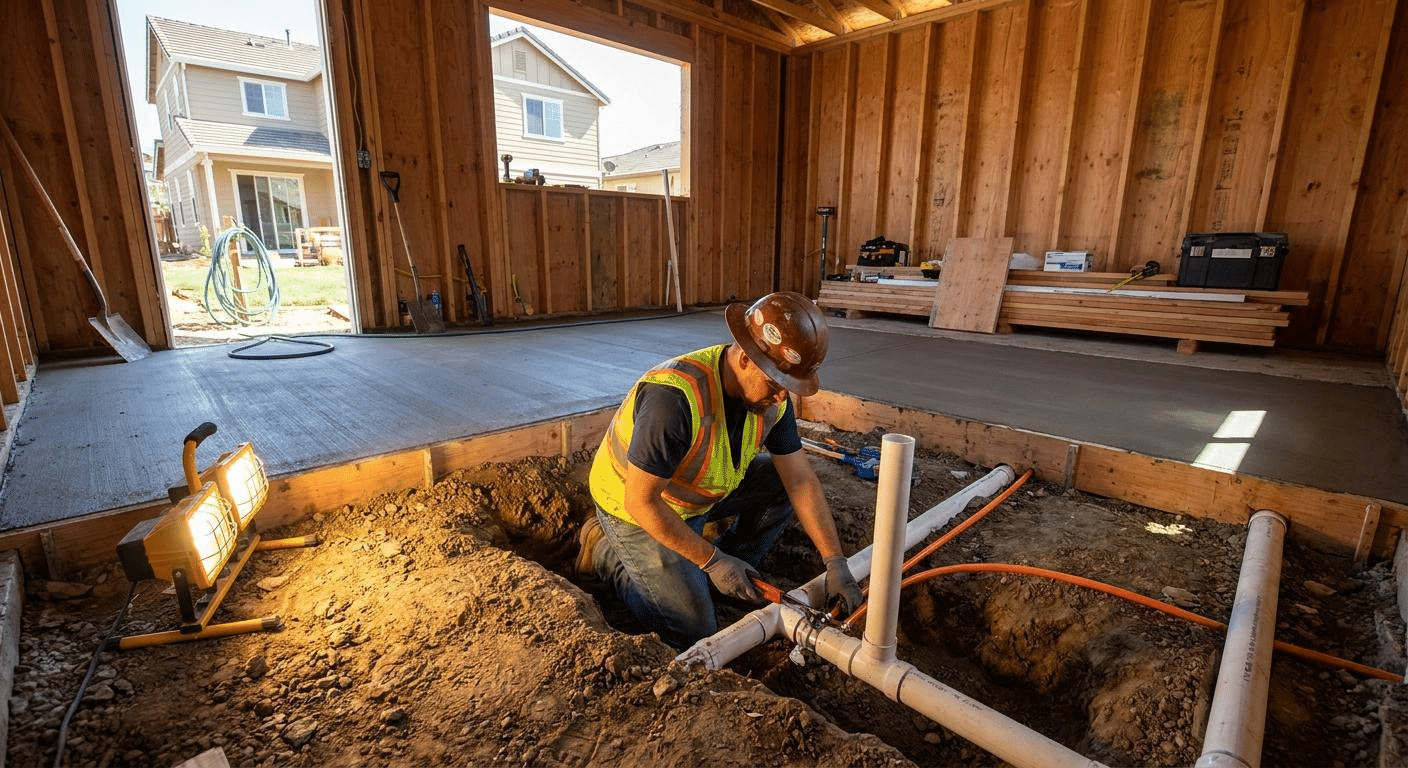
Here is the typical split for the $13,300 mid-case package. These shares are my estimating-based allocation, not a published statistic:
| Cost Component | Typical Share | Mid-Case Dollars |
| Materials (pipe, fittings, fixtures, water heater) | 40–50% | $5,900 |
| Labor | 30–40% | $4,600 |
| Equipment and small tools | 2–5% | $400 |
| Permits and inspections | 3–6% | $700 |
| Overhead and profit | 10–15% | $1,700 |
| Total | $13,300 |
Check: $5,900 + $4,600 + $400 + $700 + $1,700 = $13,300.
Here is what drives each line:
- Materials swing with pipe type, fixture grade, and water heater choice. Commodity-sensitive items like copper move the most.
- Labor depends on layout, access, and how many fixtures the crew has to set. New construction labor is far faster than remodel labor because there are no finished walls to open.
- Equipment is mostly small. Think pressure-test gear, hole saws, a trencher or mini-excavator for exterior runs, and the truck.
- Permits vary by municipality. Plan on roughly 200–1,000 for plumbing permits and inspections in most places, more in some cities.
- Overhead and profit cover insurance, licensing, warranty callbacks, and the plumber’s margin. On a subcontract price, these are already inside the number.
What Are the Main Plumbing Material Costs?
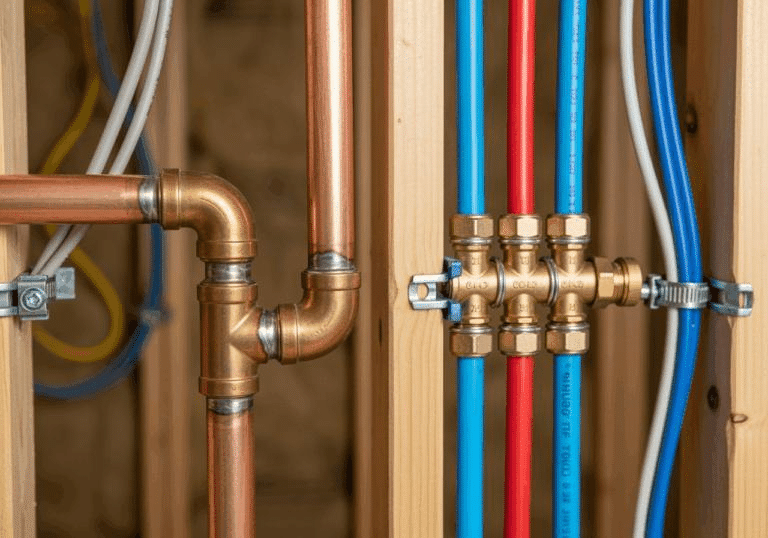
A 2,000 sq ft, 2.5-bath house typically needs about 600–900 linear feet of water supply tubing, plus a similar order of magnitude of DWV pipe and a long list of fittings, valves, and hangers. That takeoff quantity varies a lot with layout.
| Material | Typical Material Price | Unit | Notes |
| PEX tubing | 0.40–2.00 | per linear foot | Most common supply pipe in new homes; price varies by size and PEX type |
| Copper (Type L/M) | 2.00–10.00 | per linear foot | Wide range by diameter and commodity pricing |
| CPVC | 0.50–3.00 | per linear foot | Rigid plastic; used in some regions |
| PVC/ABS DWV pipe | Varies by diameter | per linear foot | Standard for drains in most markets |
| Fittings, valves, hangers | Hundreds to low thousands | per house | Many small items that add up |
| Tank water heater (50 gal) | About 600–1,200 equipment | each | Installed price higher; see below |
| Builder-grade fixtures | Varies | per fixture | Toilets, lavs, faucets, shower trim |
Unit prices come from several consumer pricing sources that overlap on the PEX and copper ranges. Treat them as planning ranges, not quotes. Pipe prices change by supplier and week.
Standard versus premium:
- Builder-grade toilets and faucets are inexpensive. Designer or smart fixtures can double or triple the trim-out line.
- A standard tank heater is the budget path. Tankless units cost more up front and may need larger gas lines or electrical upgrades.
- Cast iron DWV, often used for noise control, typically adds a few thousand dollars on a house this size, mostly through labor and weight.
What Are Plumber Labor Costs?
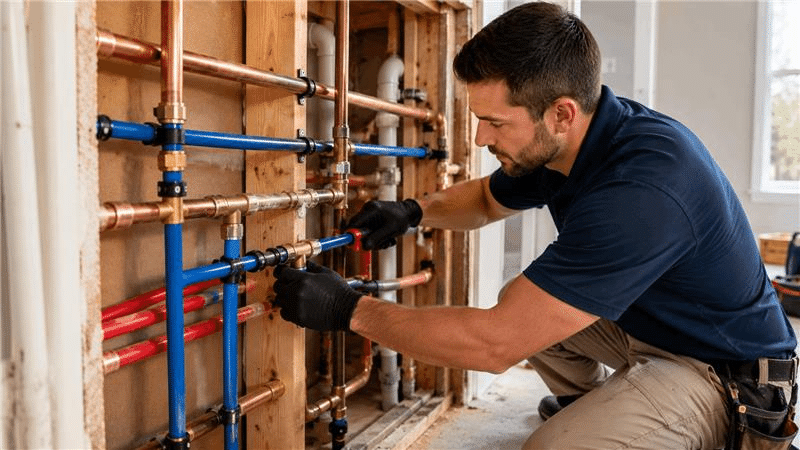
Labor is where estimates get confused, so keep three numbers separate:
| Labor Number | What It Means | Typical Range |
| Worker wage | What the plumber takes home per hour | Roughly 30–34 for a journeyman on average; union and high-cost markets run higher |
| Payroll burden | Taxes, insurance, benefits on top of wage | About 25–40% on top of wage (varies by employer) |
| Contractor billing rate | What the customer is charged | About 75–130/hr for standard residential service work; higher in some metros |
A plumber earning $34/hr with 35% burden costs the shop about $45.90/hr before the truck, tools, insurance, supervision, and warranty exposure. That is why billing rates for service calls land around 75–130.
New-construction plumbing is priced differently. Production plumbers working a new house bid by the job, with crews set up for speed. For my mid case, I assume about 75 labor hours at a production labor cost of roughly $62/hr:
75 hours × $62 = $4,650, matching the $4,600 labor line above.
For comparison, if you paid the same 75 hours at a $100/hr service-call rate, you would get $7,500. That is why flat-bid new-construction plumbing is cheaper than hourly work.
What pushes labor up:
- Two-story layouts and long vertical runs
- Baths spread across the footprint
- Slab work that needs underground piping before the pour
- Tight crawlspaces or limited access
- Overtime, rush schedules, or after-hours work (typically 1.5–2× normal rates)
- Union scale, strong demand, or labor shortages in the local market
Service call fees of roughly 50–250 do not apply to a flat-bid new-construction job, but you will see them on punch-list visits after you move in.
Does Site Preparation Affect Plumbing Costs?
Yes, and it is the number most people forget. The plumbing package above covers piping inside the building footprint and a few feet outside. Everything beyond that is site work.
Cost drivers on the site side:
- Distance to the municipal main. A 20-ft lateral and a 150-ft lateral are different jobs.
- Rock and difficult soil. Rock trenching needs equipment, time, and sometimes blasting or hammering.
- Depth. Sewer inverts, frost depth, and pump needs all change the trench.
- Slope. If the house sits below the sewer main, you may need a sewage ejector or pump.
- Wells and septic. These are separate scopes and can cost tens of thousands of dollars depending on local conditions.
- Access. Remote lots add delivery time and mobilization cost.
NAHB’s 2022 survey reported average water and sewer fees and inspections near $5,800 per home, a useful reminder that municipal charges can be a major budget line by themselves. The number is a survey average, not a rule.
Two identical houses can have plumbing budgets thousands of dollars apart because one has a 30-ft sewer tap and the other has a 300-ft run through rock.
What Does Plumbing a House Cost by Size?
| House Size | Typical Use | Estimated Range | Typical Price | Typical $/Sq Ft |
| 1,200 sq ft | 1.5–2 baths, compact ranch | 6,500–12,000 | $9,500 | $7.92 |
| 1,600 sq ft | 2 baths, starter home | 8,000–15,000 | $11,500 | $7.19 |
| 2,000 sq ft | 2.5 baths, typical new home | 9,000–20,000 | $13,300 | $6.65 |
| 2,500 sq ft | 3 baths, larger family home | 12,500–25,000 | $16,500 | $6.60 |
| 3,000 sq ft | 3.5 baths, upper-mid home | 15,000–32,000 | $20,500 | $6.83 |
| 4,000 sq ft | 4.5 baths, wet bar or second kitchen | 22,000–48,000 | $30,000 | $7.50 |
Notice the price per square foot does not fall steadily as the house grows. Fixed charges (mobilization, permit, water heater, underground connection) help small houses look expensive per foot, while more baths and longer runs push large houses back up. Bathroom count matters more than square footage.
Calculation example: the extra bathroom. Going from 2.5 to 3.5 baths adds a toilet, a lavatory, and a tub or shower, plus the drain and supply runs:
$675 (toilet) + $625 (lavatory) + $1,550 (shower/tub) = $2,850, before added piping runs.
Plan for 2,800–4,500 for each additional full bath in new construction.
What Is the Cost Per Fixture?
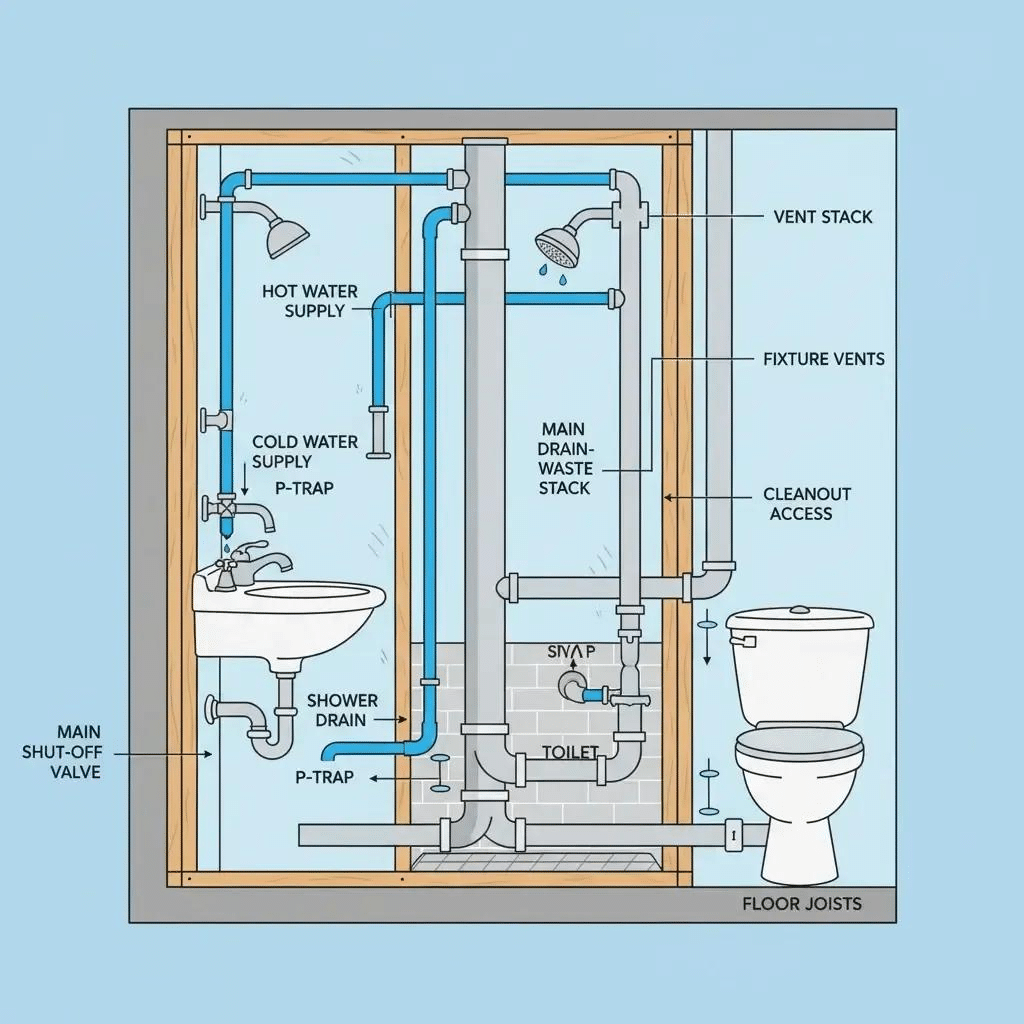
Plumbers often build a bid fixture by fixture. Here are installed rough-in and trim prices I use for planning, including their share of the piping:
| Fixture | Typical Installed Cost |
| Toilet | 450–900 |
| Lavatory (sink and faucet) | 400–850 |
| Tub or shower (valve and trim) | 900–2,200 |
| Kitchen sink (with disposal connection) | 500–1,000 |
| Laundry box | 250–500 |
| Exterior hose bib | 150–350 |
| Dishwasher or ice maker stub | 100–250 |
| 50-gal tank water heater | 1,200–2,500 |
Example: 2.5-bath house, fixture method (mid values)
| Item | Qty | Unit Price | Subtotal |
| Toilets | 3 | $675 | $2,025 |
| Lavatories | 3 | $625 | $1,875 |
| Tub/shower | 2 | $1,550 | $3,100 |
| Kitchen sink | 1 | $750 | $750 |
| Laundry box | 1 | $375 | $375 |
| Hose bibs | 2 | $250 | $500 |
| Dishwasher and ice maker stubs | 2 | $175 | $350 |
| Water heater | 1 | $1,850 | $1,850 |
| Fixture subtotal | $10,825 | ||
| Underground and main lines | $1,800 | ||
| Permits and inspections | $700 | ||
| Total | $13,325 |
That lands within $25 of the $13,300 per-square-foot estimate. When the fixture method and the square-foot method agree, the number is probably in the right neighborhood.
How Do Specifications and Quality Levels Affect Cost?
| Specification | Lower-Cost Option | Higher-Cost Option | Effect on a 2,000 Sq Ft House |
| Supply pipe | PEX | Copper | Copper typically adds 3,000–5,500 |
| Drain pipe | PVC or ABS | Cast iron | Adds a few thousand dollars, mostly labor |
| Water heater | 50-gal tank | Tankless or heat pump | Adds hundreds to a couple thousand dollars installed |
| Fixture grade | Builder grade | Designer / smart | Can double the trim-out line |
| Layout | Stacked, compact baths | Spread out or two-story | Adds pipe and labor hours |
| Hot water delivery | Standard trunk-and-branch | Manifold or recirculation | Changes pipe length and comfort |
PEX vs copper plumbing cost, worked example. Assume 700 linear feet of supply tubing, all-in material plus labor:
- PEX at about $2.75 per ft installed (mid case): 700 × $2.75 = $1,925
- Copper at about $10 per ft installed (mid case): 700 × $10 = $7,000
- Difference: $5,075
At the low end of both ranges, the gap shrinks to roughly $3,000. Copper’s per-foot cost and slower sweating labor both add up. Several repipe cost guides in 2026 report copper running 40–60% more than PEX, consistent with this range.
PEX is now the common supply choice in new residential work. Copper is still used where owners or local conventions call for it, and many plumbers use it for exposed or water-heater connections. Check which pipe types your local code adopts.
What Are the Different Types of Plumbing Scope and Their Costs?
“Plumbing cost” can mean four different things, and mixing them up is a common source of confusion.
| Scope Type | What It Covers | Typical Range (2,000 Sq Ft) | Main Cost Driver |
| Underground / under-slab | Building drain and sewer inside footprint before slab | 1,500–3,000 | Slab layout, depth, soil |
| Rough-in | Underground, DWV, supply, valves, stubs | 6,000–13,000 | Layout and bath count |
| Rough-in plus trim-out | Adds fixtures, faucets, and water heater | 9,000–20,000 | Fixture grade |
| Turnkey with site work | Adds sewer and water laterals, tap fees | Add 3,000–20,000+ | Distance, rock, municipal fees |
The ranges overlap on purpose, since contractors define scope differently. The most reliable way to compare is to compare line items.
How Much Does Plumbing Cost in Different U.S. Regions?
I do not use fixed regional multipliers because published ones disagree. What I can tell you is why prices move:
| Region | Why Prices Move | Direction vs. National Typical |
| Northeast | High labor rates, union presence, older codes, tight sites | Higher |
| Southeast | Slab foundations are common, lower labor rates in many markets | Lower to near average |
| Midwest | Lower labor rates, basements and frost depth add work | Lower to near average |
| Southwest | Slab construction, growth demand, labor competition | Near average |
| Mountain West | Growth, frost depth, rock and remote sites | Near average to higher |
| Pacific Northwest | Strong demand, higher wages, permit costs | Higher |
| California | Highest labor and permit costs, strict codes | Highest |
| Texas | Large builder market, competitive subs, varies by metro | Lower to near average |
| Florida | Slab, high demand, hurricane-season workload | Near average |
| New York | Very high labor and permit costs, union market | Highest |
Service-call data from 2026 rate roundups shows the pattern: typical plumber billing rates around 110–125/hr in markets like California, New York, Massachusetts, and Washington, versus clusters closer to 75–100/hr in lower-cost states. Those are illustrative service rates, not new-construction bid rates, but they show the direction.
Local factors also include soil, frost depth, code amendments (which pipe materials are allowed), and permit fees. A national figure is a starting point. A local plumber’s bid on your plans is the real number.
What Are the Hidden Costs of Plumbing a House?
These are the items that turn a $13,000 budget into a $19,000 bill:
- Tap and impact fees. Municipal water and sewer connection charges can run into the thousands. NAHB’s 2022 survey averaged about $5,800 for water and sewer fees and inspections.
- Long laterals and rock. Trenching beyond the footprint is usually priced separately.
- Well, pump, or septic systems. Quote these separately. They can exceed the entire house plumbing package.
- Gas piping. Often a separate line for the range, furnace, dryer, and water heater.
- Pressure-reducing valves, backflow devices, expansion tanks. Code requirements vary by jurisdiction.
- Water softener or filtration. Common in hard-water regions.
- Fixture allowances that run out. A $300 toilet allowance is not a $900 designer toilet.
- Change orders. Moving a bathroom after rough-in can cost real money. Moving a wall after pipes are set costs more than moving it on paper.
- Re-inspection fees. Failed inspections cost time and sometimes money.
- Overtime or rush charges. Typically 1.5–2× standard rates.
- Weather delays. Trenching in wet or frozen ground slows everything.
Do not pad a budget with random line items. Ask for each of these in writing as either included or excluded.
What Should a Professional Plumbing Estimate Include?
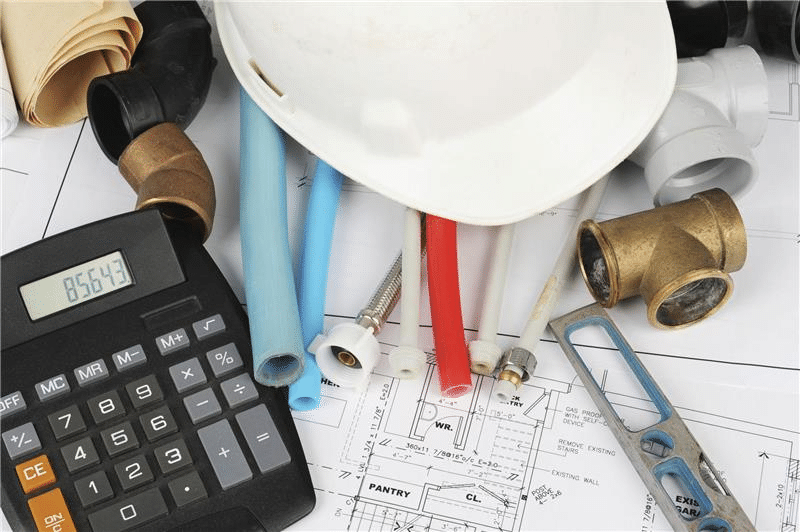
A usable plumbing estimate is itemized. Look for:
- Underground and under-slab piping (quantity, pipe type, size)
- DWV rough-in, vents, cleanouts
- Water supply rough-in (pipe type, manifold or trunk layout)
- Fixture list with model-level or allowance pricing
- Water heater type, size, venting, and expansion tank
- Exterior hose bibs, laundry box, ice maker stubs
- Gas piping (if included)
- Permit and inspection fees (who pulls and pays)
- Labor hours or labor cost by phase
- Material waste allowance
- Delivery and equipment costs
- Overhead and profit
- Warranty terms
- Clear exclusions (site utilities, tap fees, patching, fixtures supplied by others)
- Payment schedule and completion timeline
Why itemized beats lump sum. A single number gives you nothing to compare. An itemized estimate shows what is in and what is not, lets you adjust scope (swap copper for PEX, delete a fixture), and gives you a baseline if you add a bath or change the plan.
How Do You Compare Two Plumbing Bids?
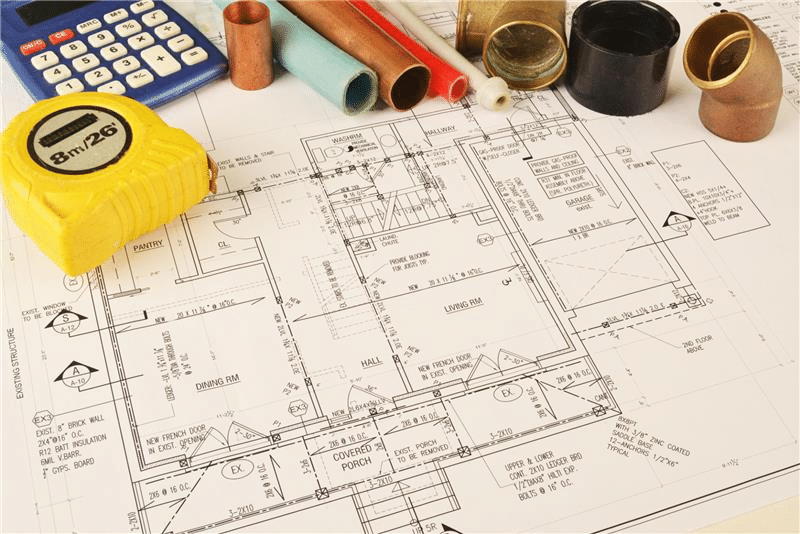
Two bids for the same house can differ by $5,000 or more and both be honest. Check these:
| Item | What to Verify |
| Scope | Rough-in only, or rough-in plus trim? Does it include the water heater? |
| Pipe material | PEX, copper, or CPVC? PVC or cast iron drains? |
| Fixtures | Allowance amounts or specific models? Who buys them? |
| Underground | Is the sewer and water lateral included? How far? |
| Permits | Included or owner-paid? Inspection re-visits? |
| Gas | Included or separate? |
| Labor assumptions | Based on your plans or an assumed layout? |
| Overhead and profit | Visible or buried? |
| Warranty | Labor warranty length and who handles callbacks |
| Schedule | Crew availability, start date, rough-in window |
| Exclusions | Anything the bid quietly leaves out |
A low bid is not automatically good or bad. It may be a leaner crew or a tighter scope, or it may be missing the water heater. A high bid might include upgrades you didn’t ask for. Ask each bidder to price the same scope and list exclusions, then compare.
When Is a Professional Plumbing Estimate Worth It?
If you are a builder, developer, or subcontractor, a detailed takeoff protects you from guessing. A professional construction estimate shows material quantities, labor requirements, equipment, scope, and cost breakdown, which supports bid preparation, flags potential cost gaps, and sets a defensible budget.
1st Estimator LLC provides construction estimating and quantity takeoff services that help contractors, builders, developers, and project owners price plumbing and other trades from plans. For example, a plumbing takeoff counts every fixture, measures pipe by type and size, and applies local labor and material pricing so you can check a sub’s bid against an independent number.
Need a detailed estimate for your upcoming project? 1st Estimator provides professional construction estimating and quantity takeoff services for residential, commercial, and industrial projects. Visit 1stestimator.com to get started.
Frequently Asked Questions
How much does it cost to plumb a 2,000 sq ft house in 2026?
Typically 9,000–20,000, with a common price around $13,300 for a 2.5-bath new build with builder-grade fixtures and a tank water heater. Site utilities and tap fees are extra.
How much does plumbing cost per square foot?
Most new-construction guides cite 4–8 per sq ft as a planning range. A complete package including fixtures and a water heater often lands closer to 6–8 per sq ft, and larger or complex houses can reach $10.
How much does rough-in plumbing cost for a 2,000 sq ft house?
About 6,000–13,000, or roughly 3.00–6.50 per sq ft, with a typical figure near $7,700. Published sources vary because they define rough-in differently, so always confirm what is included.
How much does it cost to plumb a new construction house?
For new construction, plumbing is bid by fixture count and layout. A typical 2,000 sq ft, 2.5-bath home runs around $13,300 for the full package. Add site connections, tap fees, and gas piping separately.
How much does plumbing cost per fixture?
Installed prices run roughly 450–900 for a toilet, 400–850 for a lavatory, and 900–2,200 for a tub or shower, with a water heater at 1,200–2,500.
Is PEX cheaper than copper for a new house?
Yes. For a house this size, copper typically adds about 3,000–5,500 to the supply side, because the material costs more and the labor is slower. PEX is the common choice in new residential work.