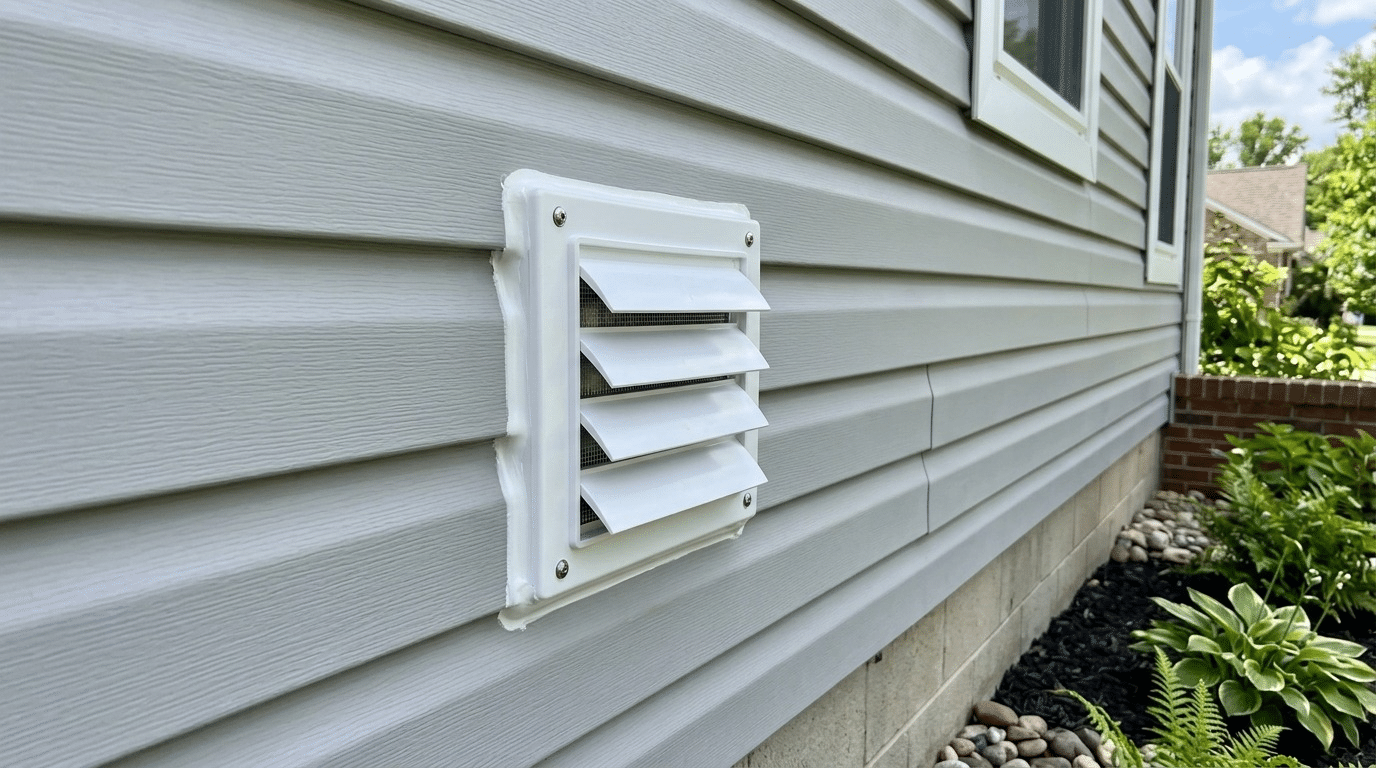
Dryer vent installation cost typically runs $200 to $600 in 2026 for a standard new vent through an exterior wall, with an average near $350 to $400. Rerouting an existing vent usually lands between $300 and $900. A roof-terminated or long attic run can reach $700 to $1,500.
Price depends mostly on run length, number of bends, wall or roof termination, duct material, access to the framing, and local labor rates. The sections below explain the cost per foot, materials, labor, hidden charges, and how to compare bids. The figures are national planning ranges, not guaranteed quotes. Local pricing can move them up or down by 20% or more.
How Much Does Dryer Vent Installation Cost in 2026?
The ranges below assume a 4-inch dryer exhaust, metal ducting, a new exterior termination with a damper, and a laundry area with reasonable access. They don’t assume structural modifications or major drywall repair.
| Project Type | Typical Specification | Installed Cost Range |
| New vent, short run | Under 6 ft, straight through exterior wall | 150–350 |
| New vent, standard run | 8–15 ft, 1–2 elbows, wall termination | 250–600 |
| Vent replacement | Swap existing duct and cap, same path | 150–450 |
| Dryer vent rerouting | New path, new termination | 300–900 |
| Through-roof installation | Attic or ceiling run, roof cap, flashing | 500–1,500 |
| Long run with booster fan | 25–35 ft, multiple bends | 600–1,500+ |
| Repair (loose joints, crushed duct, new cap) | Localized fix | 100–300 |
| Vent cleaning (not installation) | Full-run cleaning | 100–200 |
Roughly speaking, most homeowners spend $250 to $500. A first-time vent in a finished basement or interior laundry closet is the main reason the high end exists.
What Does Dryer Vent Installation Cost Per Linear Foot?
Dryer vent installation cost per foot is a rough tool, because the job has a fixed core (the wall penetration, the termination, and the trip charge) that doesn’t scale with length.
- Material only: about $1.50 to $4 per foot for rigid or semi-rigid duct, before fittings.
- Installed, typical: about $20 to $55 per linear foot, with shorter runs at the high end because the fixed costs are spread over fewer feet.
Examples:
- 10 ft × $25 = $250
- 10 ft × $55 = $550 → 250–550
- 20 ft × $22 = $440
- 20 ft × $45 = $900 → 440–900
Per-foot pricing excludes drywall repair, roof work, and booster fans. Many contractors also apply a minimum service charge of $125 to $250, so a 3-foot vent will never price at 3 × $30. Ask whether a quote is per foot or per job.
What Is the Cost Breakdown?
For a typical $400 wall-termination job:
| Cost Component | Typical Share |
| Materials (duct, elbows, cap, clamps, tape, sealant) | 15–25% |
| Labor | 45–60% |
| Tools and equipment | 0–5% |
| Access and site prep (moving the dryer, cutting openings) | 5–15% |
| Permit | 0–5% (often $0) |
| Overhead and profit | 15–25% |
Dryer vent work is labor-heavy. A 4-inch duct run uses very little material, so the price is driven by time and access. That is why two jobs with the same parts can differ by $300.
What Do Dryer Vent Materials Cost?
| Material | Unit | Typical Price (2026) | Notes |
| Rigid galvanized duct, 4″ | 4 ft section | 6–14 | Best airflow, code-preferred |
| Rigid aluminum duct, 4″ | 4 ft section | 8–16 | Lighter, easier cutting |
| Semi-rigid aluminum duct | 8 ft length | 8–18 | Flexible but still metal |
| Foil/plastic flex hose | 8 ft length | 5–12 | Not recommended for concealed runs |
| 90° elbow | each | 5–12 | Adds equivalent length |
| 45° elbow | each | 4–9 | Less airflow restriction |
| Wall vent cap with damper | each | 8–30 | Louvered or hooded |
| Roof vent cap | each | 20–60 | Plus flashing |
| Roof flashing/boot | each | 25–70 | Depends on roof type |
| Clamps | each | 2–5 | Not screws |
| Foil tape and sealant | roll/tube | 8–12 each | Metal-rated tape only |
| Recessed dryer vent box | each | 15–45 | Keeps dryer closer to wall |
| Booster fan kit | each | 100–250 | For long runs |
Rigid metal dryer vent costs a bit more than semi-rigid but produces less lint buildup because the inside is smooth. Semi-rigid dryer vent is a middle option for tight turns. Plastic or vinyl duct is a poor choice and is prohibited under the IRC.
Material example (15-ft run):
- 4 rigid sections at $9 = $36
- 2 elbows at $8 = $16
- Wall cap = $15
- 6 clamps at $3 = $18
- Tape = $10
- Sealant = $8
Total: $103. A contractor typically marks up materials 15–30%.
What Does Dryer Vent Labor Cost?
Three numbers are often confused:
- Worker wage: what the technician is paid, often 20–40 per hour depending on market and skill. The Bureau of Labor Statistics publishes occupational wage data by state if you want local figures.
- Payroll burden: taxes, insurance, workers’ comp, and benefits, typically adding 25–40% on top of wages.
- Contractor billing rate: what you’re charged, including burden, vehicle, insurance, overhead, and profit. Handymen often bill 50–100 per hour. HVAC technicians usually bill 85–150 per hour.
Typical labor hours:
| Task | Approximate Hours |
| Replace duct and cap, same path | 1–1.5 |
| New wall vent, easy access | 1.5–3 |
| New vent through joists or basement | 3–5 |
| Rerouting with new termination | 3–6 |
| Roof or attic termination | 4–8 |
Labor example: 2.5 hours × $90 = $225.
Add the $103 in materials (about $124 with markup) and the total is roughly $350, which matches the national average.
What increases labor: finished ceilings, tight crawl spaces, brick or stucco walls, second-story installs, and a dryer wedged into a closet.
Does Site Preparation Matter for Dryer Vent Installation?
Yes, and it’s the most commonly underestimated part. “Site prep” here means getting to the path:
- Moving a dryer and, in some homes, a washer
- Cutting through drywall, plaster, or paneling to reach joists
- Drilling through brick, stone, or stucco, which can add $50 to $200 for masonry bits and time
- Working in a crawl space or attic
- Removing an old, lint-packed duct
- Ladders or lifts for a second-story termination
A basement laundry with an exposed rim joist can be a one-hour job. The same dryer on the second floor of an interior bath-adjacent closet can take half a day.
What Does Dryer Vent Installation Cost by Run Length?
| Scenario | Typical Use | Estimated Cost |
| Short run | Laundry on an exterior wall, 3–6 ft | 150–350 |
| Standard run | Laundry room, 10 ft, 1–2 bends | 250–550 |
| Long run | Interior laundry, 20 ft, 2–3 bends | 450–900 |
| Extra long / roof | 30–35 ft, attic or roof termination | 700–1,500 |
Pricing doesn’t scale linearly. Short jobs carry the minimum charge. Long jobs add bends, hangers, and penetrations. A roof termination adds flashing and sealing, and some roofers charge a separate trip.
How Do Duct Type and Code Requirements Affect Cost?
| Specification | Effect on Cost |
| Rigid metal vs. semi-rigid | Rigid adds 10–40 in parts and some labor, but gives the best airflow |
| Wall vs. roof termination | Roof adds 150–600 |
| Number of bends | Each elbow adds parts and reduces allowable length |
| Insulated duct (cold attics) | Adds 30–100 and prevents condensation |
| Booster fan | Adds 100–250 for the unit plus wiring |
| Concealed vs. exposed duct | Concealed runs need rigid metal and more labor |
Code basics (always confirm with your local jurisdiction): The International Residential Code (Section M1502) requires dryers to exhaust outdoors through a metal duct with a smooth interior, a nominal 4-inch diameter, and a backdraft damper. The maximum developed length is generally 35 feet, reduced for each elbow (commonly 5 ft per 90° bend and 2.5 ft per 45° bend, unless the dryer manufacturer allows more). Screws that protrude into the duct are not allowed, because they catch lint. Always check the dryer manufacturer’s installation manual, since it can be stricter.
Dryer exhaust that is too long or too restricted slows drying and increases lint buildup. The U.S. Fire Administration and the Consumer Product Safety Commission both publish dryer fire safety guidance.
What Types of Dryer Vent Work Are There and What Do They Cost?
| Type | Typical Use | Cost Range | Main Cost Driver |
| New vent installation | Laundry with no existing vent | 250–900 | Run length, access |
| Replacement | Existing path, worn or wrong duct | 150–450 | Duct type |
| Rerouting | Moving dryer or fixing a bad path | 300–900 | New penetration, drywall |
| Through-roof | Interior laundry, no wall access | 500–1,500 | Roof work, flashing |
| Repair | Crushed duct, loose connection, bad cap | 100–300 | Access |
| Cleaning | Maintenance only | 100–200 | Length, access |
Cleaning is a different service from installation, but people often compare them. Cleaning is routine maintenance. Replacement is for damaged or code-noncompliant ducts.
How Much Does Dryer Vent Installation Cost in Different U.S. Regions?
I don’t have defensible dollar figures by state, so the table shows relative pricing and the drivers behind it.
| Region | Relative Price Level | Why |
| Northeast / New York | Higher | Labor rates, older homes, insulated ducts |
| California / Pacific Northwest | Higher | Labor, permitting, cost of living |
| Mountain West | Moderate to higher | Cold-climate insulation, rural travel |
| Midwest | Moderate to lower | Lower labor costs, basements simplify routing |
| Southeast / Florida | Moderate | Slab homes mean attic or roof routing |
| Texas / Southwest | Moderate | Slab construction, high-volume HVAC labor |
Homes on slabs have fewer basement options, so they more often need attic or roof terminations. Cold climates need insulated ducts to prevent condensation. Local building departments also differ on whether they inspect dryer vent work.
What Are the Hidden Costs of Dryer Vent Installation?
- Drywall and paint repair: 75–300 for patching and finishing.
- Service charge or trip fee: 50–150 where not folded into the quote.
- Disposal of old ducting: 0–50.
- Masonry penetration: 50–200 for brick, stone, or stucco.
- Roof flashing and sealing: 75–300 beyond the cap itself.
- Electrical for a booster fan: 100–300 if no outlet is nearby.
- Dryer cleaning or lint removal: 100–200 if the old vent is clogged.
- Permit: commonly $0, but some jurisdictions charge 50–150.
- Weekend or emergency rates: often 1.5× the normal rate.
What Should a Professional Dryer Vent Estimate Include?
An itemized quote should list:
- Run length and number of bends
- Duct type and diameter
- Termination type (wall or roof) and cap
- Quantities and unit prices for materials
- Labor hours and hourly rate
- Access work, cutting, and repair
- Permit and disposal
- Overhead and profit
- Warranty terms
- Exclusions (paint, masonry, electrical)
Itemization lets you see whether the quote includes rigid duct or the cheaper flex, and whether drywall repair is in or out. A lump-sum number hides all of that.
How Do You Compare Two Dryer Vent Bids?
| Item to Check | Why It Matters |
| Scope | Does it include new termination or just a hose swap? |
| Duct material | Rigid metal vs. foil flex |
| Run length and bends | Confirms the quote matches your layout |
| Drywall repair | Often excluded |
| Roof or masonry work | Can add hundreds |
| Warranty | 1 year on labor is common |
| License and insurance | Required for roof or HVAC work |
A low bid isn’t automatically good or bad. It may mean a shorter run, lighter duct, or exclusions. A high bid may include repair and finish work. Ask each contractor to confirm the duct type, termination, repair, and warranty in writing.
When Is a Professional Estimate Useful?
For a single laundry room, an hour of a technician’s time and a written quote is usually enough. For a multifamily building, a remodel with several laundry rooms, or a builder pricing dozens of units, you need quantities, labor, and equipment broken out before you bid.
A professional estimator can help contractors, builders, and developers with material takeoffs, labor requirements, scope, and budget gaps. Need a detailed estimate for your upcoming project? 1st Estimator provides professional construction estimating and quantity takeoff services for residential, commercial, and industrial projects.
DIY vs. Professional Dryer Vent Installation
DIY materials for a short wall-termination vent typically cost $60 to $150, with tools you may already own. DIY makes sense if the path is short, accessible, and goes through a wood-framed wall. It makes less sense for roof work, masonry, attic crawling, or anything involving structural framing. Professionals typically save time and make sure the length, bends, and termination meet code. Mistakes cause lint buildup, moisture, and fire risk.
Frequently Asked Questions
How much does dryer vent installation cost in 2026?
Most homeowners pay $250 to $600 for a standard new vent through an exterior wall. Complex roof or long-run installations can reach $1,500.
How much does it cost to install a dryer vent per foot?
About $20 to $55 per linear foot installed, with a minimum service charge on short jobs.
How much does dryer vent replacement cost?
Usually $150 to $450 if the path stays the same and access is easy.
How much does it cost to reroute a dryer vent?
Typically $300 to $900, depending on new wall or roof penetrations and drywall repair.
Is rigid or semi-rigid duct better?
Rigid metal gives the smoothest airflow and is preferred for concealed runs. Semi-rigid aluminum works for tight turns. Avoid plastic or thin foil flex in walls.
How long can a dryer vent be?
The IRC generally sets a 35-foot maximum developed length, reduced for bends. Check your dryer manual and local code.
Can I install a dryer vent myself?
Yes, if the run is short and accessible. Roof, masonry, and long attic runs are better left to a professional.
What makes dryer vent installation more expensive?
Long runs, multiple bends, roof terminations, masonry walls, difficult access, and finish repair.
Do I need a permit?
Often no, but it depends on your jurisdiction. Call your local building department.
How accurate are online dryer vent cost estimates?
They’re good for a ballpark but can’t account for your layout. A written on-site quote is more reliable.