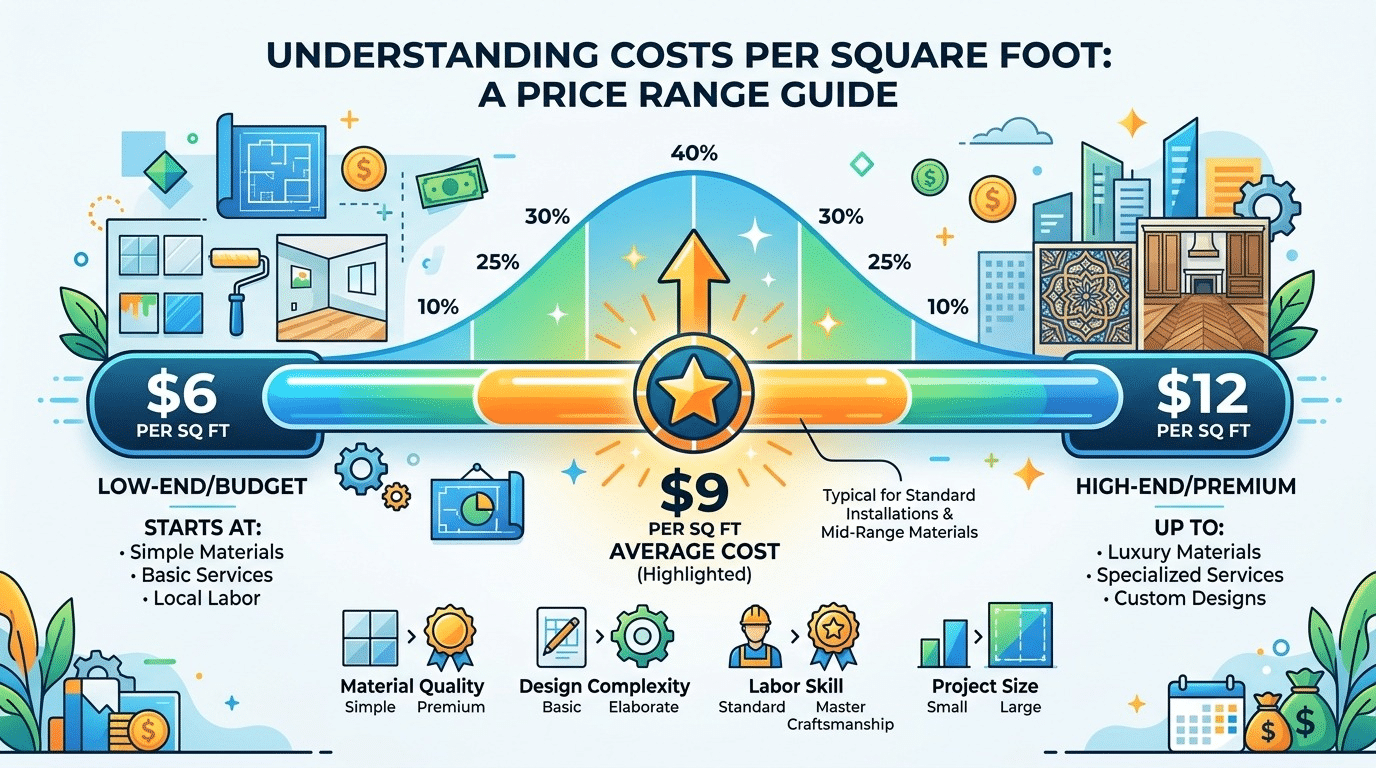
A concrete slab costs about $6 to $12 per square foot installed in 2026 for a standard 4-inch residential slab, with a typical average near $9 per square foot. A 1,000-square-foot slab therefore usually lands between $7,000 and $12,000. Decorative, heavily reinforced, post-tensioned, or industrial slabs can run $12 to $20+ per square foot.
The final concrete slab cost depends on size, thickness, reinforcement, site preparation, finish, and local labor and material prices. Small pads cost more per square foot than large pours, and poor soil can add thousands before any concrete arrives.
This guide covers the cost per square foot, material and labor breakdowns, site prep, size examples, regional differences, hidden costs, and how to compare bids.
All figures are national planning ranges for 2026, not contractor quotes. Confirm ready-mix, steel, and labor prices locally before committing to a budget.
What Does the Typical Concrete Slab Price Assume?
Most $6 to $12 per square foot figures assume:
- A 4-inch slab-on-grade with a 3,000 to 4,000 PSI mix
- Compacted gravel base and basic grading on a reasonably level site
- Wood forms, a vapor barrier where needed, and light reinforcement (mesh or fiber)
- A broom or trowel finish
- Ready-mix delivered by truck with normal access
- Contractor overhead and profit included
Change any of these and the price moves. Here is how the national ranges break down by project type:
| Project Type | Typical Specification | Installed Cost Range |
| Basic patio or walkway | 4″, mesh, broom finish | 6–12/sq ft |
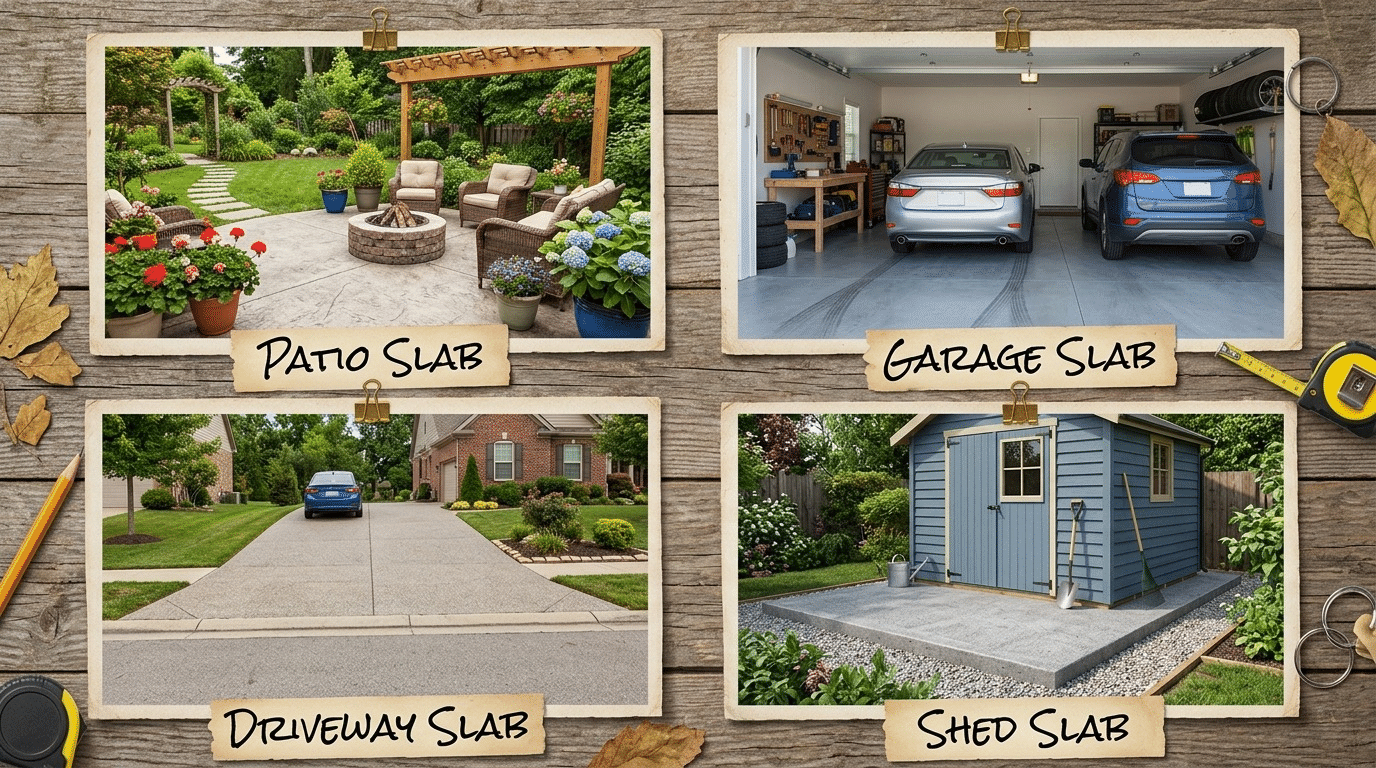
| Shed pad | 4″, gravel base, small area | 6–14/sq ft |
| Garage slab | 4″–6″, mesh or rebar | 7–13/sq ft |
| Driveway | 4″–6″, reinforced, control joints | 7–14/sq ft |
| Slab-on-grade house foundation | 4″ slab, thickened edges, vapor barrier | 7–14/sq ft |
| Stamped/decorative slab | Color, pattern, sealer | 12–22/sq ft |
| Post-tensioned slab | Engineered cable system | 8–16/sq ft |
| Commercial slab | 5″–6″, rebar, sawcuts | 8–16/sq ft |
| Industrial slab | 6″–8″+, heavy rebar, dowels, hardener | 9–20+/sq ft |
Treat these as planning ranges. A tight urban site with pumped concrete can exceed them, and a large open pour in a low-cost market can come in under.
What Does a Concrete Slab Cost Per Square Foot?
| Level | Cost per sq ft | What It Usually Means |
| Low-end | 4–6 | Large, simple pour; level site; minimal prep; light reinforcement |
| Typical | 6–12 | Standard residential slab with base, forms, and finish |
| High-end | 12–20+ | Decorative finish, heavy reinforcement, poor soil, tight access, or engineered design |
Contractors quote differently for reasons that have nothing to do with honesty:
- Included: Some prices bundle grading, base, forms, vapor barrier, and reinforcement. Others cover only “place and finish.”
- Excluded: Excavation, haul-off, permits, engineering, pump trucks, and sawcuts are often separate line items.
- Minimums: Small jobs carry fixed costs (mobilization, short-load fees, crew minimums) that get spread over fewer square feet.
When you see a price per square foot, ask what is inside it.
What Is the Concrete Slab Cost Breakdown?
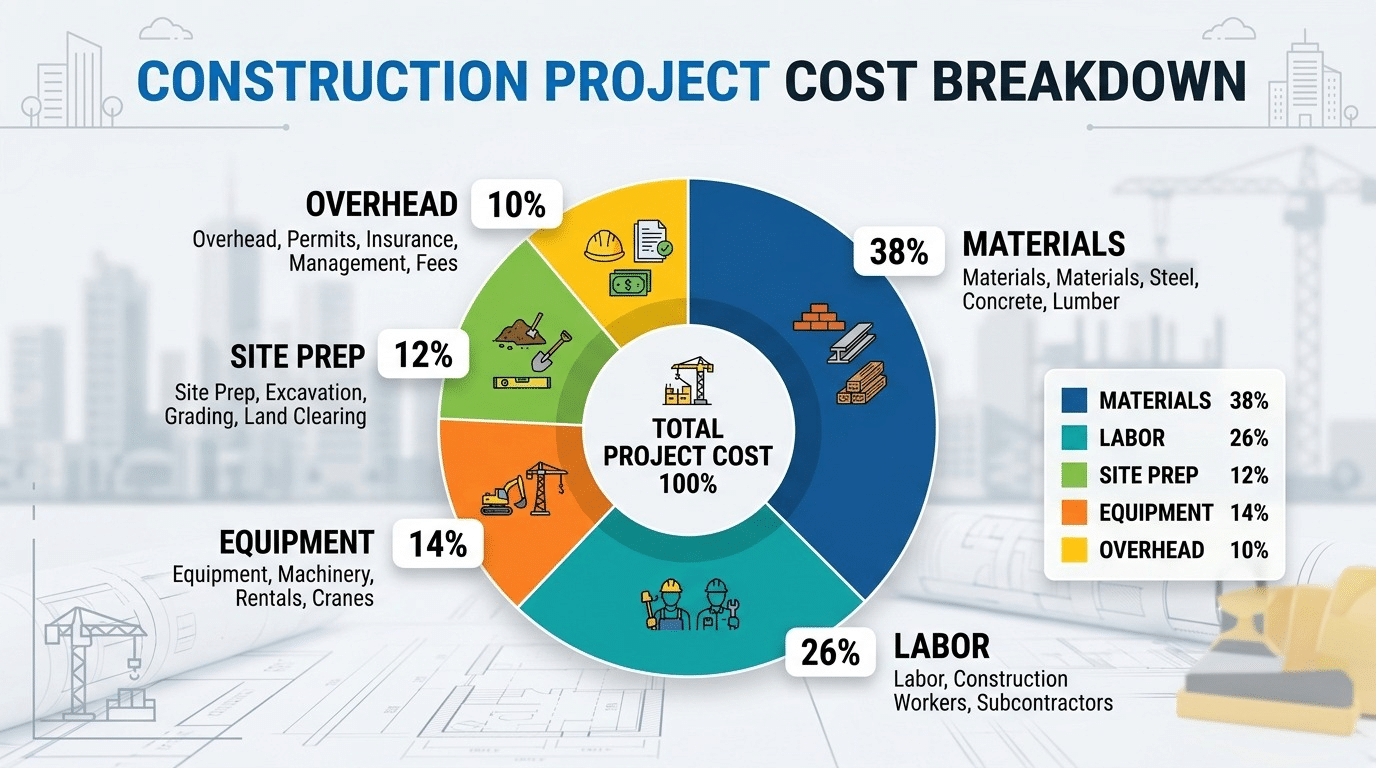
For a typical residential slab, costs split roughly like this:
| Cost Component | Typical Share |
| Materials (concrete, reinforcement, base, vapor barrier) | 30–35% |
| Labor (forming, placing, finishing) | 28–35% |
| Site preparation (grading, base, minor excavation) | 10–15% |
| Equipment (pump, compactor, saw, screed) | 4–8% |
| Permits, inspections, testing | 2–4% |
| Overhead and profit | 12–18% |
These shares shift by project. Material share rises on thicker slabs. Labor share rises on decorative work. Site prep share can climb above 25% on sloped or poorly draining lots.
A Bottom-Up Example: 1,000 Sq Ft, 4-Inch Slab
Here is what a bottom-up estimate looks like for a 1,000 sq ft slab with base, forms, vapor barrier, and reinforcement:
| Line Item | Low | High |
| Grading and compacted gravel base | $1,000 | $2,000 |
| Forms | $400 | $900 |
| Vapor barrier | $100 | $300 |
| Concrete (about 13.3 cu yd) | $2,260 | $2,660 |
| Reinforcement (mesh or rebar) | $500 | $1,500 |
| Placing and finishing labor | $1,800 | $3,200 |
| Pump/equipment | $0 | $700 |
| Permit/inspection | $100 | $400 |
| Direct cost subtotal | $6,160 | $11,660 |
| Overhead and profit (15%–20%) | $924 | $2,332 |
| Total | $7,084 | $13,992 |
The low column assumes an easy site and light reinforcement. The high column stacks every complication. A mid-case slab with base, forms, vapor barrier, and reinforcement lands around $10,000 to $10,500, which is why well-prepped slabs sit in the upper half of the typical range.
What Do Concrete Slab Materials Cost?
Concrete
Ready-mix is the biggest single material line. In 2026, expect roughly $165 to $210 per cubic yard delivered for a standard 3,000 to 4,000 PSI mix, though local plants vary and some markets run higher.
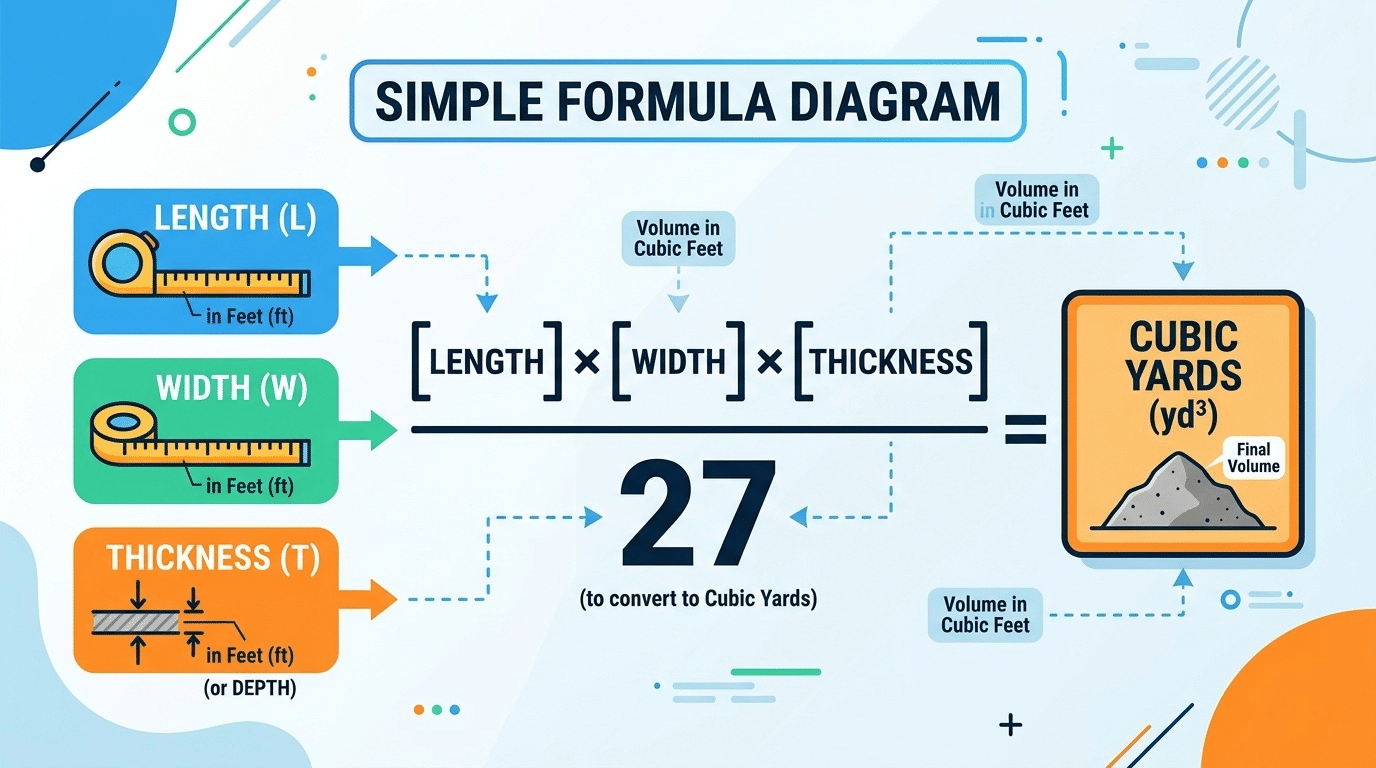
Quantity math is straightforward:
Cubic yards = (length × width × thickness in feet) ÷ 27
For a 4-inch slab, one cubic yard covers about 81 square feet.
Example: 30 ft × 40 ft slab, 4 inches thick.
- 1,200 sq ft × (4 ÷ 12) = 400 cubic feet
- 400 ÷ 27 = 14.8 cubic yards
- Add 8% for waste, uneven subgrade, and spillage = about 16.0 cubic yards
- At 170–200 per yard: 16.0 × $170 = $2,720 to 16.0 × $200 = $3,200
Estimators typically add 5% to 10% waste. Slabs on rough subgrade or with thickened edges need more.
Reinforcement
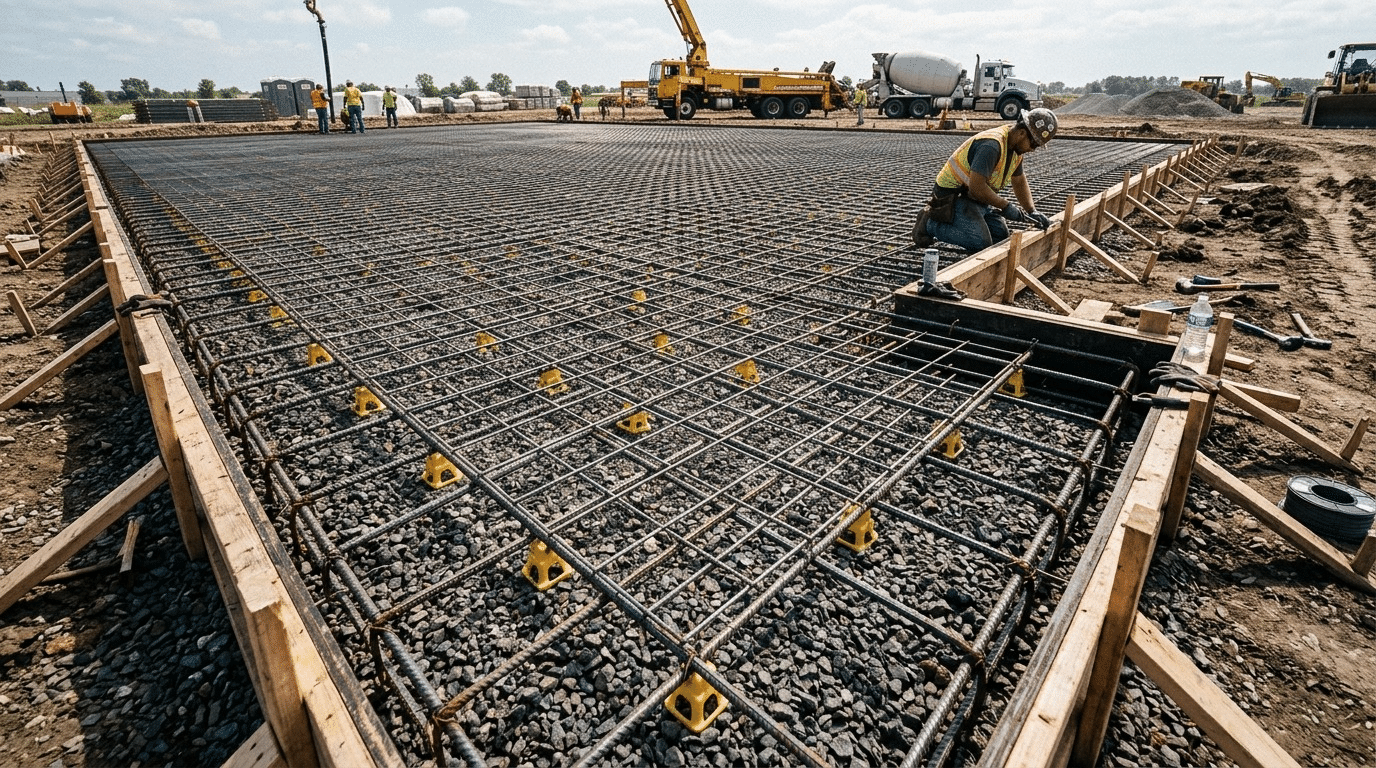
| Material | Typical Installed Cost | Notes |
| Fiber mesh (added to mix) | 0.10–0.30/sq ft | Controls shrinkage cracking; not a structural substitute for steel |
| Welded wire mesh | 0.40–0.90/sq ft | Common for patios and light-duty slabs |
| Rebar grid (#3 at 18″ or #4 at 24″) | 0.75–2.00/sq ft | Common for garages, driveways, foundations |
| Post-tension cables | Priced within a PT system | Requires engineering and stressing |
To show why rebar prices vary: a #4 bar weighs 0.668 lb per foot. On a 24-inch grid you place about 1 linear foot per square foot, or roughly 0.67 lb/sq ft. At about $1 per pound for steel, that is around $0.67/sq ft in material alone, before ties, chairs, and labor. Tighter spacing or larger bars raise the cost quickly.
Base, Vapor Barrier, and Forms
- Gravel base: 4 inches of compacted crushed stone is common. On 1,000 sq ft that is about 12.3 cubic yards, or roughly 17 to 20 tons. Installed, base runs about $0.75 to $1.75 per sq ft depending on stone price and haul distance.
- Vapor barrier: Polyethylene sheeting runs about $0.10 to $0.30 per sq ft installed. The International Residential Code generally calls for a vapor retarder under slabs in conditioned space, and 10-mil is common in practice.
- Forms: Typically $1.50 to $4 per linear foot for setting and stripping wood forms, more for curves.
How Much Does Concrete Slab Labor Cost?
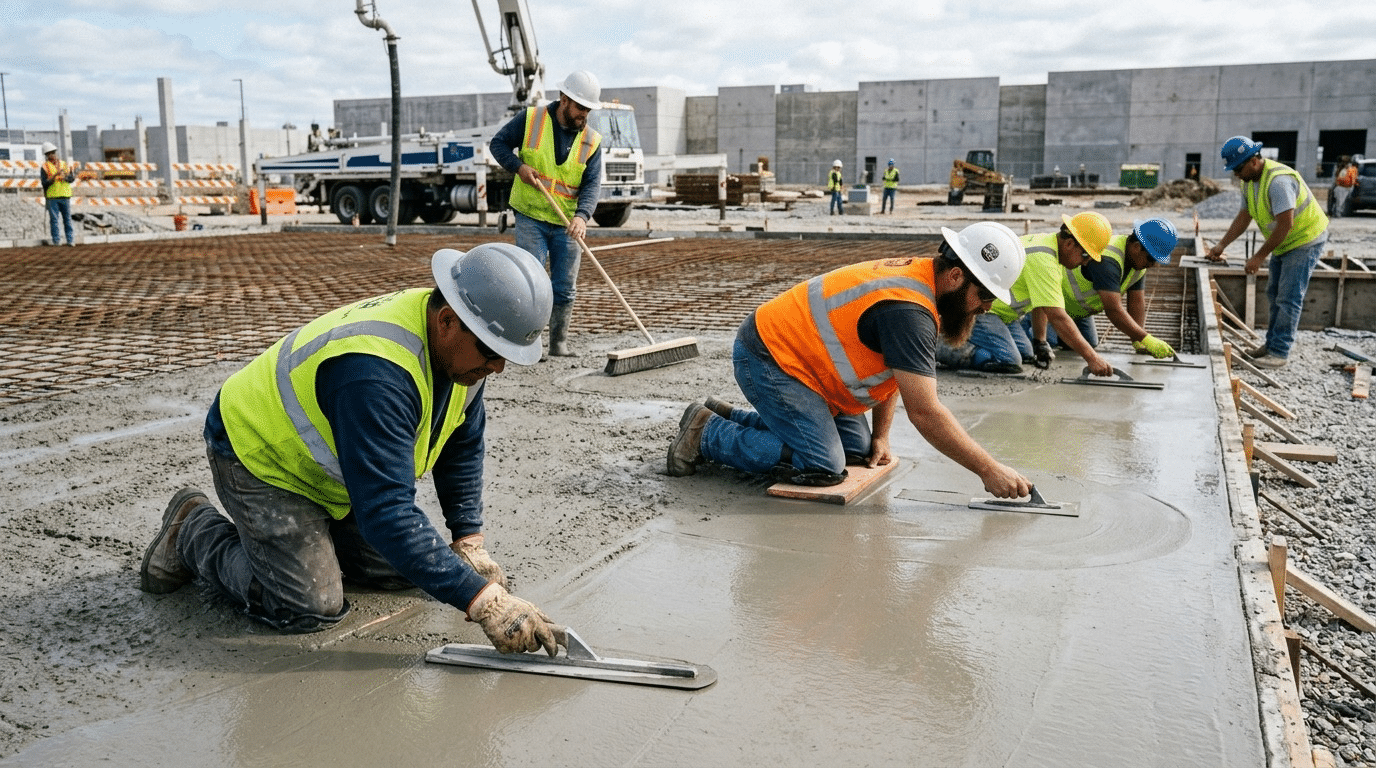
Labor is where estimates get misread, so it helps to separate three numbers:
- Worker wage. The U.S. Bureau of Labor Statistics reports median hourly pay for cement masons and concrete finishers in the mid-to-high $20s, with higher pay in some metro areas and union markets.
- Payroll burden. Workers’ comp, payroll taxes, insurance, and benefits typically add 25% to 40% on top of wages.
- Contractor billing rate. After burden, supervision, tools, truck costs, overhead, and profit, contractors commonly bill roughly $55 to $95 per labor hour, sometimes more in high-cost metros.
A typical crew for a residential pour is 3 to 5 people. Setting forms, prepping, placing, screeding, finishing, and cutting joints on a 1,000 sq ft slab often takes roughly 40 to 70 labor hours total. That puts labor at about $2.00 to $4.50 per sq ft on straightforward work.
Labor rises when:
- Access is poor (wheelbarrows or a pump instead of a chute)
- The finish is decorative (stamping, coloring, exposed aggregate)
- Weather forces schedule changes or overtime
- The slab needs tight flatness tolerances
- The crew must work in small, separated pours
Skilled finishers cost more than general laborers. A slab that looks fine on day one but cracks or ponders water usually traces back to finishing and joint decisions made by a thin crew.
How Much Does Site Preparation Add to Concrete Slab Cost?
Two slabs with identical dimensions can differ by thousands of dollars purely because of what is under them.
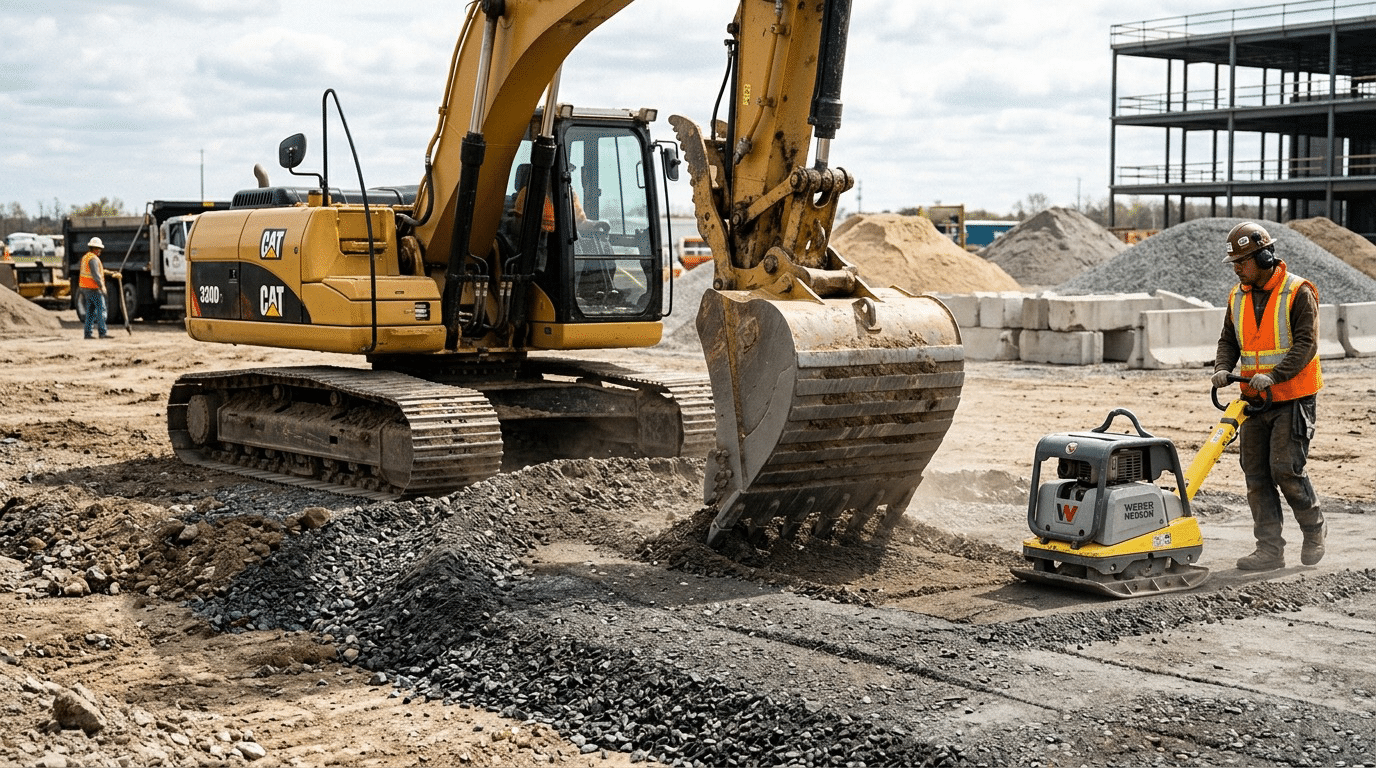
| Site Prep Item | Typical Planning Range |
| Light clearing and grading | 0.50–3.00/sq ft |
| Excavation and off-site haul | Often 20–60/cu yd, plus trucking |
| Compacted gravel base | 0.75–1.75/sq ft |
| Demolition of existing concrete | Varies widely; often 2–8/sq ft plus disposal |
| Drainage (swales, drains, stone) | Highly project-specific |
Key factors:
- Soil conditions. Expansive clay, fill, organic soils, and high water tables often require over-excavation, geotextile, engineered fill, or a thicker base.
- Slope. Cut-and-fill work adds equipment time and hauling.
- Access. No room for a truck means pumping or hand-carrying concrete.
- Existing structures. Old slabs, roots, utilities, and buried debris all add cost.
- Equipment. Plate compactors, skid steers, and excavators are typically rented by the day, with small equipment often in the low hundreds per day.
If your lot needs a geotechnical report or engineered fill, request it before pricing the slab, not after.
What Does a Concrete Slab Cost by Size?
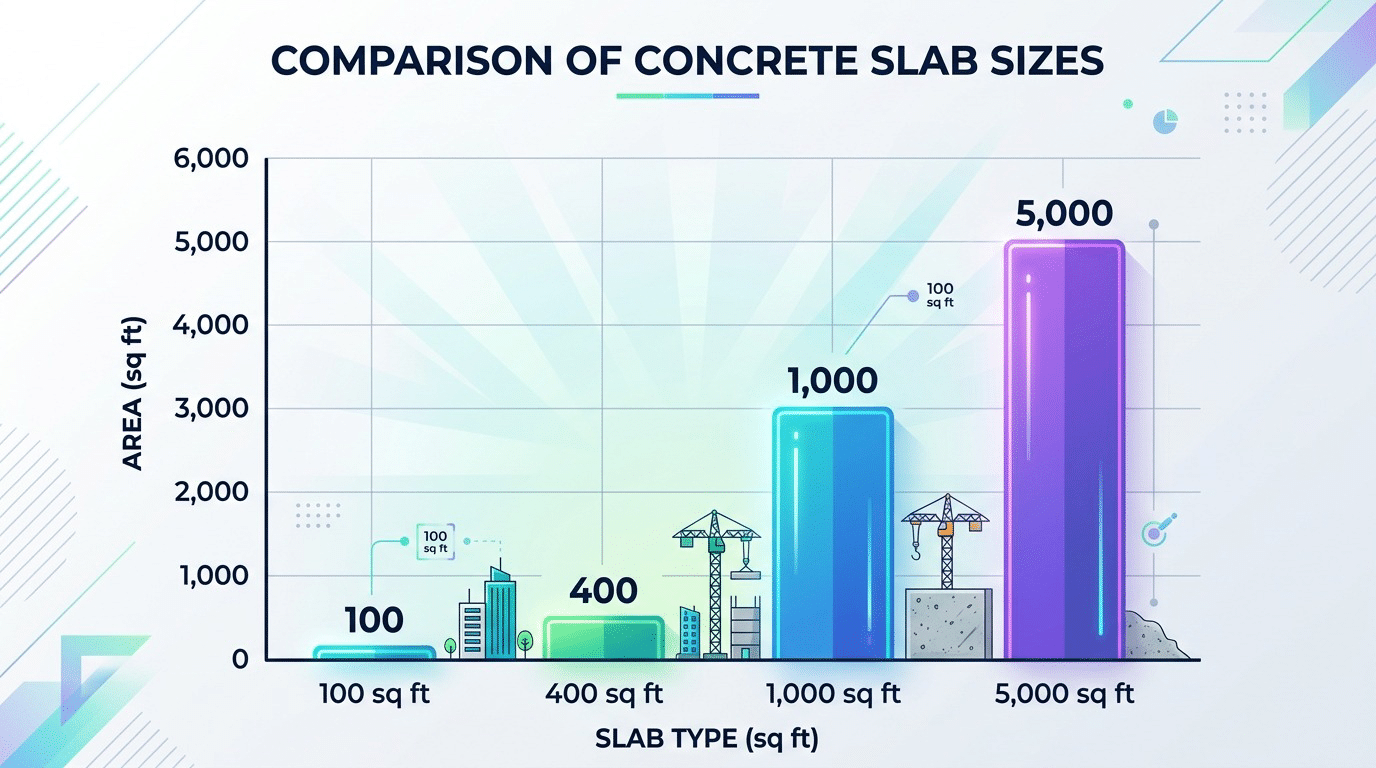
Larger slabs cost less per square foot because mobilization, pump setup, and minimum delivery charges are spread over more area. Small pours get hit by short-load fees and crew minimums.
| Size | Typical Use | Estimated Cost | Approx. $/sq ft |
| 100 sq ft (10×10) | Small pad, AC unit | 1,000–1,800 | 10–18 |
| 200 sq ft (10×20) | Shed, small patio | 1,600–2,800 | 8–14 |
| 400 sq ft (20×20) | Patio, small workshop | 3,000–5,000 | 7.50–12.50 |
| 600 sq ft (20×30) | Two-car garage or driveway | 4,200–7,200 | 7–12 |
| 1,000 sq ft | Addition, large garage | 7,000–12,000 | 7–12 |
| 2,000 sq ft | House slab foundation | 13,000–24,000 | 6.50–12 |
| 5,000 sq ft | Small commercial building | 30,000–60,000 | 6–12 |
| 10,000 sq ft | Warehouse floor | 55,000–110,000 | 5.50–11 |
These assume 4-inch slabs with base and basic reinforcement, except larger commercial and warehouse slabs, which often use thicker sections and heavier steel and will trend to the top of their range.
More Worked Examples
Two-car garage, 24 × 24 ft (576 sq ft) at 8–13/sq ft
- 576 × $8 = $4,608
- 576 × $13 = $7,488
- Range: 4,608–7,488
Backyard patio, 12 × 20 ft (240 sq ft) at 7–12/sq ft
- 240 × $7 = $1,680
- 240 × $12 = $2,880
- Range: 1,680–2,880
Driveway, 12 × 40 ft (480 sq ft), 5-inch reinforced at 8–14/sq ft
- 480 × $8 = $3,840
- 480 × $14 = $6,720
- Range: 3,840–6,720
How Do Thickness, PSI, and Reinforcement Affect Concrete Slab Cost?
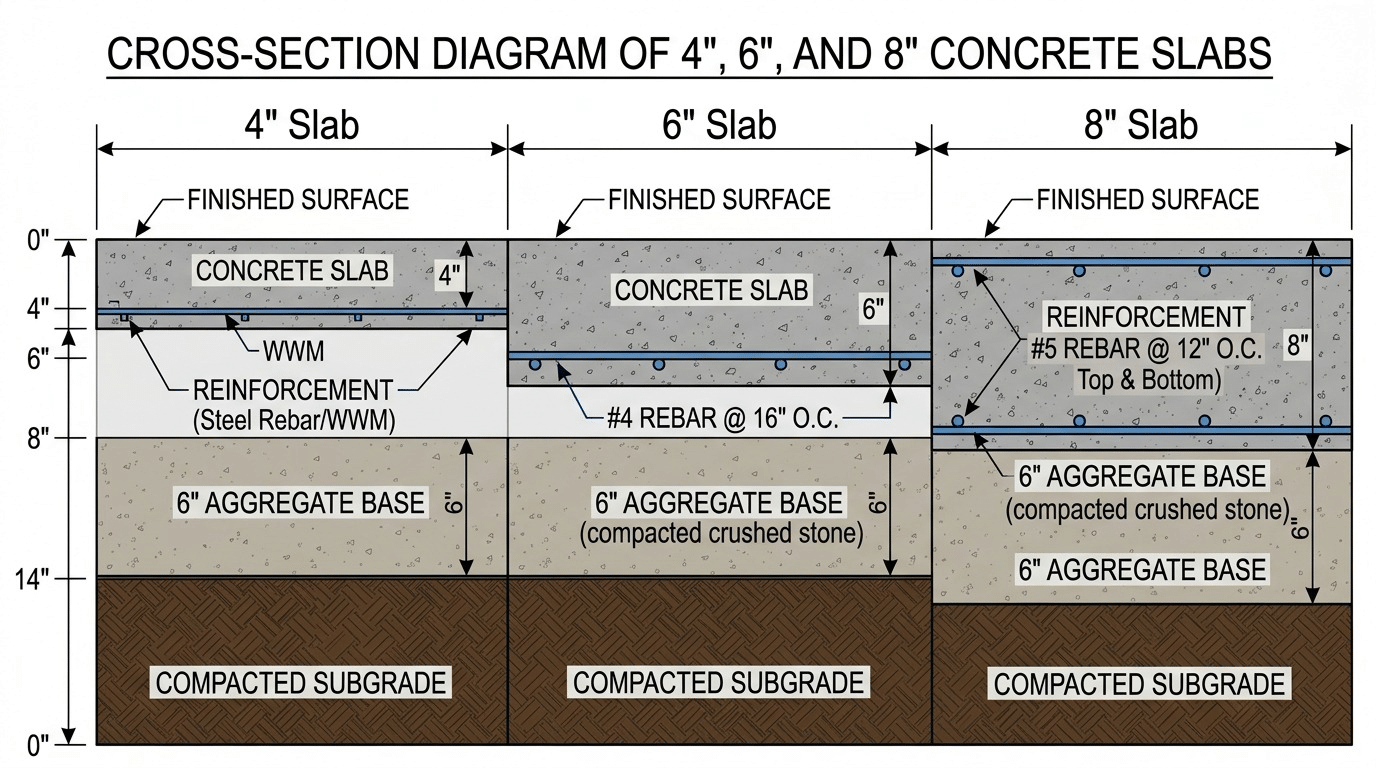
Thickness
Each extra inch of thickness costs roughly $0.55 to $0.70 per sq ft in concrete alone at typical ready-mix prices. Here is the math: one inch over one square foot is 0.0031 cubic yards, and at $185 per yard that is about $0.57, plus waste.
| Thickness | Typical Use | Added Cost vs. 4″ (Installed) |
| 4″ | Patios, walkways, light residential | Baseline |
| 5″ | Driveways, garages | +0.60–1.00/sq ft |
| 6″ | Heavy vehicles, commercial | +1.20–2.00/sq ft |
| 8″+ | Industrial, heavy loads | +2.40–3.50+/sq ft |
The International Residential Code sets a minimum slab-on-ground thickness of 3.5 inches, but most builders use 4 inches or more.
PSI (Compressive Strength)
PSI affects cost less than people expect on a slab. A higher-strength mix might add $5 to $15 per cubic yard for 3,500 to 4,000 PSI over a 3,000 PSI baseline, and $15 to $35 per yard for 4,500 to 5,000 PSI. On a 4-inch slab that works out to only about $0.06 to $0.40 per sq ft. Strength requirements come from the engineer or local conditions (freeze-thaw exposure, traffic loads).
Reinforcement
| Option | Best For | Cost Impact |
| Fiber only | Light-duty slabs | Lowest |
| Wire mesh | Patios, sidewalks, small pads | Low |
| Rebar | Garages, drives, foundations | Moderate |
| Post-tension | Expansive soils, large residential/commercial | Highest, but can reduce thickness or joints |
Reinforcement controls crack width; it does not prevent cracking. Good subgrade preparation and jointing matter as much as the steel.
Finish
A broom finish is the baseline. Troweled finishes cost more labor. Stamped concrete typically runs $12 to $22 per sq ft because of integral color, release agents, stamps, extra labor, and sealer, and it is sensitive to weather timing.
What Are the Different Types of Concrete Slabs and Their Costs?
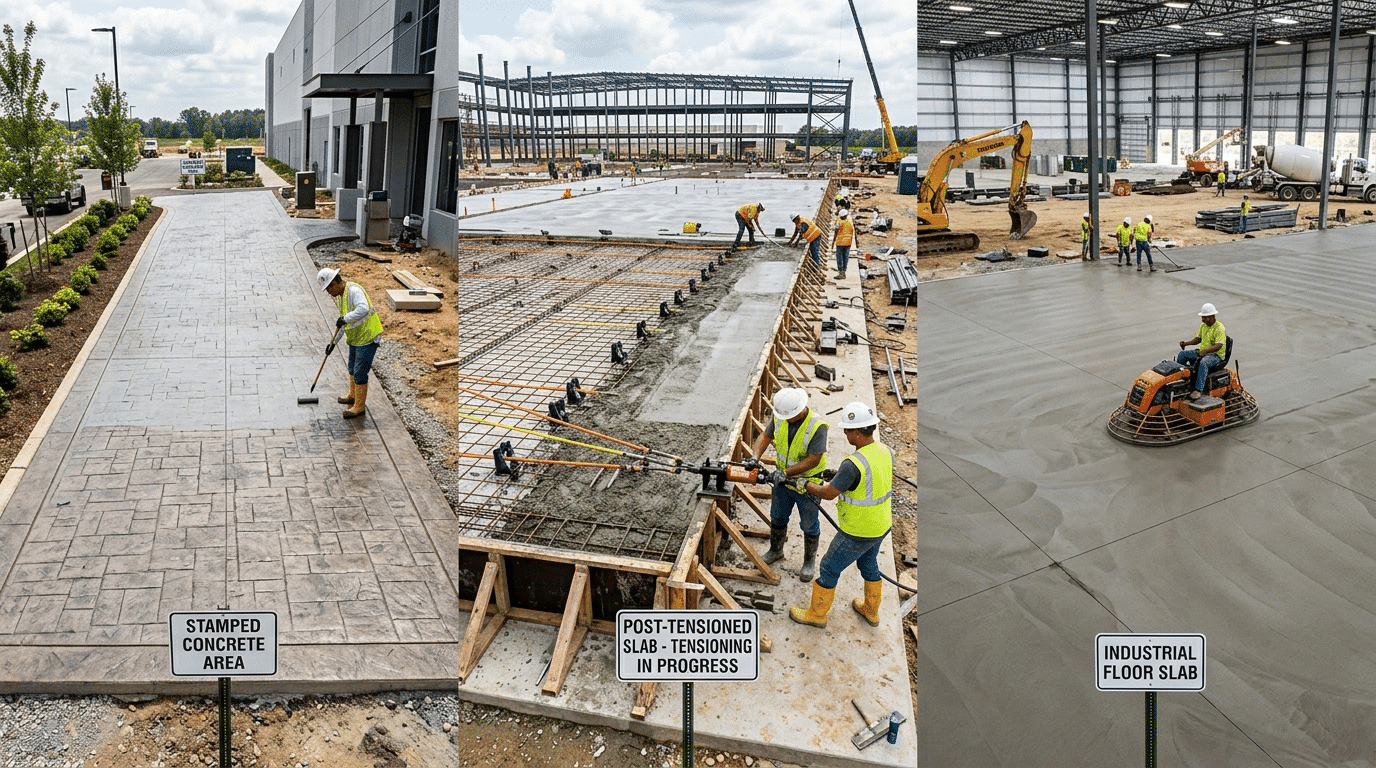
| Type | Typical Use | Cost Range | Main Cost Driver |
| Standard slab-on-grade | Patios, garages, sheds | 6–12/sq ft | Base, thickness, finish |
| Slab foundation (monolithic) | House foundations | 7–14/sq ft | Thickened edges, vapor barrier, inspection |
| Post-tensioned | Expansive soil regions, large slabs | 8–16/sq ft | Engineering, cables, stressing labor |
| Stamped/decorative | Patios, pool decks | 12–22/sq ft | Pattern work, color, sealer |
| Commercial | Retail, offices | 8–16/sq ft | Rebar, sawcuts, thickness |
| Industrial | Warehouses, plants | 9–20+/sq ft | Loads, flatness, dowels, hardeners |
Post-tensioned slabs are common where expansive clay is an issue, such as parts of Texas. Whether PT saves or costs money compared to conventional reinforcement depends on the engineer’s design and local labor familiarity.
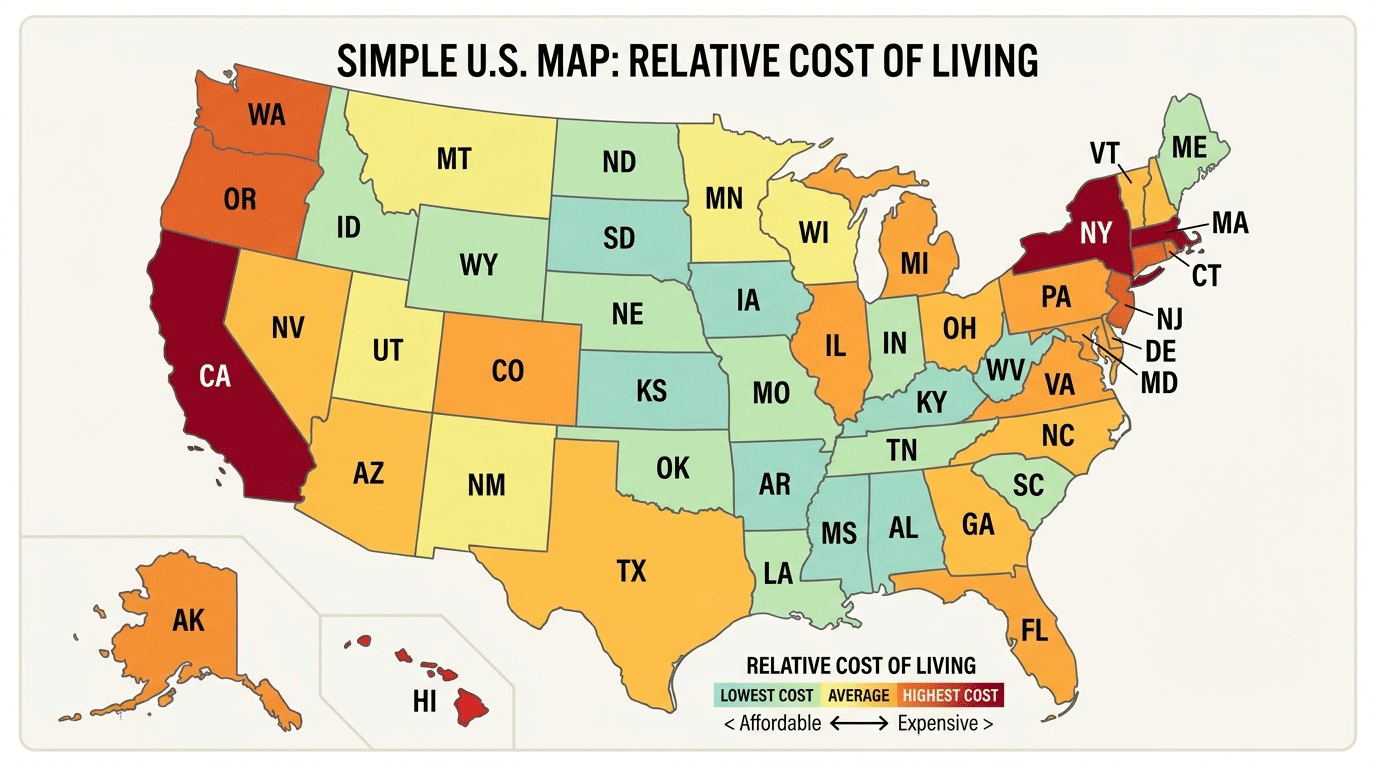
How Much Does a Concrete Slab Cost in Different U.S. Regions?
Reliable state-by-state slab pricing is hard to pin down because ready-mix, labor, and permit costs vary by county. Rather than invent numbers, here is how regions tend to compare and why. For local adjustment, RSMeans city cost indexes are a widely used reference.
| Region | Relative Cost Tendency | Why |
| Northeast / New York | Higher | Labor rates, tight sites, permit and union factors |
| California | Higher | Labor, regulation, material and hauling costs |
| Pacific Northwest | Moderate to higher | Labor demand, wet-weather scheduling |
| Mountain West | Moderate, varies by metro | Hauling distances, altitude and temperature considerations |
| Midwest | Often lower to moderate | Lower labor costs; cold-weather pours add protection costs |
| Southeast | Often lower to moderate | Lower labor; humidity and storm scheduling |
| Texas | Moderate; varies widely | Large market, expansive clay drives PT and engineering |
| Florida | Moderate | Sandy soils, high water table, wind and flood design |
Climate also matters. Cold-weather concreting requires blankets, heaters, and admixtures. Hot-weather pours need retarders and faster crews.
What Are the Hidden Costs of a Concrete Slab?
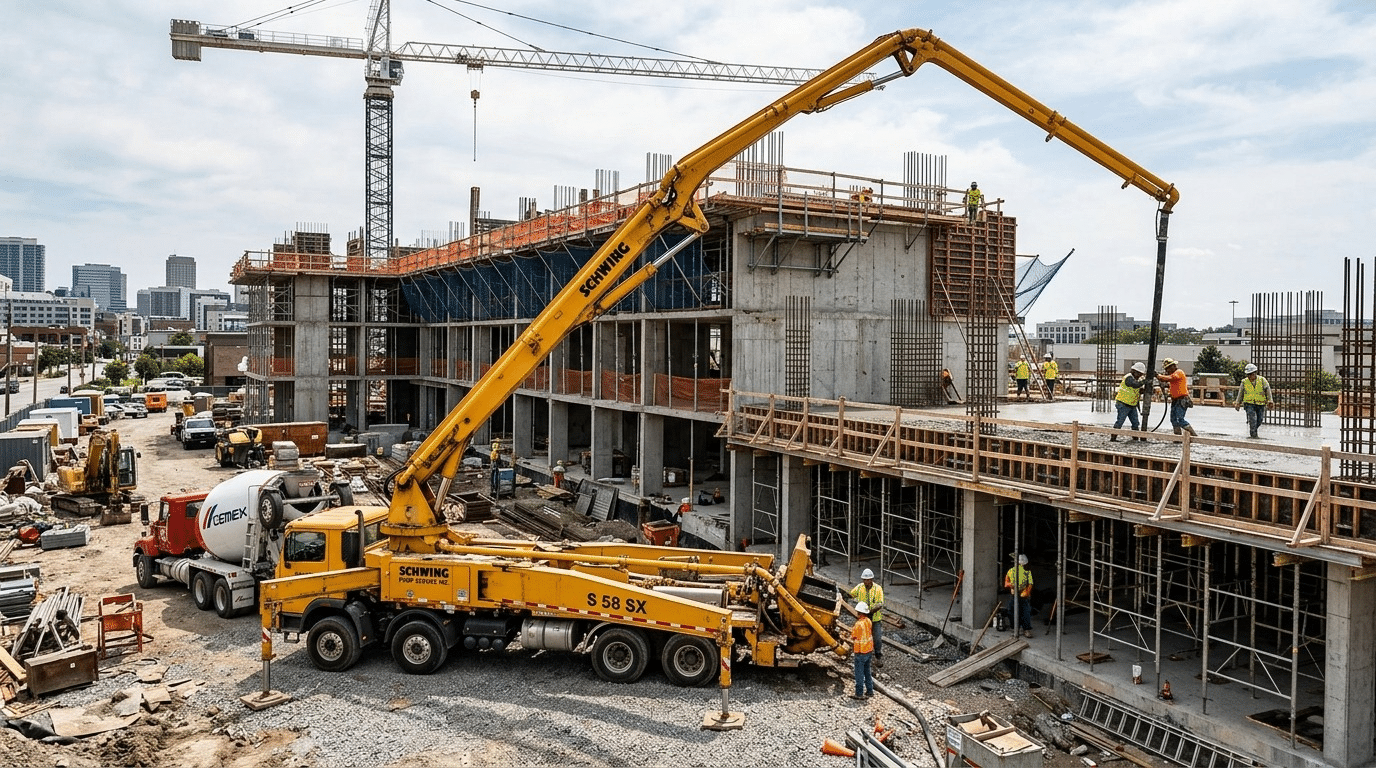
| Hidden Cost | Typical Range | Notes |
| Short-load fee | Often 75–250+ | Charged when ordering less than a plant’s minimum |
| Delivery/fuel surcharge | Varies by plant | Distance-based |
| Concrete pump | Roughly 600–1,500 per pour | When trucks can’t reach the pour |
| Demolition and disposal | Project-specific | Old slabs, roots, debris |
| Permit fees | Often 100–500+ | Set locally |
| Engineering/soil report | Project-specific | Common for foundations and PT |
| Testing | Project-specific | Cylinder breaks, slump on larger jobs |
| Sawcuts and joint sealing | Varies | Often missed on driveways and commercial floors |
| Overtime/weekend pours | Varies | Weather or scheduling |
| Utility relocation | Project-specific | Meters, irrigation, gas, electric |
| Weather protection/delays | Varies | Rain covers, cold-weather measures |
| Change orders | Varies | Soft spots, added footings, redesign |
A practical rule: carry a contingency of 5% to 15% depending on how much is unknown about the site.
What Should a Professional Concrete Slab Estimate Include?
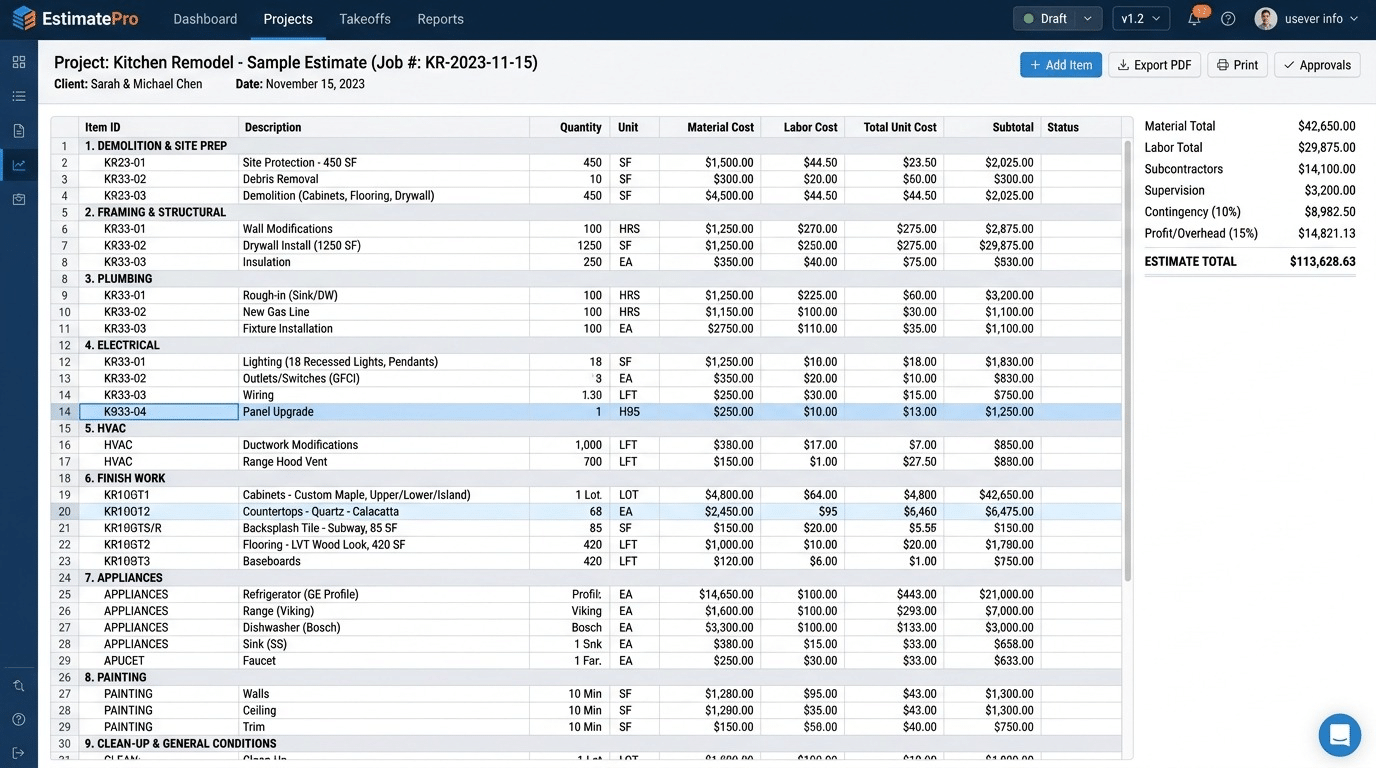
A useful estimate is itemized. Look for:
- Slab dimensions, thickness, and total area
- Concrete quantity in cubic yards, PSI, and waste factor
- Reinforcement type, size, spacing, and quantity
- Gravel base depth and material
- Vapor barrier and edge insulation, if applicable
- Forming, screeding, finishing, and curing
- Joints (control and isolation) and sawcutting
- Labor hours and crew assumptions
- Equipment (pump, compactor, saw)
- Delivery and short-load charges
- Excavation, grading, and haul-off
- Permits, inspections, and testing
- Overhead and profit
- Exclusions and allowances
An itemized estimate lets you see where money goes, compare bids fairly, and adjust scope without guessing. A lump-sum number hides all of that.
How Do You Compare Two Concrete Slab Bids?
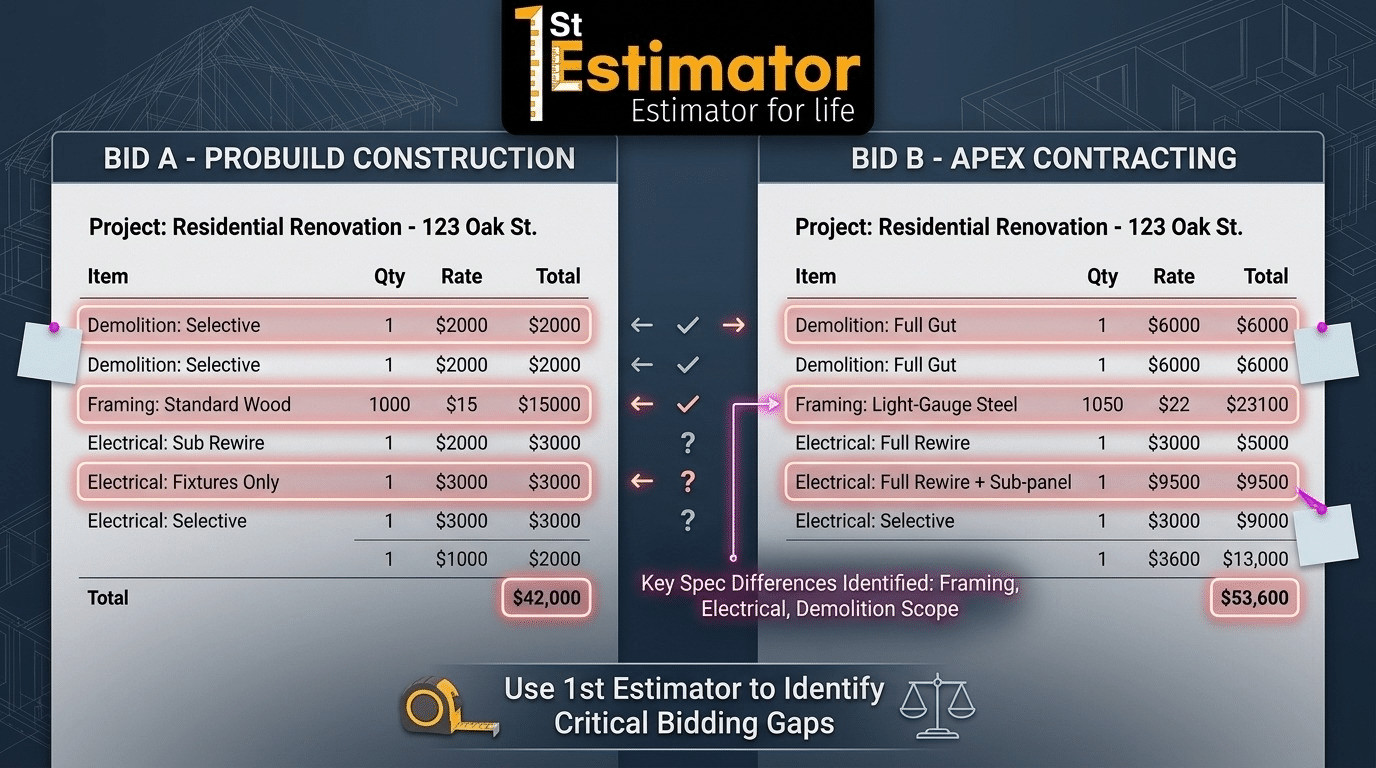
Two contractors can quote 30% apart for the same slab. That doesn’t automatically mean one is padding or cutting corners. Check:
| Item | What to Verify |
| Scope | Is base, grading, forms, and haul-off included? |
| Thickness | Same design thickness, including thickened edges? |
| Mix | Same PSI and any air entrainment? |
| Reinforcement | Same bar size, spacing, or mesh type? |
| Site prep | Same excavation depth and base? |
| Equipment | Pump included or excluded? |
| Finish | Broom, trowel, stamped? Sealer? |
| Joints | Sawcuts included? |
| Exclusions | Permits, engineering, testing, disposal? |
| Overhead and profit | Reasonable and disclosed? |
| Warranty | Duration and what it covers |
| Schedule | Start date, cure time, weather assumptions |
A low bid may be excellent if the contractor is efficient and your scope is simple. It may also leave out prep, reinforcement, or joints. A high bid may reflect a better crew or a more complete scope, or it may be padded. Ask each bidder to confirm the same assumptions in writing before you compare totals.
When Is a Professional Concrete Estimate Worth It?
For a small patio, a couple of contractor quotes are usually enough. For foundations, commercial floors, multi-pour jobs, or anything with engineering, a detailed takeoff is worth the cost.
A professional estimate helps contractors, builders, developers, subcontractors, and owners understand material quantities, labor requirements, equipment, scope, and the cost breakdown. It also supports bid preparation, exposes cost gaps between competing proposals, and gives lenders or partners a defensible budget.
Need a detailed estimate for your upcoming project? 1st Estimator provides professional construction estimating and quantity takeoff services for residential, commercial, and industrial projects.
Frequently Asked Questions
How much does a concrete slab cost per square foot?
Most standard 4-inch slabs cost about $6 to $12 per square foot installed in 2026. Decorative, industrial, and engineered slabs can run $12 to $20 or more.
How much does it cost to pour a concrete slab?
For a 1,000 sq ft slab, plan on roughly $7,000 to $12,000. Small slabs cost more per square foot; large ones cost less.
How do you estimate the cost of a concrete slab?
Calculate area, convert thickness to cubic yards (÷ 27), add 5–10% waste, then add base, forms, reinforcement, labor, equipment, permits, and overhead and profit.
What is included in a concrete slab cost estimate?
A complete estimate covers concrete, reinforcement, base, vapor barrier, forming, labor, finishing, joints, equipment, delivery, permits, and stated exclusions.
How much does a 1,000-square-foot concrete slab cost?
About $7,000 to $12,000 typically. At $8 to $12 per square foot, that’s 1,000 × $8 = $8,000 to 1,000 × $12 = $12,000.
How much does a concrete slab foundation cost?
Typically $7 to $14 per square foot, so a 2,000 sq ft house slab often falls around $14,000 to $28,000 depending on footings, soil, and inspection requirements.
What affects the cost of a concrete slab?
Size, thickness, PSI, reinforcement, finish, soil and drainage, access, region, and how much site prep is needed.
How much do concrete slab materials cost?
Ready-mix runs about $165 to $210 per cubic yard, reinforcement roughly $0.10 to $2.00 per sq ft depending on type, and gravel base and vapor barrier add about $0.85 to $2.05 per sq ft combined.
How much does concrete slab labor cost?
Roughly $2.00 to $4.50 per square foot on straightforward residential work. Contractor billing rates commonly run about $55 to $95 per labor hour and are higher than worker wages because of burden, overhead, and profit.
How much does concrete slab reinforcement cost?
Fiber runs about $0.10 to $0.30 per sq ft, wire mesh $0.40 to $0.90, and rebar grids $0.75 to $2.00, installed.
How much does site preparation add?
On easy sites, around $1.75 to $4.75 per sq ft for grading and base. Poor soil, slopes, or demolition can add much more.
How accurate are online concrete slab cost estimates?
They are useful for budgeting, but local ready-mix pricing, labor rates, soil conditions, and scope can shift real costs by 20% or more.
How do you compare concrete slab contractor bids?
Line up scope, thickness, PSI, reinforcement, prep, finish, joints, exclusions, and warranty before comparing totals.
When should you hire a professional concrete estimator?
When the project involves a foundation, commercial or industrial floor, engineering requirements, multiple pours, or competitive bidding.