A single measurement error during material takeoff can cost you a contract before you even calculate your profit margin. Miscounting drywall sheets, misinterpreting a scale, or transposing a figure from your notebook to a spreadsheet can make your estimate incorrect from the first line, no matter how competitive your pricing is.
This is precisely why the debate between construction estimating software and manual material takeoff methods is so relevant today. Manual takeoffs remain the norm for many general contractors, subcontractors, and owner-builders managing their own projects. However, digital measurement tools are rapidly gaining ground, and the gap in speed and accuracy between the two methods widens every year.
So, which approach helps you win more contracts?
This article compares the two methods in terms of speed, accuracy, costs, scalability, and collaboration, while also offering an honest look at situations where manual methods remain a valid choice. By the end, you will know exactly which approach best suits your business or when it makes the most sense to opt for a hybrid solution.
What is a manual takeoff?

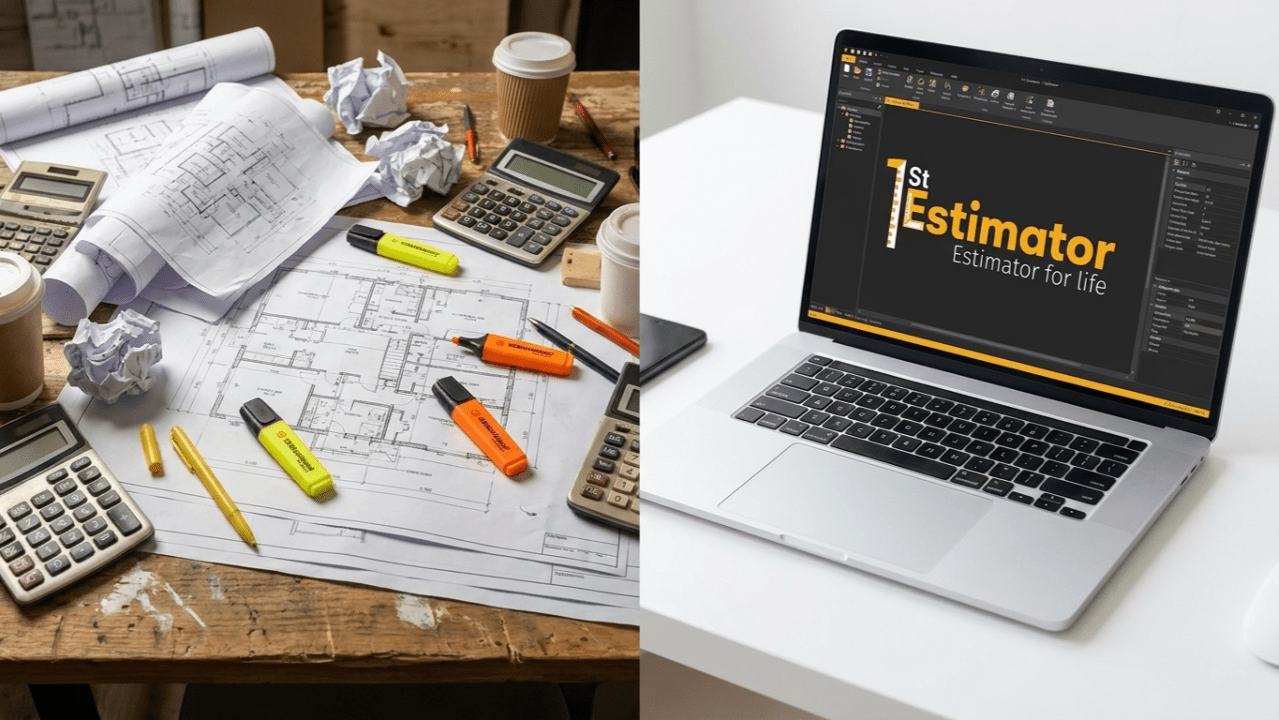
A manual takeoff is the traditional, direct method of converting a set of construction drawings into a list of quantities and costs. It typically involves:
- Printed or PDF drawings, either spread out on a table or reviewed on-screen
- A scale ruler or digitizer to measure lengths, areas, and volumes
- Highlighters or colored pencils to mark items that have already been counted
- A calculator or spreadsheet to sum up the totals
The general process is as follows:
1. List all materials and components shown on the drawings 2. Manually measure the quantity of each item 3. Assign a price to each item based on current material and labor costs 4. Sum everything up to arrive at a final estimate
Manual takeoffs have been the standard for decades, and for good reason: they are inexpensive to implement, require no new software, and allow experienced estimators to develop a deep, intuitive understanding of the project by working through it manually.
However, this manual approach comes with real drawbacks:
- They are time-consuming, especially for large or detailed projects
- They are repetitive, as any revision to the drawings requires redoing parts of the process
- They are prone to error, given that every measurement must be read, noted down, and re-entered (three separate opportunities for a mistake)
- They are difficult to scale, particularly for companies bidding on multiple projects simultaneously
Manual takeoffs work. They are simply slow and carry higher risks as project complexity increases.
What Is Construction Estimating Software?
Construction cost estimation software is a digital platform that helps contractors calculate the costs of labor, materials, equipment, and overhead required to complete a project. It is often used alongside or directly integrated with digital takeoff tools, which handle the measurement-related aspect of the process.
This is where the important distinction lies:


Many modern platforms, including 1st Estimator, combine both functions into a single workflow. Here is how the process typically works:
1. Upload project plans (PDF or CAD files). 2. Set the scale so the software knows how to interpret measurements. 3. Perform on-screen measurements using digital tools instead of a physical ruler. 4. Automatically generate costs, as quantities are linked directly to pricing data. 5. Create a professionally formatted estimate, ready to send to the client.
This is where plan-reading software and automated cost estimation come into play: the program not only enables faster measurement but also reduces the need for manual data entry, a stage where errors frequently occur.
You are likely familiar with established names in this sector, such as PlanSwift and Bluebeam. These tools helped popularize digital takeoffs in construction and set the standard; however, the category has expanded significantly with the arrival of newer platforms designed specifically to integrate measurement and estimation into a single, more streamlined workflow.
Construction cost estimation software vs. manual takeoffs: a direct comparison
1. Speed
This is where the difference is most apparent.
- Manual takeoffs require physically measuring each element, noting it down, and double-checking it; furthermore, if the architect sends revised plans on a Friday afternoon, you often have to start from scratch.
- Software allows you to measure directly on the digital plan, automatically recalculating quantities whenever a change occurs.
Practical example: You receive a set of revised plans in your inbox the day before the bid submission deadline.
- With a manual takeoff, you must re-measure the affected areas by hand and manually update the spreadsheet a process that can take hours.
- With estimation software, you simply reload or adjust the plan, and the quantities and costs update almost instantly.
2. Accuracy
Manual measurements lose accuracy at almost every stage:
- When reading the measurement on the ruler.
- When noting it down on paper or in a notebook.
- When entering it into a spreadsheet or budget form.
Each data transfer carries the risk of transposing figures, misinterpreting the scale, or omitting an item.
Digital measurement tools significantly reduce this risk:
- Measurements are calculated once and transferred automatically.
- Automated cost forecasting applies current prices without the need for manual re-entry.
- Integrated checks can detect inconsistencies before they make it into the final bid.
An important caveat: software cannot work miracles. If the wrong scale is set or symbols on the plans are misinterpreted, the software will calculate that error perfectly. This technology reduces data transfer errors but does not eliminate the need for a qualified estimator.
3. Cost and ROI

At first glance, manual takeoffs seem “free” no subscriptions or new tools to learn. However, that approach overlooks the true cost:
Hidden costs of manual takeoffs:
- Hours spent re-measuring after every revision
- Extra work due to missed items or calculation errors
- Lost bids caused by slower turnaround times compared to competitors
- Estimator time that could be spent on higher-value tasks
The cost of software, on the other hand:
- A subscription or licensing fee
- Initial time spent learning to use the platform
The right question isn’t “Which option is cheaper upfront?” but rather “Which one generates a better return?” For most companies bidding on more than a few projects a year, the time saved and the improved win rate quickly offset the cost of the software.
4. Scalability and complexity
- Manual takeoff processes become overwhelmed under pressure: large commercial projects, phased construction, or simultaneous bids push an estimator’s capacity for accurate manual tracking to the limit.
- Software handles complexity far more effectively, whether it involves a commercial project with multiple trades or a developer managing several projects in parallel.
If your business is growing with more bids, larger-scale projects, and tighter deadlines, manual takeoff becomes a bottleneck precisely when you can least afford it.
5. Collaboration and sharing
- Manual takeoffs often reside in a single location: a set of annotated plans or a spreadsheet on one computer. If the person responsible is out sick or the file is lost, the entire estimate is at risk.
- Estimating software is designed for teams: cloud-hosted files can be instantly shared among general contractors, subcontractors, architects, and developers, ensuring everyone works with the same up-to-date data.
This is especially important for teams where multiple stakeholders architects, general contractors, and specialized subcontractors need visibility into the same project data.
6. Learning curve and skill development
This is where manual computations really continue to prove their value.
- Performing calculations by hand teaches you to read plans, recognize their symbols, and understand scales: fundamental skills that every estimator needs.
- Develop spatial reasoning: draw perimeters, subtract openings and understand if a measurement includes the finishes or reaches the base structure.
- Estimators who learn using manual methods tend to detect errors in software results more quickly, since they understand why a figure should have a certain value.
The software reaches its full potential once that basic knowledge has been established; it acts as an accelerator, not a substitute, for knowledge under construction.
When manual measurements still make sense
Despite the clear advantages of digital tools regarding speed and accuracy, manual measurements have not become obsolete. They remain a logical choice for:
- Very small or one-off projects, such as a renovation carried out by the property owner themselves.
- New or trainee estimators who are still acquiring the fundamentals of reading blueprints.
- Worksites with poor connectivity, where using digital tools is not practical at the time.
- Simple scopes of work, where the effort required to learn the software outweighs the time that would be saved by using it.
The most competitive companies often combine both approaches: manual methods for training and simple tasks, and software for projects involving greater complexity or significant time pressure.
How to Choose the Best Software for Estimators
When evaluating platforms, consider the following criteria:
- Accurate plan-reading software that handles PDF and CAD files without compromising precision.
- Integrated pricing data so that quantities translate directly into costs, rather than just measurements.
- Ease of use, especially if your team is transitioning from manual to digital methods.
- Cloud or mobile access to facilitate collaboration on the job site or across different locations.
- Compatibility with multiple trades, allowing subcontractors and general contractors to work on the same platform.
- Automated cost projection that updates pricing as material and labor costs fluctuate.
Established tools like PlanSwift and Bluebeam helped define this category and serve as excellent benchmarks. However, if you are looking to combine takeoff and estimating into a single, streamlined workflow designed specifically to address the aforementioned speed and accuracy challenges that is precisely what 1st Estimator offers.
In summary
Manual takeoffs gave rise to the construction cost estimating profession and continue to teach skills that are essential for any estimator. However, in terms of speed, accuracy, scalability, and collaboration, estimating software is the winning choice for most modern companies, especially those bidding on multiple projects, coordinating various trades, or competing against more agile firms.
For most contractors, the smartest approach isn’t choosing one method over the other, but knowing when each is most suitable and having the right software available when speed and accuracy are critical.
Want to see the difference for yourself? Try 1st Estimator and discover how quickly you can complete your next takeoff and estimate.
Frequently Asked Questions
Is it worth it for small contractors to use construction cost estimation software?
Yes, in most cases. Even small companies benefit from increased speed and a reduction in costly errors, especially when they start bidding on more than a few projects a year.
Is it still necessary to know how to perform a manual takeoff?
Yes. Understanding the manual takeoff process develops blueprint-reading and spatial reasoning skills that allow you to better use and verify the results generated by any software.
What is the difference between takeoff software and estimation software?
Takeoff software measures quantities from blueprints, whereas estimation software converts those quantities into priced costs. Many modern platforms, including 1st Estimator, combine both functions.
Can digital takeoff tools completely replace an estimator?
No. Software streamlines measurement and calculation, but it still relies on a skilled estimator to correctly interpret blueprints, establish accurate pricing assumptions, and detect any anomalies.
How accurate is automated cost forecasting compared to manual estimates?
Automated cost forecasting eliminates data transfer errors common in manual processes (such as misreading, writing errors, or data re-entry), but its accuracy still depends on correct scale settings and up-to-date pricing data.