Every construction professional has lived this moment: the estimate “looked fine on paper,” the project got the green light, and three months into the build, the budget started bleeding. Material prices shifted. A subcontractor’s scope didn’t match the drawings. A change order snowballed into five more.
Here’s the uncomfortable truth: most estimates don’t fail because of bad math. They fail because they’re built as fixed snapshots: a single number, frozen in time, that never carries its assumptions forward. When conditions change (and they always do), the estimate has nothing left to stand on.
This guide breaks down construction cost estimating for developers and every other stakeholder on a project the smart way: as a living, defensible system that flexes with reality instead of cracking under it. Whether you’re a general contractor bidding jobs, a subcontractor pricing trade work, a real estate developer evaluating feasibility, an architect designing to budget, or an owner-builder tackling your first project, this is your roadmap.
What Is Construction Cost Estimating for Developers?
At its core, construction cost estimating is the process of projecting the total cost of a project before work begins and using that number to decide whether, and how, to move forward.
But “cost estimating” doesn’t mean the same thing to everyone on the job:
- Developers use it to test feasibility, secure financing, and project ROI.
- General contractors use it to build a competitive, profitable bid.
- Subcontractors use it to price their specific trade scope accurately.
- Architects and designers use it to keep creative decisions aligned with budget reality.
- Owner-builders use it to avoid the costly surprises that sink first-time projects.
Why “Developer” Estimating Is Its Own Discipline
Developers aren’t just pricing construction they’re pricing an entire venture. That means factoring in:
- Land acquisition and entitlement costs
- Financing and interest carry
- Soft costs (design, permitting, legal, insurance)
- Hard construction costs
- Contingency for market and timeline risk
A smart estimate for a developer isn’t just “what will it cost to build” it’s “what will it cost to build, finance, and deliver a profitable asset.”
The 3 Core Cost Categories Every Estimate Needs

Regardless of who’s building the estimate, every complete cost estimate breaks down into three buckets:
- Direct Costs: Materials, labor, subcontractor pricing, and equipment. These are expenses tied directly to physical construction.
- Indirect Costs: Permits, insurance, administrative overhead, and general conditions. Easy to overlook, but they add up fast.
- Contingency & Risk Buffers: A reserved percentage of the budget to absorb the unexpected. Skipping this step is one of the fastest ways to blow a budget.
Rule of thumb: if your estimate only accounts for direct costs, it isn’t a real estimate it’s a guess with a decimal point.
The 5 Levels of Construction Estimates (and When to Use Each)

Not every estimate needs the same level of detail. Using the wrong type at the wrong stage is one of the most common and costly mistakes in the industry.

The takeaway: a conceptual estimate should never be treated like a bid number, and a bid number shouldn’t be confused with a final control budget. Matching the right estimate type to the right project phase is what separates a “smart” estimating process from a reactive one.
Smart Construction Cost Estimating Methods, Compared
There’s no single “correct” way to estimate the right method depends on how much information you have and how much precision you need.
- Unit Cost Estimating: Pricing based on cost-per-unit (per square foot, per linear foot, per fixture). Fast, but less precise for complex scopes.
- Parametric Estimating: Uses statistical relationships between project parameters (square footage, complexity rating) and historical cost data. Great for early-stage projections.
- Analogous / Historical Estimating: Bases the new estimate on a comparable past project. Quick, but only as accurate as the comparison.
- Detailed Take-Off Estimating: Full quantity take-offs priced line-by-line. Slower, but the most accurate and defensible method for bidding.
Quick comparison:

Step-by-Step: How to Build a Defensible Cost Estimate
A defensible estimate is one you can explain, adjust, and stand behind even after conditions change. Here’s the process:
- Lock scope, specs, and drawings first: Ambiguity at this stage guarantees inaccurate pricing later. Don’t estimate against a moving target.
- Break down quantities (take-offs): Quantify everything materials, labor hours, equipment needs division by division.
- Price labor, materials, and equipment: Use current, real-time pricing data rather than stale rate sheets. In a volatile market, last quarter’s numbers can already be wrong.
- Add overhead, fees, and contingency: Build in the indirect costs and risk buffer discussed above don’t treat them as optional.
- Build in assumptions and cost drivers: Document why the numbers are what they are, so the estimate can be intelligently adjusted when scope or pricing shifts instead of rebuilt from scratch.
- Review, validate, and get stakeholder sign-off: A number nobody has scrutinized isn’t a plan it’s a placeholder.
Common Construction Cost Estimating Mistakes (and How to Avoid Them)
Even experienced teams fall into these traps. Watch for:
- Vague scope: Starting an estimate before specs and drawings are locked in.
- Stale pricing data: Using outdated rate sheets in a market where material and labor costs shift monthly.
- No contingency line: Assuming everything will go according to plan (it won’t).
- Treating the estimate as “done”: Filing it away instead of updating it as the project evolves.
- Design-cost misalignment: Architects designing features the budget can’t actually support.
- Poor communication of assumptions: Developers, GCs, and subs working off different versions of “what’s included.”
Fix: build estimates that carry their assumptions forward, so anyone on the team can see why a number is what it is and adjust it intelligently when something changes.
Construction Cost Estimating for Developers vs. GCs vs. Architects: Who Needs What
Cost estimating isn’t one-size-fits-all. Here’s how the priorities shift by role:
For Real Estate Developers
- Focus on feasibility, financing terms, and projected ROI
- Need estimates that account for soft costs, land, and carrying costs not just construction
- Use estimates to decide whether to pursue a project, not just how to price it
For General Contractors
- Focus on bid accuracy and protecting margin
- Need estimates detailed enough to win competitive bids without underpricing risk
- Rely on estimates to structure schedules and evaluate subcontractor pricing
For Subcontractors (Trade Specialists)
- Focus on trade-specific scope, material takeoffs, and labor pricing
- Need estimates isolated to their scope of work, without absorbing GC-level overhead
- Accuracy here directly protects trade-level profitability
For Architects & Designers
- Focus on cost-informed design decisions
- Need estimates early enough to guide value engineering before designs are finalized
- Use estimating data to balance creative vision against budget constraints
For Owner-Builders
- Focus on avoiding the most common first-timer budget traps
- Need clear, jargon-free estimates that expose hidden costs (permits, contingency, financing)
- Benefit most from tools and guidance that translate industry-standard estimating into plain language
Tools & Technology: Modern Construction Cost Estimating Software

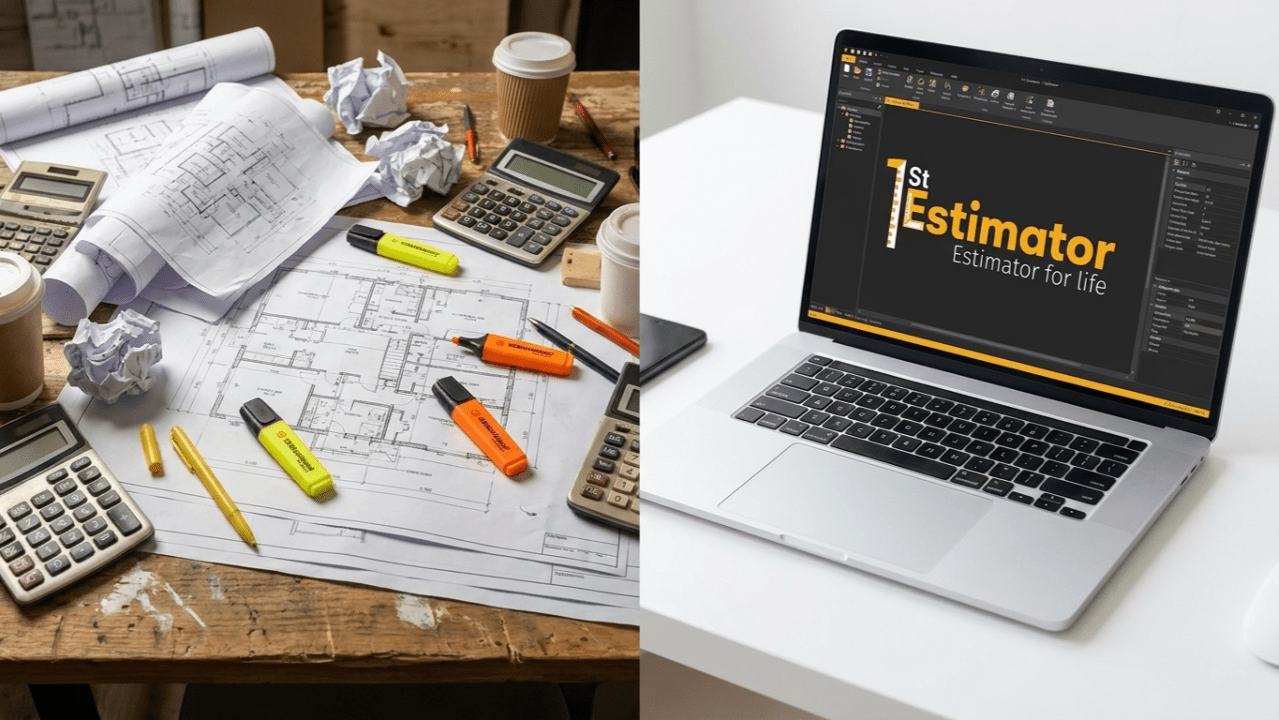
Spreadsheets can carry a small project but they break down fast when pricing changes, scope shifts, or multiple stakeholders need visibility into the same numbers.
What to look for in modern estimating software:
- Real-time material and labor pricing data
- Integrated take-off tools (no manual re-entry)
- Version control, so you can track how and why an estimate changed
- Collaboration features that keep developers, GCs, subs, and architects aligned on the same numbers
- The ability to turn a static estimate into a living, trackable budget
This is exactly the gap 1st Estimator is built to close helping teams move from disconnected spreadsheets to estimates that stay accurate, explainable, and controllable as a project evolves, from first feasibility number through final walkthrough.
Keeping Estimates “Smart”: Turning a Snapshot Into a Living Budget
The theme running through this entire guide: a smart estimate isn’t a document it’s a process.
The projects that stay on budget aren’t the ones with the “best” initial number. They’re the ones where the estimate:
- Carries its assumptions and cost drivers forward
- Gets revisited as scope, pricing, or timelines shift
- Stays visible and understandable to every stakeholder, not just the person who built it
- Flags overruns early, instead of surfacing them at the final invoice
Treat your estimate like a living budget, not a one-time snapshot, and you’ll catch problems while they’re still cheap to fix.
Key Takeaways
- Smart construction cost estimating for developers means building a living budget, not a fixed snapshot.
- Match the estimate type (conceptual, design development, bid, control) to the correct project stage.
- Every estimate needs direct costs, indirect costs, and contingency no exceptions.
- Different stakeholders (developers, GCs, subs, architects, owner-builders) need the estimate to answer different questions build accordingly.
- The right estimating software turns a static number into a trackable, defensible budget.
Ready to stop rebuilding estimates from scratch every time something changes? 1st Estimator helps developers, contractors, and project teams build smart, living estimates that stay accurate from feasibility through final walkthrough.
FAQs on Construction Cost Estimating for Developers
What’s the difference between an estimate and a budget? An estimate is a projection of expected costs before work begins. A budget is the approved spending plan built from that estimate and it should be actively tracked against actual costs as the project progresses.
How accurate should a construction cost estimate be at each project stage? Early conceptual estimates are typically accurate within a wide range (often ±20-30%), while detailed bid estimates should be accurate within a much tighter margin (often ±5-10%), since they’re based on finalized drawings and specifications.
How often should an estimate be updated during a project? Estimates should be revisited any time scope, pricing, or timeline assumptions change not just at pre-set milestones. In volatile markets, that can mean monthly or even more frequent reviews of key cost drivers.
What’s the biggest estimating mistake developers make on their first project? Underestimating soft costs and contingency. First-time developers often price the physical build accurately but overlook financing costs, permitting delays, and the buffer needed to absorb the unexpected.