Quick answer: A mid-sized landscaping company reduced its average estimating time from roughly 20 hours a week to 5 by switching from manual site measurements to automated property estimating with 1st Estimator. The result: faster bids, a higher win rate, and enough reclaimed hours to take on 30% more work without hiring a single additional estimator.
If you’re a General Contractor, Subcontractor, Real Estate Developer, Architect, or Owner-Builder who has ever waited days for a landscaping bid to land in your inbox, this case study is for you. Below, we break down exactly what changed, why it worked, and what it means for anyone who relies on fast, accurate estimates to keep a project moving.
Note: This case study is a composite example built from patterns and results reported across the landscaping industry as companies adopt automated estimating tools. Figures reflect realistic, representative outcomes for a mid-sized landscaping business.
The Estimating Bottleneck Every Landscaping Company Knows

Before switching to automated estimating, this company a 22-person commercial landscaping contractor handling everything from HOA maintenance to multi-acre commercial sites was estimating the old-fashioned way: measuring wheels, clipboards, windshield surveys, and hours of manual spreadsheet work.
Here’s what that looked like in practice:
- Site visits required for every bid: No estimate could be started until someone physically walked the property.
- 20+ hours per week: spent on estimating tasks across the team.
- 6 hours average: to turn around a single detailed commercial estimate.
- 15% error rate: on measurements, largely due to eyeballed areas, missed features, and inconsistent notes between estimators.
- Missed bid deadlines: on fast-moving commercial and developer-driven projects, where competitors with faster turnaround simply got there first.
The breaking point came when the company lost two back-to-back commercial maintenance contracts not because their pricing was wrong, but because a competitor submitted a bid 48 hours faster.
For General Contractors and Developers reading this: this is the exact frustration you’ve likely experienced from the other side of the table. A landscaping subcontractor who can’t turn around a fast, accurate number becomes a bottleneck in your own project timeline.
Choosing an Automated Estimating Solution What Mattered Most

The company’s leadership evaluated several options before settling on 1st Estimator. Their decision criteria were straightforward, and they’re worth listing because they’re the same questions any contractor should ask before adopting new estimating technology:
- Measurement accuracy: Could the software reliably measure lawn area, hardscape, mulch beds, and tree count without a site visit?
- Speed to first estimate: How fast could a rough number go from “new lead” to “sendable quote”?
- Ease of adoption: Would existing estimators need weeks of retraining, or could they be productive in days?
- Integration: Would it work with their existing CRM and proposal software, or create a second disconnected system?
- Scalability for commercial work: Could it handle multi-acre commercial and developer sites, not just small residential lawns?
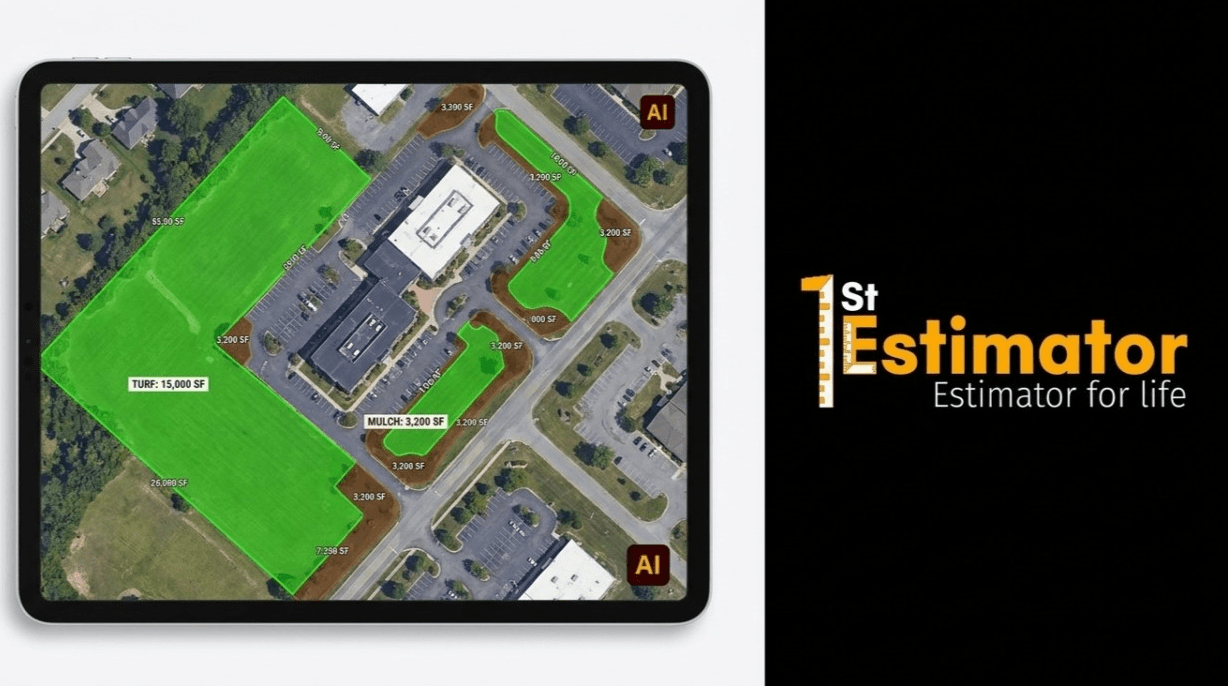
1st Estimator checked every box by combining high-resolution aerial and satellite imagery with AI-driven takeoff tools, allowing the team to generate accurate site measurements lawn area, hedges, mulch beds, hardscape, and tree counts without ever leaving the office. The estimator still reviewed every output, applied pricing, and built the final proposal; the software simply eliminated the repetitive measurement work that used to eat up most of the day.
Rolling Out Automated Estimating What Changed Day-to-Day
Adoption is often where good software either sticks or gets abandoned. Here’s how the rollout actually went:
- Week 1: Estimating team ran 1st Estimator side-by-side with their old manual process on real bids, comparing results for accuracy.
- Week 2: Confidence in measurement accuracy allowed the team to drop manual site visits for straightforward properties.
- Week 3–4: Full transition to automated measurement as the default first step for every new bid, with site visits reserved only for complex or heavily obstructed properties.
- By Month 2: The estimating workflow was fully rebuilt around automation estimators now spent their time reviewing AI-generated measurements, refining pricing, and writing proposals instead of driving to properties and manually calculating square footage.
The single biggest workflow shift: estimators stopped measuring and started reviewing. That reallocation of time is where almost all of the 75% reduction came from.
The Results: 75% Faster Estimates and What Came With It

This is the core of the story and the numbers speak for themselves.

How the Time Savings Broke Down
The 75% reduction didn’t come from one single change it came from compounding savings across the whole estimating workflow:
- Measurement time: Cut by roughly 80%, since satellite and aerial data replaced physical site walks for most properties.
- Pricing time: Cut by about 40%, since accurate quantities fed directly into pricing templates instead of being manually re-entered.
- Proposal drafting time: Cut by roughly 30%, as clean, standardized data made it faster to build a polished, professional quote.
- Travel time: Nearly eliminated for initial estimates, freeing up hours that used to be spent driving between prospective job sites.
For a Real Estate Developer or General Contractor coordinating multiple trades, this kind of turnaround difference is the gap between a landscaping bid holding up your schedule and one that keeps pace with your other subcontractors.
Beyond Speed Secondary Benefits of Automated Estimating

Speed was the headline result, but it wasn’t the only one. Several second-order benefits emerged that mattered just as much to the business long-term:
- More professional client-facing proposals. Clean, data-backed estimates with accurate measurements built more trust with commercial clients and developers up front.
- Ability to bid larger, more complex properties. Multi-acre commercial and developer sites that once required a half-day site visit could now be measured and quoted remotely.
- Reduced estimator burnout. Fewer hours spent driving and manually measuring meant estimators had more capacity for higher-value work like relationship-building and proposal strategy.
- Better historical data for future bids. Every completed estimate became a reusable data point, making future quotes for similar properties even faster.
- Fewer costly rework situations. With measurement error rates dropping from 15% to under 3%, the company avoided the budget overruns and change orders that used to strain client relationships.
Lessons Learned: Advice for Contractors Considering Automated Estimating
If you’re considering a similar move whether you’re a landscaping contractor or a GC evaluating how your subcontractors estimate here’s what this case study suggests you should keep in mind:
- Run it in parallel first: Don’t rip out your existing process overnight. Validate the software’s accuracy against your own manual measurements before fully switching over.
- Reserve site visits for genuinely complex properties: Automation handles the majority of properties well, but heavily obstructed or unusual sites may still benefit from a quick verification visit.
- Retrain your team around review, not just measurement: The biggest mindset shift for estimators is moving from “I measure everything myself” to “I verify and refine what the software gives me.”
- Use the time savings to bid more, not just work less: The real ROI shows up when reclaimed hours go toward submitting more bids, not just finishing the workday earlier.
- Track your numbers from day one: Before-and-after data (like the table above) is what makes the case for further investment in automation and what proves the value to clients and stakeholders.
Why This Case Study Matters Beyond Landscaping
While this story centers on a landscaping contractor, the implications reach well beyond one trade:
- General Contractors & Subcontractors: Faster, more accurate landscaping bids mean fewer delays when coordinating multi-trade project timelines and fewer surprises during budget reconciliation.
- Real Estate Developers: Automated estimating enables faster, more reliable site cost projections during the planning and pre-construction phase critical when evaluating land acquisition or phased development budgets.
- Architects & Designers: Early, accurate cost data helps align design specifications with realistic budgets before plans are finalized, reducing costly redesigns later.
- Owner-Builders: Faster turnaround and more transparent, data-backed quotes make it easier to compare bids and move a project forward with confidence.
In short: when the trades you depend on can estimate faster and more accurately, your entire project timeline benefits not just theirs. As more contractors across every trade adopt automated estimating, it’s quickly becoming less of a competitive edge and more of a baseline expectation the same way digital proposals and online payments went from “nice to have” to standard practice over the past decade.
Ready to Cut Your Own Estimating Time?

Cutting estimating time by 75% isn’t a fluke it’s what happens when repetitive manual measurement gets replaced with accurate, AI-driven data and your team’s time gets reinvested into pricing strategy and client relationships.
If your estimating process still depends on measuring wheels, windshield surveys, and hours of spreadsheet work, it may be time to see what automated estimating could do for your business.
Frequently Asked Questions About Automated Landscape Estimating
How much time can automated estimating save on landscaping bids?
Companies that adopt automated property estimating commonly report time savings between 40% and 75%, depending on how much of their prior process relied on manual site visits and spreadsheet-based takeoffs.
Is automated estimating accurate for large commercial properties?
Yes. Automated estimating tools like 1st Estimator are particularly well-suited to large commercial and developer sites, where AI-driven measurement from aerial and satellite imagery can cover lawn area, hardscape, mulch beds, and tree counts far faster than a manual walk-through.
Does automated estimating replace the need for an estimator?
No. Automated estimating removes the repetitive measurement work, but a human estimator still reviews the data, applies pricing, evaluates risk, and builds the final proposal. The software acts as an accelerant, not a replacement.
How long does it take to implement automated estimating software?
Most companies can run automated estimating in parallel with their existing process within the first one to two weeks, with full workflow adoption typically achieved within one to two months.
What is the ROI of automated property estimating?
Beyond the direct time savings, companies frequently see ROI through higher bid volume, improved win rates, reduced measurement errors, and the ability to take on more projects without adding estimating staff.